

whereas XGC1, GENE and Gkeyll are gyrokinetic codes which, however, also have
some differences).
As a result, their application limits are different (for example, JOREK is usually
used to simulate ELM, whereas the others are usually used for the simulation of edge
plasma turbulence). We will discuss some results coming from these codes later.
However, we notice that the codes used for the simulation of edge plasma turbulence, in most cases, cannot describe edge plasma transport on the relevant time
scale, due to both the lack of some important physics needed for such a description
and the limitation of current computational resources. Therefore, they often use the
plasma parameter profiles taken either from experimental data or from the results of
simulation of the edge plasma parameters with 2D edge plasma transport codes such
as SOLPS or UEDGE.
Now we consider the main features, outlined above, which govern anomalous
transport in the edge plasma.
7.3.1 Generation of Sheared Plasma Flow Via Plasma
Turbulence
As we found in the previous section, in strongly magnetized plasma, the unstable
modes are characterized by a strong anisotropy, which is characterized by the
inequality jk k j ( j k
!
⊥ j . Therefore, within some limitations, the interaction of the
plasma waves and plasma turbulence can, in general, be considered two-dimensional
(2D). This feature makes the dynamics of magnetized plasma somewhat similar to
that of geophysical fluids [110]. However, it is known since a long time ago that the
main features of the turbulence in 2D fluids (including the magnetized plasma) are
very different from the predictions following from such a cornerstone of threedimensional (3D) fluid turbulence as the Kolmogorov turbulence model. The main
0.4
4
Measured
λ
Te,u [mm]
n/n GW
6
8
10
12
14
0.5
0.6
H-mode attached
partially
detached
completely
detached
0.7
0.8
0.9
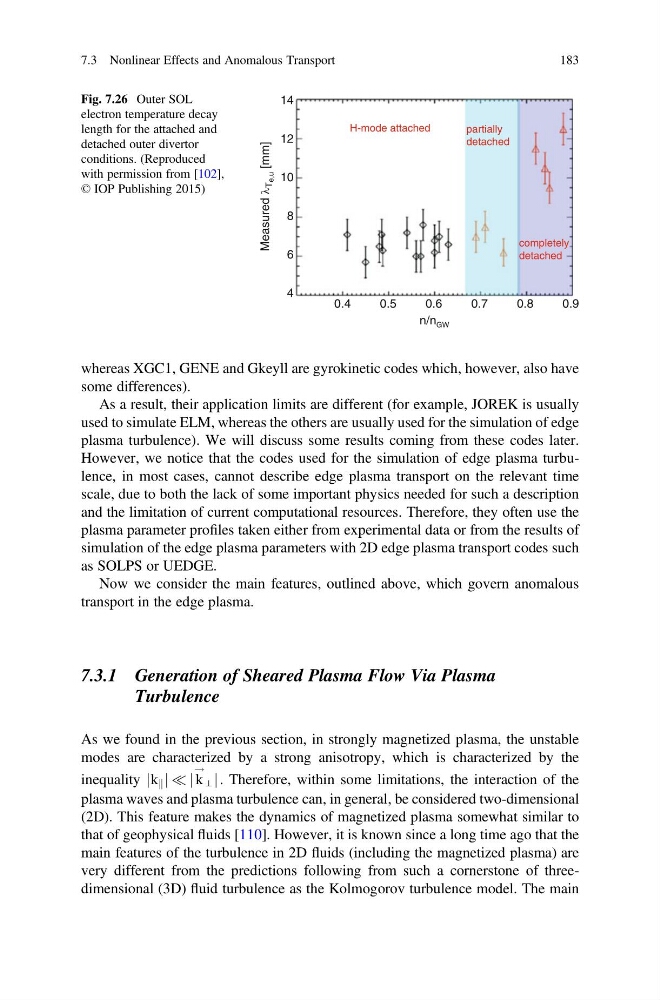
Fig. 7.26 Outer SOL
electron temperature decay
length for the attached and
detached outer divertor
conditions. (Reproduced
with permission from [102],
© IOP Publishing 2015)
7.3 Nonlinear Effects and Anomalous Transport
183
some differences).
As a result, their application limits are different (for example, JOREK is usually
used to simulate ELM, whereas the others are usually used for the simulation of edge
plasma turbulence). We will discuss some results coming from these codes later.
However, we notice that the codes used for the simulation of edge plasma turbulence, in most cases, cannot describe edge plasma transport on the relevant time
scale, due to both the lack of some important physics needed for such a description
and the limitation of current computational resources. Therefore, they often use the
plasma parameter profiles taken either from experimental data or from the results of
simulation of the edge plasma parameters with 2D edge plasma transport codes such
as SOLPS or UEDGE.
Now we consider the main features, outlined above, which govern anomalous
transport in the edge plasma.
7.3.1 Generation of Sheared Plasma Flow Via Plasma
Turbulence
As we found in the previous section, in strongly magnetized plasma, the unstable
modes are characterized by a strong anisotropy, which is characterized by the
inequality jk k j ( j k
!
⊥ j . Therefore, within some limitations, the interaction of the
plasma waves and plasma turbulence can, in general, be considered two-dimensional
(2D). This feature makes the dynamics of magnetized plasma somewhat similar to
that of geophysical fluids [110]. However, it is known since a long time ago that the
main features of the turbulence in 2D fluids (including the magnetized plasma) are
very different from the predictions following from such a cornerstone of threedimensional (3D) fluid turbulence as the Kolmogorov turbulence model. The main
0.4
4
Measured
λ
Te,u [mm]
n/n GW
6
8
10
12
14
0.5
0.6
H-mode attached
partially
detached
completely
detached
0.7
0.8
0.9
Fig. 7.26 Outer SOL
electron temperature decay
length for the attached and
detached outer divertor
conditions. (Reproduced
with permission from [102],
© IOP Publishing 2015)
7.3 Nonlinear Effects and Anomalous Transport
183