

Mode (GAM), see [34, 35] and the references therein. The physics of the GAM is
rather simple: the compressibility of the toroidally symmetric E
! Â B
!
plasma flow
causes a poloidaly asymmetric plasma pressure perturbation, e P , and the
corresponding diamagnetic current across magnetic flux surfaces,
e
J
! / B
! Â e P .
This current is not divergence-free due to toroidal effects. It reverses the sign of
the electric field and, finally, results in plasma oscillations, GAM. For a relatively
large safety factor q, which is typical for the edge plasma, the plasma dynamics
along the magnetic field lines can be ignored and, in the simplest case, the expression
for the GAM frequency reads:
ω
2
GAM ¼ 2γP 0 =ρ 0 R
2 ,
ð7:95Þ
where P 0 and ρ 0 are the unperturbed plasma pressure and density, R is the tokamak
major radius and γ is the ratio of the specific heats.
7.3 Nonlinear Effects and Anomalous Transport
In the previous section, we considered some plasma instabilities which can be
important for plasma transport at the edge and in the SOL of a tokamak. We also
considered possible stabilizing effects, which are the magnetic and velocity shear.
However, in some cases, strong magnetic shear (e.g. in the vicinity of the X-point)
can facilitate instabilities. In this section, we discuss some features of anomalous
plasma transport associated with these instabilities as well as the available stabilizing
effects.
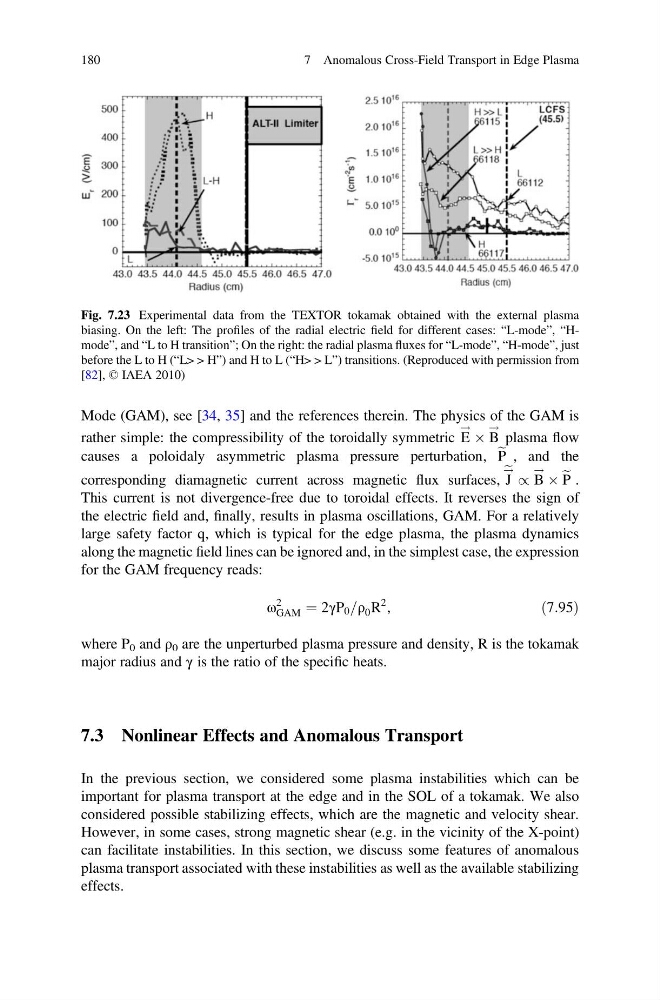
Fig. 7.23 Experimental data from the TEXTOR tokamak obtained with the external plasma
biasing. On the left: The profiles of the radial electric field for different cases: “L-mode”, “Hmode”, and “L to H transition”; On the right: the radial plasma fluxes for “L-mode”, “H-mode”, just
before the L to H (“L> > H”) and H to L (“H> > L”) transitions. (Reproduced with permission from
[82], © IAEA 2010)
180
7 Anomalous Cross-Field Transport in Edge Plasma
rather simple: the compressibility of the toroidally symmetric E
! Â B
!
plasma flow
causes a poloidaly asymmetric plasma pressure perturbation, e P , and the
corresponding diamagnetic current across magnetic flux surfaces,
e
J
! / B
! Â e P .
This current is not divergence-free due to toroidal effects. It reverses the sign of
the electric field and, finally, results in plasma oscillations, GAM. For a relatively
large safety factor q, which is typical for the edge plasma, the plasma dynamics
along the magnetic field lines can be ignored and, in the simplest case, the expression
for the GAM frequency reads:
ω
2
GAM ¼ 2γP 0 =ρ 0 R
2 ,
ð7:95Þ
where P 0 and ρ 0 are the unperturbed plasma pressure and density, R is the tokamak
major radius and γ is the ratio of the specific heats.
7.3 Nonlinear Effects and Anomalous Transport
In the previous section, we considered some plasma instabilities which can be
important for plasma transport at the edge and in the SOL of a tokamak. We also
considered possible stabilizing effects, which are the magnetic and velocity shear.
However, in some cases, strong magnetic shear (e.g. in the vicinity of the X-point)
can facilitate instabilities. In this section, we discuss some features of anomalous
plasma transport associated with these instabilities as well as the available stabilizing
effects.
Fig. 7.23 Experimental data from the TEXTOR tokamak obtained with the external plasma
biasing. On the left: The profiles of the radial electric field for different cases: “L-mode”, “Hmode”, and “L to H transition”; On the right: the radial plasma fluxes for “L-mode”, “H-mode”, just
before the L to H (“L> > H”) and H to L (“H> > L”) transitions. (Reproduced with permission from
[82], © IAEA 2010)
180
7 Anomalous Cross-Field Transport in Edge Plasma