

To be more precise, we will not discuss any particular scaling of anomalous crossfield transport coefficients in the edge plasmas (e.g. see [90]). Instead, we consider
the main features governing anomalous transport in the edge plasma. The reason for
this can be explained as follows. First, the most common approach to estimating
analytically the impact of a particular unstable mode on anomalous transport is based
on a local (on a given flux surface) diffusive approximation where the transport
coefficients (say, the particle diffusion coefficient, D) are described by the
expression
D % γk
À2
⊥ ,
ð7:96Þ
where γ and k ⊥ are the characteristic growth rate and cross-field wave number of the
mode (e.g. see [90, 91] and the references therein). However, as we found in the
previous section, in edge plasma, different modes can be unstable simultaneously
and it is virtually impossible to find their contribution to the anomalous cross-field
transport coefficients, which depend not only on plasma parameters and their radial
derivatives but also on the shear of plasma flow velocity. We will see that sheared
plasma flow can be generated by plasma turbulence itself (e.g. see [59, 88, 89, 92]
and the references therein). Moreover, the interplay of the sheared plasma flow
generation by turbulence and the impact of such a flow on the turbulence itself can
result in time-dependent fluctuations of the amplitudes of plasma turbulence and
shear of plasma flow velocity [93]. In addition, experiments show that a large
contribution of edge plasma transport is from radial advection (predominantly, at
the outboard side of the torus) of coherent filamentary structures with plasma density
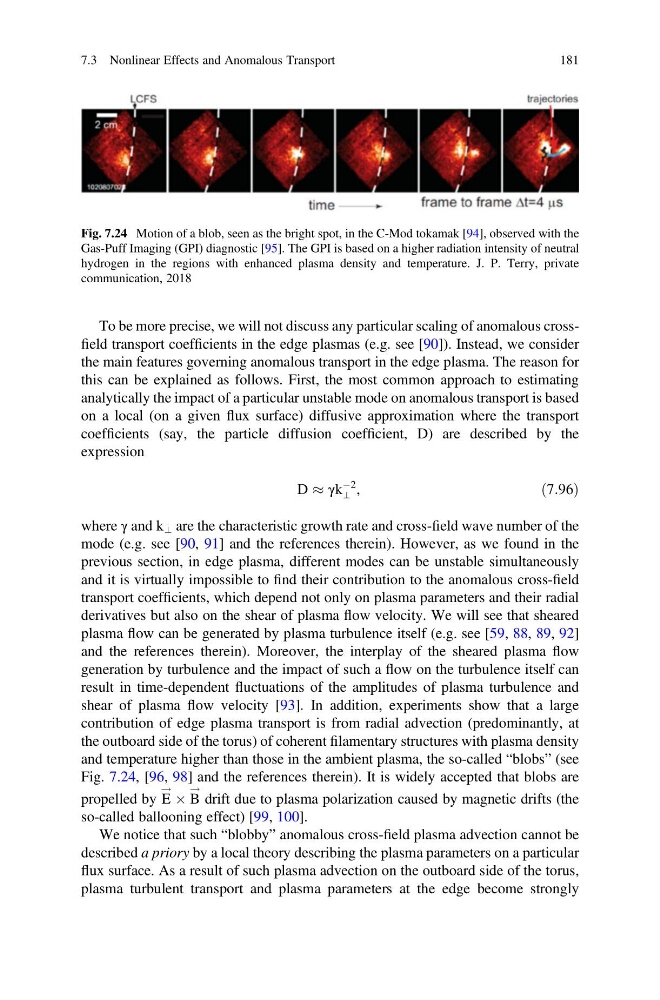
and temperature higher than those in the ambient plasma, the so-called “blobs” (see
Fig. 7.24, [96, 98] and the references therein). It is widely accepted that blobs are
propelled by E
! Â B
!
drift due to plasma polarization caused by magnetic drifts (the
so-called ballooning effect) [99, 100].
We notice that such “blobby” anomalous cross-field plasma advection cannot be
described a priory by a local theory describing the plasma parameters on a particular
flux surface. As a result of such plasma advection on the outboard side of the torus,
plasma turbulent transport and plasma parameters at the edge become strongly
Fig. 7.24 Motion of a blob, seen as the bright spot, in the C-Mod tokamak [94], observed with the
Gas-Puff Imaging (GPI) diagnostic [95]. The GPI is based on a higher radiation intensity of neutral
hydrogen in the regions with enhanced plasma density and temperature. J. P. Terry, private
communication, 2018
7.3 Nonlinear Effects and Anomalous Transport
181
the main features governing anomalous transport in the edge plasma. The reason for
this can be explained as follows. First, the most common approach to estimating
analytically the impact of a particular unstable mode on anomalous transport is based
on a local (on a given flux surface) diffusive approximation where the transport
coefficients (say, the particle diffusion coefficient, D) are described by the
expression
D % γk
À2
⊥ ,
ð7:96Þ
where γ and k ⊥ are the characteristic growth rate and cross-field wave number of the
mode (e.g. see [90, 91] and the references therein). However, as we found in the
previous section, in edge plasma, different modes can be unstable simultaneously
and it is virtually impossible to find their contribution to the anomalous cross-field
transport coefficients, which depend not only on plasma parameters and their radial
derivatives but also on the shear of plasma flow velocity. We will see that sheared
plasma flow can be generated by plasma turbulence itself (e.g. see [59, 88, 89, 92]
and the references therein). Moreover, the interplay of the sheared plasma flow
generation by turbulence and the impact of such a flow on the turbulence itself can
result in time-dependent fluctuations of the amplitudes of plasma turbulence and
shear of plasma flow velocity [93]. In addition, experiments show that a large
contribution of edge plasma transport is from radial advection (predominantly, at
the outboard side of the torus) of coherent filamentary structures with plasma density
and temperature higher than those in the ambient plasma, the so-called “blobs” (see
Fig. 7.24, [96, 98] and the references therein). It is widely accepted that blobs are
propelled by E
! Â B
!
drift due to plasma polarization caused by magnetic drifts (the
so-called ballooning effect) [99, 100].
We notice that such “blobby” anomalous cross-field plasma advection cannot be
described a priory by a local theory describing the plasma parameters on a particular
flux surface. As a result of such plasma advection on the outboard side of the torus,
plasma turbulent transport and plasma parameters at the edge become strongly
Fig. 7.24 Motion of a blob, seen as the bright spot, in the C-Mod tokamak [94], observed with the
Gas-Puff Imaging (GPI) diagnostic [95]. The GPI is based on a higher radiation intensity of neutral
hydrogen in the regions with enhanced plasma density and temperature. J. P. Terry, private
communication, 2018
7.3 Nonlinear Effects and Anomalous Transport
181