

function ω(k x ¼ 0, x) must have at least one extremum. For the case where ω Ã x
ð Þ ¼
b
ω Ã cosh
À2 x=w
ð
Þ, it is easy to show that this is only possible for
jV
0
0 j
0 j loc %
4
3
3=2
b
ω Ã = wk y
À
Á
1 þ ρ 2
s k
2
y
:
ð7:94Þ
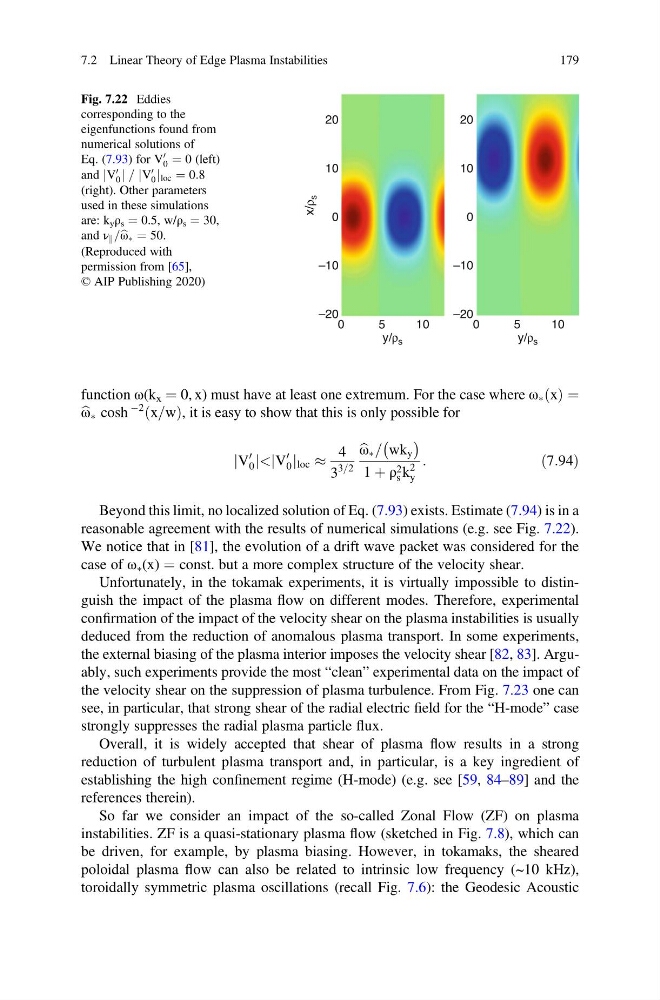
Beyond this limit, no localized solution of Eq. (7.93) exists. Estimate (7.94) is in a
reasonable agreement with the results of numerical simulations (e.g. see Fig. 7.22).
We notice that in [81], the evolution of a drift wave packet was considered for the
case of ω Ã (x) ¼ const. but a more complex structure of the velocity shear.
Unfortunately, in the tokamak experiments, it is virtually impossible to distinguish the impact of the plasma flow on different modes. Therefore, experimental
confirmation of the impact of the velocity shear on the plasma instabilities is usually
deduced from the reduction of anomalous plasma transport. In some experiments,
the external biasing of the plasma interior imposes the velocity shear [82, 83]. Arguably, such experiments provide the most “clean” experimental data on the impact of
the velocity shear on the suppression of plasma turbulence. From Fig. 7.23 one can
see, in particular, that strong shear of the radial electric field for the “H-mode” case
strongly suppresses the radial plasma particle flux.
Overall, it is widely accepted that shear of plasma flow results in a strong
reduction of turbulent plasma transport and, in particular, is a key ingredient of
establishing the high confinement regime (H-mode) (e.g. see [59, 84–89] and the
references therein).
So far we consider an impact of the so-called Zonal Flow (ZF) on plasma
instabilities. ZF is a quasi-stationary plasma flow (sketched in Fig. 7.8), which can
be driven, for example, by plasma biasing. However, in tokamaks, the sheared
poloidal plasma flow can also be related to intrinsic low frequency (~10 kHz),
toroidally symmetric plasma oscillations (recall Fig. 7.6): the Geodesic Acoustic
0
–20
–10
0
10
20
–20
–10
0
10
20
5
y/ρ s
x/ρ
s
10
0
5
y/ρ s
10
Fig. 7.22 Eddies
corresponding to the
eigenfunctions found from
numerical solutions of
Eq. (7.93) for V
0
0 ¼ 0 (left)
and jV
0
0 j = jV
0
0 j loc ¼ 0:8
(right). Other parameters
used in these simulations
are: k y ρ s ¼ 0.5, w/ρ s ¼ 30,
and ν k =b ω Ã ¼ 50.
(Reproduced with
permission from [65],
© AIP Publishing 2020)
7.2 Linear Theory of Edge Plasma Instabilities
179
ð Þ ¼
b
ω Ã cosh
À2 x=w
ð
Þ, it is easy to show that this is only possible for
jV
0
0 j
0 j loc %
4
3
3=2
b
ω Ã = wk y
À
Á
1 þ ρ 2
s k
2
y
:
ð7:94Þ
Beyond this limit, no localized solution of Eq. (7.93) exists. Estimate (7.94) is in a
reasonable agreement with the results of numerical simulations (e.g. see Fig. 7.22).
We notice that in [81], the evolution of a drift wave packet was considered for the
case of ω Ã (x) ¼ const. but a more complex structure of the velocity shear.
Unfortunately, in the tokamak experiments, it is virtually impossible to distinguish the impact of the plasma flow on different modes. Therefore, experimental
confirmation of the impact of the velocity shear on the plasma instabilities is usually
deduced from the reduction of anomalous plasma transport. In some experiments,
the external biasing of the plasma interior imposes the velocity shear [82, 83]. Arguably, such experiments provide the most “clean” experimental data on the impact of
the velocity shear on the suppression of plasma turbulence. From Fig. 7.23 one can
see, in particular, that strong shear of the radial electric field for the “H-mode” case
strongly suppresses the radial plasma particle flux.
Overall, it is widely accepted that shear of plasma flow results in a strong
reduction of turbulent plasma transport and, in particular, is a key ingredient of
establishing the high confinement regime (H-mode) (e.g. see [59, 84–89] and the
references therein).
So far we consider an impact of the so-called Zonal Flow (ZF) on plasma
instabilities. ZF is a quasi-stationary plasma flow (sketched in Fig. 7.8), which can
be driven, for example, by plasma biasing. However, in tokamaks, the sheared
poloidal plasma flow can also be related to intrinsic low frequency (~10 kHz),
toroidally symmetric plasma oscillations (recall Fig. 7.6): the Geodesic Acoustic
0
–20
–10
0
10
20
–20
–10
0
10
20
5
y/ρ s
x/ρ
s
10
0
5
y/ρ s
10
Fig. 7.22 Eddies
corresponding to the
eigenfunctions found from
numerical solutions of
Eq. (7.93) for V
0
0 ¼ 0 (left)
and jV
0
0 j = jV
0
0 j loc ¼ 0:8
(right). Other parameters
used in these simulations
are: k y ρ s ¼ 0.5, w/ρ s ¼ 30,
and ν k =b ω Ã ¼ 50.
(Reproduced with
permission from [65],
© AIP Publishing 2020)
7.2 Linear Theory of Edge Plasma Instabilities
179