

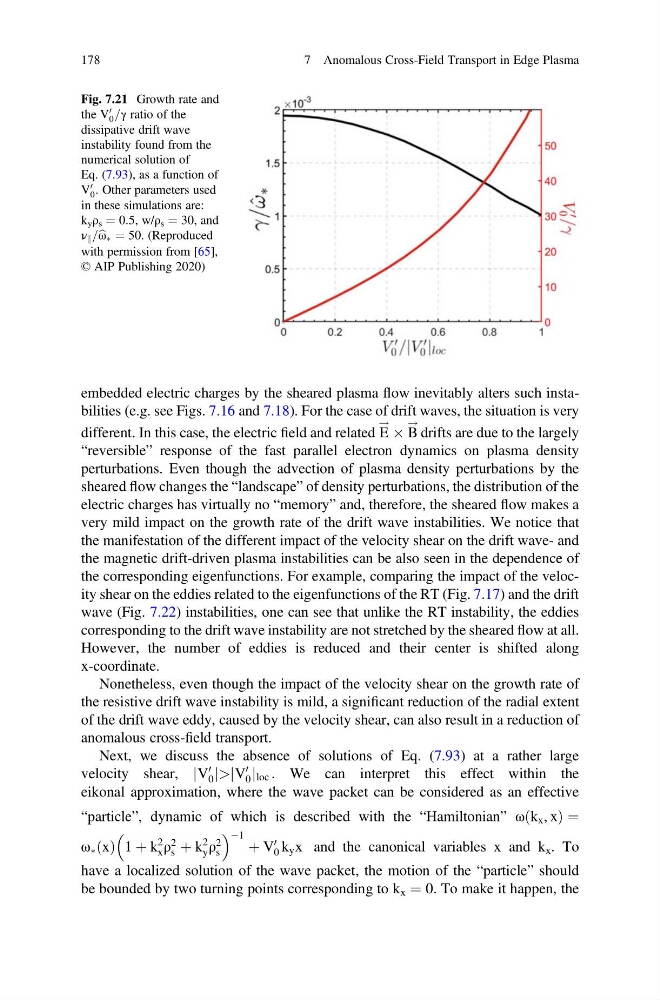
embedded electric charges by the sheared plasma flow inevitably alters such instabilities (e.g. see Figs. 7.16 and 7.18). For the case of drift waves, the situation is very
different. In this case, the electric field and related E
! Â B
!
drifts are due to the largely
“reversible” response of the fast parallel electron dynamics on plasma density
perturbations. Even though the advection of plasma density perturbations by the
sheared flow changes the “landscape” of density perturbations, the distribution of the
electric charges has virtually no “memory” and, therefore, the sheared flow makes a
very mild impact on the growth rate of the drift wave instabilities. We notice that
the manifestation of the different impact of the velocity shear on the drift wave- and
the magnetic drift-driven plasma instabilities can be also seen in the dependence of
the corresponding eigenfunctions. For example, comparing the impact of the velocity shear on the eddies related to the eigenfunctions of the RT (Fig. 7.17) and the drift
wave (Fig. 7.22) instabilities, one can see that unlike the RT instability, the eddies
corresponding to the drift wave instability are not stretched by the sheared flow at all.
However, the number of eddies is reduced and their center is shifted along
x-coordinate.
Nonetheless, even though the impact of the velocity shear on the growth rate of
the resistive drift wave instability is mild, a significant reduction of the radial extent
of the drift wave eddy, caused by the velocity shear, can also result in a reduction of
anomalous cross-field transport.
Next, we discuss the absence of solutions of Eq. (7.93) at a rather large
velocity shear, jV
0
0 j>jV
0
0 j loc . We can interpret this effect within the
eikonal approximation, where the wave packet can be considered as an effective
“particle”, dynamic of which is described with the “Hamiltonian” ω k x , x
ð
Þ¼
ω Ã x
ð Þ 1 þ k
2
x ρ
2
s þ k
2
y ρ
2
s
À1 þ V
0
0 k y x and the canonical variables x and k x . To
have a localized solution of the wave packet, the motion of the “particle” should
be bounded by two turning points corresponding to k x ¼ 0. To make it happen, the
Fig. 7.21 Growth rate and
the V
0
0 =γ ratio of the
dissipative drift wave
instability found from the
numerical solution of
Eq. (7.93), as a function of
V
0
0 . Other parameters used
in these simulations are:
k y ρ s ¼ 0.5, w/ρ s ¼ 30, and
ν k =b ω Ã ¼ 50. (Reproduced
with permission from [65],
© AIP Publishing 2020)
178
7 Anomalous Cross-Field Transport in Edge Plasma
different. In this case, the electric field and related E
! Â B
!
drifts are due to the largely
“reversible” response of the fast parallel electron dynamics on plasma density
perturbations. Even though the advection of plasma density perturbations by the
sheared flow changes the “landscape” of density perturbations, the distribution of the
electric charges has virtually no “memory” and, therefore, the sheared flow makes a
very mild impact on the growth rate of the drift wave instabilities. We notice that
the manifestation of the different impact of the velocity shear on the drift wave- and
the magnetic drift-driven plasma instabilities can be also seen in the dependence of
the corresponding eigenfunctions. For example, comparing the impact of the velocity shear on the eddies related to the eigenfunctions of the RT (Fig. 7.17) and the drift
wave (Fig. 7.22) instabilities, one can see that unlike the RT instability, the eddies
corresponding to the drift wave instability are not stretched by the sheared flow at all.
However, the number of eddies is reduced and their center is shifted along
x-coordinate.
Nonetheless, even though the impact of the velocity shear on the growth rate of
the resistive drift wave instability is mild, a significant reduction of the radial extent
of the drift wave eddy, caused by the velocity shear, can also result in a reduction of
anomalous cross-field transport.
Next, we discuss the absence of solutions of Eq. (7.93) at a rather large
velocity shear, jV
0
0 j>jV
0
0 j loc . We can interpret this effect within the
eikonal approximation, where the wave packet can be considered as an effective
“particle”, dynamic of which is described with the “Hamiltonian” ω k x , x
ð
Þ¼
ω Ã x
ð Þ 1 þ k
2
x ρ
2
s þ k
2
y ρ
2
s
À1 þ V
0
0 k y x and the canonical variables x and k x . To
have a localized solution of the wave packet, the motion of the “particle” should
be bounded by two turning points corresponding to k x ¼ 0. To make it happen, the
Fig. 7.21 Growth rate and
the V
0
0 =γ ratio of the
dissipative drift wave
instability found from the
numerical solution of
Eq. (7.93), as a function of
V
0
0 . Other parameters used
in these simulations are:
k y ρ s ¼ 0.5, w/ρ s ¼ 30, and
ν k =b ω Ã ¼ 50. (Reproduced
with permission from [65],
© AIP Publishing 2020)
178
7 Anomalous Cross-Field Transport in Edge Plasma