

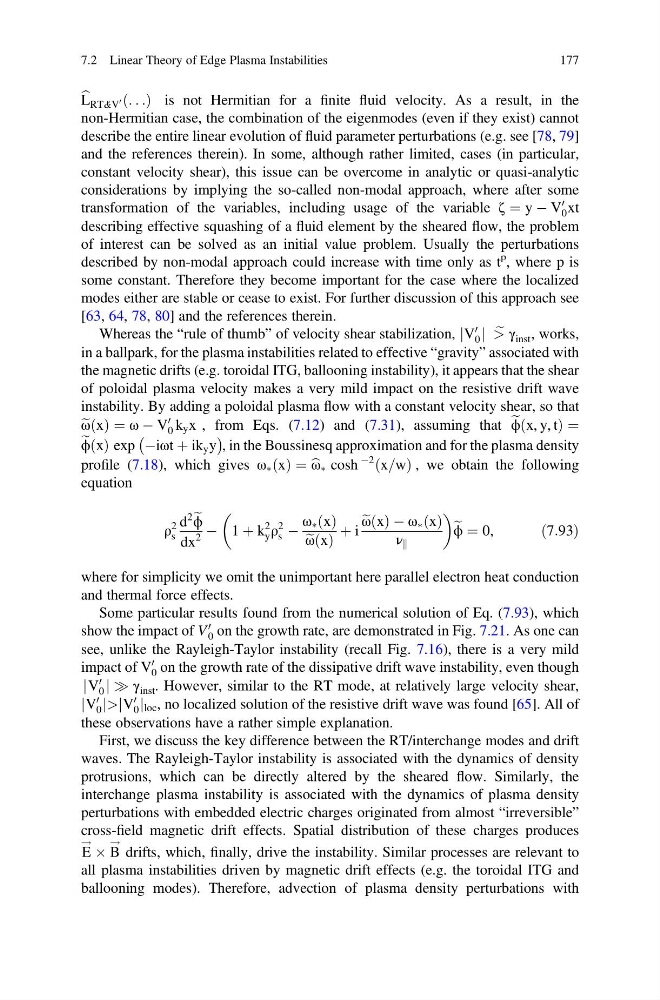
b
L RT&V
0 . . .
ð Þ is not Hermitian for a finite fluid velocity. As a result, in the
non-Hermitian case, the combination of the eigenmodes (even if they exist) cannot
describe the entire linear evolution of fluid parameter perturbations (e.g. see [78, 79]
and the references therein). In some, although rather limited, cases (in particular,
constant velocity shear), this issue can be overcome in analytic or quasi-analytic
considerations by implying the so-called non-modal approach, where after some
transformation of the variables, including usage of the variable ζ ¼ y À V
0
0 xt
describing effective squashing of a fluid element by the sheared flow, the problem
of interest can be solved as an initial value problem. Usually the perturbations
described by non-modal approach could increase with time only as t
p , where p is
some constant. Therefore they become important for the case where the localized
modes either are stable or cease to exist. For further discussion of this approach see
[63, 64, 78, 80] and the references therein.
Whereas the “rule of thumb” of velocity shear stabilization, jV
0
0 j e
> γ inst , works,
in a ballpark, for the plasma instabilities related to effective “gravity” associated with
the magnetic drifts (e.g. toroidal ITG, ballooning instability), it appears that the shear
of poloidal plasma velocity makes a very mild impact on the resistive drift wave
instability. By adding a poloidal plasma flow with a constant velocity shear, so that
e
ω x
ð Þ ¼ ω À V
0
0 k y x , from Eqs. (7.12) and (7.31), assuming that e
ϕ x, y, t
ð
Þ¼
e
ϕ x
ð Þ exp Àiωt þ ik y y
À
Á
, in the Boussinesq approximation and for the plasma density
profile (7.18), which gives ω Ã x
ð Þ ¼ b
ω Ã cosh
À2 x=w
ð
Þ, we obtain the following
equation
ρ
2
s
d
2 e
ϕ
dx
2
À 1 þ k
2
y ρ
2
s À
ω Ã x
ð Þ
e
ω x
ð Þ
þ i
e
ω x
ð Þ À ω Ã x
ð Þ
ν k
e
ϕ ¼ 0,
ð7:93Þ
where for simplicity we omit the unimportant here parallel electron heat conduction
and thermal force effects.
Some particular results found from the numerical solution of Eq. (7.93), which
show the impact of V
0
0 on the growth rate, are demonstrated in Fig. 7.21. As one can
see, unlike the Rayleigh-Taylor instability (recall Fig. 7.16), there is a very mild
impact of V
0
0 on the growth rate of the dissipative drift wave instability, even though
jV
0
0 j ) γ inst . However, similar to the RT mode, at relatively large velocity shear,
jV
0
0 j>jV
0
0 j loc , no localized solution of the resistive drift wave was found [65]. All of
these observations have a rather simple explanation.
First, we discuss the key difference between the RT/interchange modes and drift
waves. The Rayleigh-Taylor instability is associated with the dynamics of density
protrusions, which can be directly altered by the sheared flow. Similarly, the
interchange plasma instability is associated with the dynamics of plasma density
perturbations with embedded electric charges originated from almost “irreversible”
cross-field magnetic drift effects. Spatial distribution of these charges produces
E
! Â B
!
drifts, which, finally, drive the instability. Similar processes are relevant to
all plasma instabilities driven by magnetic drift effects (e.g. the toroidal ITG and
ballooning modes). Therefore, advection of plasma density perturbations with
7.2 Linear Theory of Edge Plasma Instabilities
177
L RT&V
0 . . .
ð Þ is not Hermitian for a finite fluid velocity. As a result, in the
non-Hermitian case, the combination of the eigenmodes (even if they exist) cannot
describe the entire linear evolution of fluid parameter perturbations (e.g. see [78, 79]
and the references therein). In some, although rather limited, cases (in particular,
constant velocity shear), this issue can be overcome in analytic or quasi-analytic
considerations by implying the so-called non-modal approach, where after some
transformation of the variables, including usage of the variable ζ ¼ y À V
0
0 xt
describing effective squashing of a fluid element by the sheared flow, the problem
of interest can be solved as an initial value problem. Usually the perturbations
described by non-modal approach could increase with time only as t
p , where p is
some constant. Therefore they become important for the case where the localized
modes either are stable or cease to exist. For further discussion of this approach see
[63, 64, 78, 80] and the references therein.
Whereas the “rule of thumb” of velocity shear stabilization, jV
0
0 j e
> γ inst , works,
in a ballpark, for the plasma instabilities related to effective “gravity” associated with
the magnetic drifts (e.g. toroidal ITG, ballooning instability), it appears that the shear
of poloidal plasma velocity makes a very mild impact on the resistive drift wave
instability. By adding a poloidal plasma flow with a constant velocity shear, so that
e
ω x
ð Þ ¼ ω À V
0
0 k y x , from Eqs. (7.12) and (7.31), assuming that e
ϕ x, y, t
ð
Þ¼
e
ϕ x
ð Þ exp Àiωt þ ik y y
À
Á
, in the Boussinesq approximation and for the plasma density
profile (7.18), which gives ω Ã x
ð Þ ¼ b
ω Ã cosh
À2 x=w
ð
Þ, we obtain the following
equation
ρ
2
s
d
2 e
ϕ
dx
2
À 1 þ k
2
y ρ
2
s À
ω Ã x
ð Þ
e
ω x
ð Þ
þ i
e
ω x
ð Þ À ω Ã x
ð Þ
ν k
e
ϕ ¼ 0,
ð7:93Þ
where for simplicity we omit the unimportant here parallel electron heat conduction
and thermal force effects.
Some particular results found from the numerical solution of Eq. (7.93), which
show the impact of V
0
0 on the growth rate, are demonstrated in Fig. 7.21. As one can
see, unlike the Rayleigh-Taylor instability (recall Fig. 7.16), there is a very mild
impact of V
0
0 on the growth rate of the dissipative drift wave instability, even though
jV
0
0 j ) γ inst . However, similar to the RT mode, at relatively large velocity shear,
jV
0
0 j>jV
0
0 j loc , no localized solution of the resistive drift wave was found [65]. All of
these observations have a rather simple explanation.
First, we discuss the key difference between the RT/interchange modes and drift
waves. The Rayleigh-Taylor instability is associated with the dynamics of density
protrusions, which can be directly altered by the sheared flow. Similarly, the
interchange plasma instability is associated with the dynamics of plasma density
perturbations with embedded electric charges originated from almost “irreversible”
cross-field magnetic drift effects. Spatial distribution of these charges produces
E
! Â B
!
drifts, which, finally, drive the instability. Similar processes are relevant to
all plasma instabilities driven by magnetic drift effects (e.g. the toroidal ITG and
ballooning modes). Therefore, advection of plasma density perturbations with
7.2 Linear Theory of Edge Plasma Instabilities
177