

where e
ω ¼ ω À k y V 0 x
ð Þ . This equation is usually solved as an eigenfunctioneigenvalue problem, where the role of the eigenvalues goes to ω. We notice that
the last term in Eq. (7.92) can drive the Kelvin-Helmholtz [26] and facilitate the
Rayleigh-Taylor [66] instabilities.
Assuming that in the fluid at rest, the Rayleigh-Taylor instability develops, the
impact of the velocity shear can be characterized by the effective Richardson number
which in our case we define as Ri ¼ g jdℓn ρ
ð Þ=dxj V
0
0
À Á À2 . The case where a
stratified fluid is bounded by two horizontal walls separated by a distance h was
considered in [61] in the Boussinesq approximation.
It was assumed that dℓn(ρ)/dx and V
0
0 are constants and zero perturbed fluid
velocity at the walls was used as the boundary conditions. It was shown that for such
settings, no unstable eigenfunction-eigenvalue solutions of Eq. (7.92) exist for
Ri < Ri crit % 1 Ä 2, where Ri crit depends on jk y j w and stabilization of smaller k y
requires a somewhat lower Ri crit . Thus, these findings are consistent with the
simplified physical picture of the impact of shear stabilization on the instability
described by the inequality jV
0
0 j e
> γ inst . However, the results of the numerical
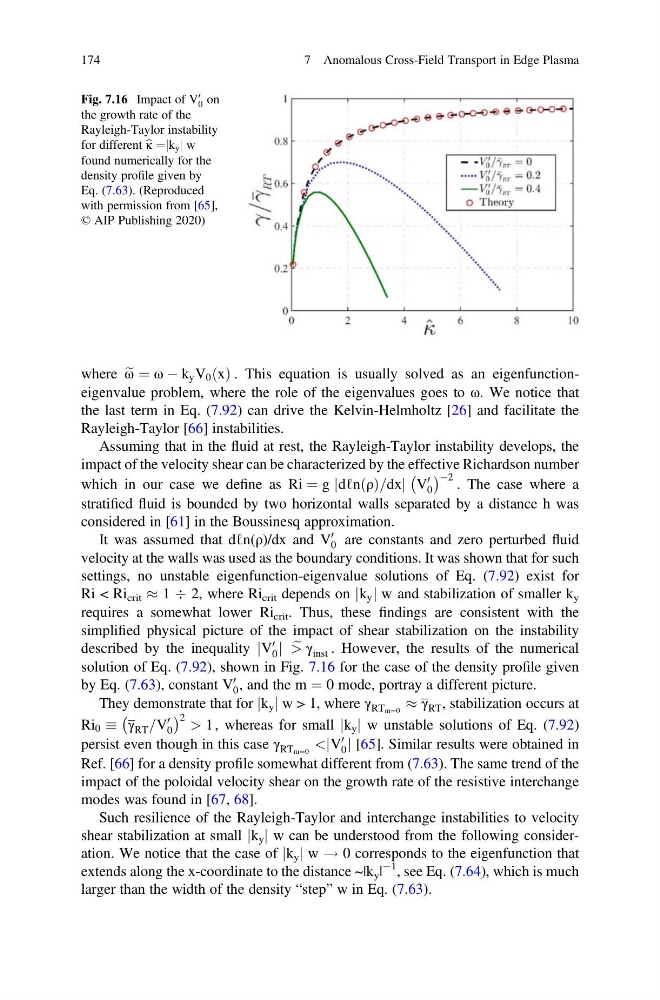
solution of Eq. (7.92), shown in Fig. 7.16 for the case of the density profile given
by Eq. (7.63), constant V
0
0 , and the m ¼ 0 mode, portray a different picture.
They demonstrate that for jk y j w > 1, where γ RT m¼0 % γ RT , stabilization occurs at
Ri 0 γ RT =V
0
0
À
Á 2 > 1 , whereas for small jk y j w unstable solutions of Eq. (7.92)
persist even though in this case γ RT m¼0
0 j [65]. Similar results were obtained in
Ref. [66] for a density profile somewhat different from (7.63). The same trend of the
impact of the poloidal velocity shear on the growth rate of the resistive interchange
modes was found in [67, 68].
Such resilience of the Rayleigh-Taylor and interchange instabilities to velocity
shear stabilization at small jk y j w can be understood from the following consideration. We notice that the case of jk y j w ! 0 corresponds to the eigenfunction that
extends along the x-coordinate to the distance ~|k y |
À1 , see Eq. (7.64), which is much
larger than the width of the density “step” w in Eq. (7.63).
Fig. 7.16 Impact of V
0
0 on
the growth rate of the
Rayleigh-Taylor instability
for different b κ ¼jk y j w
found numerically for the
density profile given by
Eq. (7.63). (Reproduced
with permission from [65],
© AIP Publishing 2020)
174
7 Anomalous Cross-Field Transport in Edge Plasma
ω ¼ ω À k y V 0 x
ð Þ . This equation is usually solved as an eigenfunctioneigenvalue problem, where the role of the eigenvalues goes to ω. We notice that
the last term in Eq. (7.92) can drive the Kelvin-Helmholtz [26] and facilitate the
Rayleigh-Taylor [66] instabilities.
Assuming that in the fluid at rest, the Rayleigh-Taylor instability develops, the
impact of the velocity shear can be characterized by the effective Richardson number
which in our case we define as Ri ¼ g jdℓn ρ
ð Þ=dxj V
0
0
À Á À2 . The case where a
stratified fluid is bounded by two horizontal walls separated by a distance h was
considered in [61] in the Boussinesq approximation.
It was assumed that dℓn(ρ)/dx and V
0
0 are constants and zero perturbed fluid
velocity at the walls was used as the boundary conditions. It was shown that for such
settings, no unstable eigenfunction-eigenvalue solutions of Eq. (7.92) exist for
Ri < Ri crit % 1 Ä 2, where Ri crit depends on jk y j w and stabilization of smaller k y
requires a somewhat lower Ri crit . Thus, these findings are consistent with the
simplified physical picture of the impact of shear stabilization on the instability
described by the inequality jV
0
0 j e
> γ inst . However, the results of the numerical
solution of Eq. (7.92), shown in Fig. 7.16 for the case of the density profile given
by Eq. (7.63), constant V
0
0 , and the m ¼ 0 mode, portray a different picture.
They demonstrate that for jk y j w > 1, where γ RT m¼0 % γ RT , stabilization occurs at
Ri 0 γ RT =V
0
0
À
Á 2 > 1 , whereas for small jk y j w unstable solutions of Eq. (7.92)
persist even though in this case γ RT m¼0
0 j [65]. Similar results were obtained in
Ref. [66] for a density profile somewhat different from (7.63). The same trend of the
impact of the poloidal velocity shear on the growth rate of the resistive interchange
modes was found in [67, 68].
Such resilience of the Rayleigh-Taylor and interchange instabilities to velocity
shear stabilization at small jk y j w can be understood from the following consideration. We notice that the case of jk y j w ! 0 corresponds to the eigenfunction that
extends along the x-coordinate to the distance ~|k y |
À1 , see Eq. (7.64), which is much
larger than the width of the density “step” w in Eq. (7.63).
Fig. 7.16 Impact of V
0
0 on
the growth rate of the
Rayleigh-Taylor instability
for different b κ ¼jk y j w
found numerically for the
density profile given by
Eq. (7.63). (Reproduced
with permission from [65],
© AIP Publishing 2020)
174
7 Anomalous Cross-Field Transport in Edge Plasma