

Therefore, the mode does not “feel” the detail of the density variation, but only
the size of the density “step”. Thus, the case of jk y j w ! 0 can be considered by
adopting a step-function for the density profile, ρ x
ð Þ ¼ ρ À Δρ θ x
ð Þ À 1=2
f
g , where
θ(x) is the Heaviside function: θ(x < 0) ¼ 0, θ(x > 0) ¼ 1. Then, from Eq. (7.92) we
have e
ψ jxj> 0
ð
Þ¼ exp Àjk y xj
À
Á
and integrating Eq. (7.92) around x ¼ 0, we find
that the growth rate is γ
2
RT m¼0
¼ γ
2
RT jk y j w and the velocity shear does not change
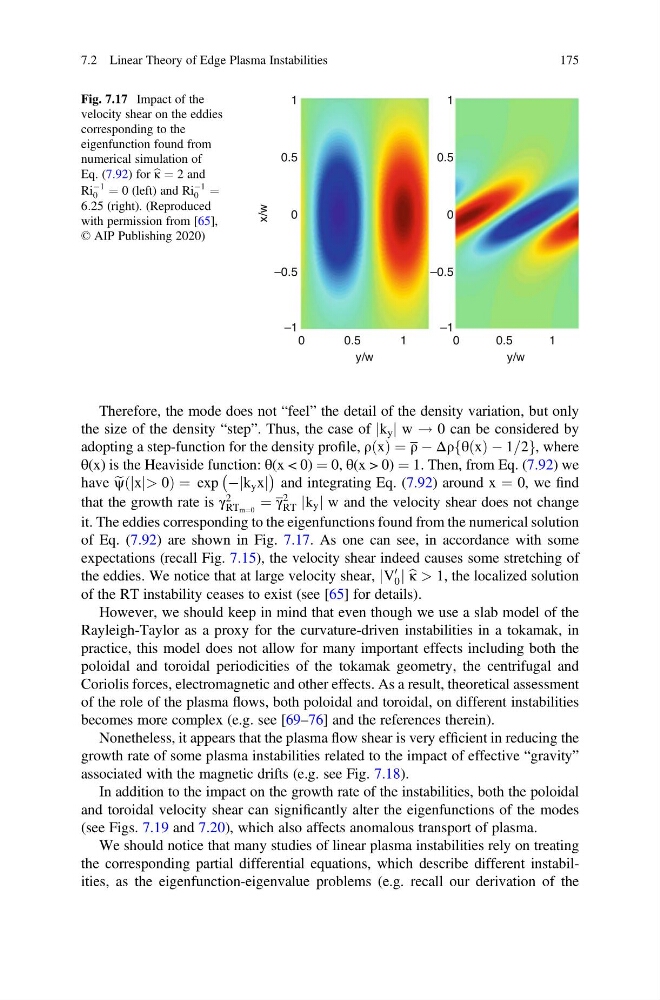
it. The eddies corresponding to the eigenfunctions found from the numerical solution
of Eq. (7.92) are shown in Fig. 7.17. As one can see, in accordance with some
expectations (recall Fig. 7.15), the velocity shear indeed causes some stretching of
the eddies. We notice that at large velocity shear, jV
0
0 j b κ > 1, the localized solution
of the RT instability ceases to exist (see [65] for details).
However, we should keep in mind that even though we use a slab model of the
Rayleigh-Taylor as a proxy for the curvature-driven instabilities in a tokamak, in
practice, this model does not allow for many important effects including both the
poloidal and toroidal periodicities of the tokamak geometry, the centrifugal and
Coriolis forces, electromagnetic and other effects. As a result, theoretical assessment
of the role of the plasma flows, both poloidal and toroidal, on different instabilities
becomes more complex (e.g. see [69–76] and the references therein).
Nonetheless, it appears that the plasma flow shear is very efficient in reducing the
growth rate of some plasma instabilities related to the impact of effective “gravity”
associated with the magnetic drifts (e.g. see Fig. 7.18).
In addition to the impact on the growth rate of the instabilities, both the poloidal
and toroidal velocity shear can significantly alter the eigenfunctions of the modes
(see Figs. 7.19 and 7.20), which also affects anomalous transport of plasma.
We should notice that many studies of linear plasma instabilities rely on treating
the corresponding partial differential equations, which describe different instabilities, as the eigenfunction-eigenvalue problems (e.g. recall our derivation of the
0
–1
–0.5
0
0.5
1
0.5
y/w
x/w
1
0
–1
–0.5
0
0.5
1
0.5
y/w
1
Fig. 7.17 Impact of the
velocity shear on the eddies
corresponding to the
eigenfunction found from
numerical simulation of
Eq. (7.92) for b κ ¼ 2 and
Ri
À1
0 ¼ 0 (left) and Ri
À1
0 ¼
6:25 (right). (Reproduced
with permission from [65],
© AIP Publishing 2020)
7.2 Linear Theory of Edge Plasma Instabilities
175
the size of the density “step”. Thus, the case of jk y j w ! 0 can be considered by
adopting a step-function for the density profile, ρ x
ð Þ ¼ ρ À Δρ θ x
ð Þ À 1=2
f
g , where
θ(x) is the Heaviside function: θ(x < 0) ¼ 0, θ(x > 0) ¼ 1. Then, from Eq. (7.92) we
have e
ψ jxj> 0
ð
Þ¼ exp Àjk y xj
À
Á
and integrating Eq. (7.92) around x ¼ 0, we find
that the growth rate is γ
2
RT m¼0
¼ γ
2
RT jk y j w and the velocity shear does not change
it. The eddies corresponding to the eigenfunctions found from the numerical solution
of Eq. (7.92) are shown in Fig. 7.17. As one can see, in accordance with some
expectations (recall Fig. 7.15), the velocity shear indeed causes some stretching of
the eddies. We notice that at large velocity shear, jV
0
0 j b κ > 1, the localized solution
of the RT instability ceases to exist (see [65] for details).
However, we should keep in mind that even though we use a slab model of the
Rayleigh-Taylor as a proxy for the curvature-driven instabilities in a tokamak, in
practice, this model does not allow for many important effects including both the
poloidal and toroidal periodicities of the tokamak geometry, the centrifugal and
Coriolis forces, electromagnetic and other effects. As a result, theoretical assessment
of the role of the plasma flows, both poloidal and toroidal, on different instabilities
becomes more complex (e.g. see [69–76] and the references therein).
Nonetheless, it appears that the plasma flow shear is very efficient in reducing the
growth rate of some plasma instabilities related to the impact of effective “gravity”
associated with the magnetic drifts (e.g. see Fig. 7.18).
In addition to the impact on the growth rate of the instabilities, both the poloidal
and toroidal velocity shear can significantly alter the eigenfunctions of the modes
(see Figs. 7.19 and 7.20), which also affects anomalous transport of plasma.
We should notice that many studies of linear plasma instabilities rely on treating
the corresponding partial differential equations, which describe different instabilities, as the eigenfunction-eigenvalue problems (e.g. recall our derivation of the
0
–1
–0.5
0
0.5
1
0.5
y/w
x/w
1
0
–1
–0.5
0
0.5
1
0.5
y/w
1
Fig. 7.17 Impact of the
velocity shear on the eddies
corresponding to the
eigenfunction found from
numerical simulation of
Eq. (7.92) for b κ ¼ 2 and
Ri
À1
0 ¼ 0 (left) and Ri
À1
0 ¼
6:25 (right). (Reproduced
with permission from [65],
© AIP Publishing 2020)
7.2 Linear Theory of Edge Plasma Instabilities
175