

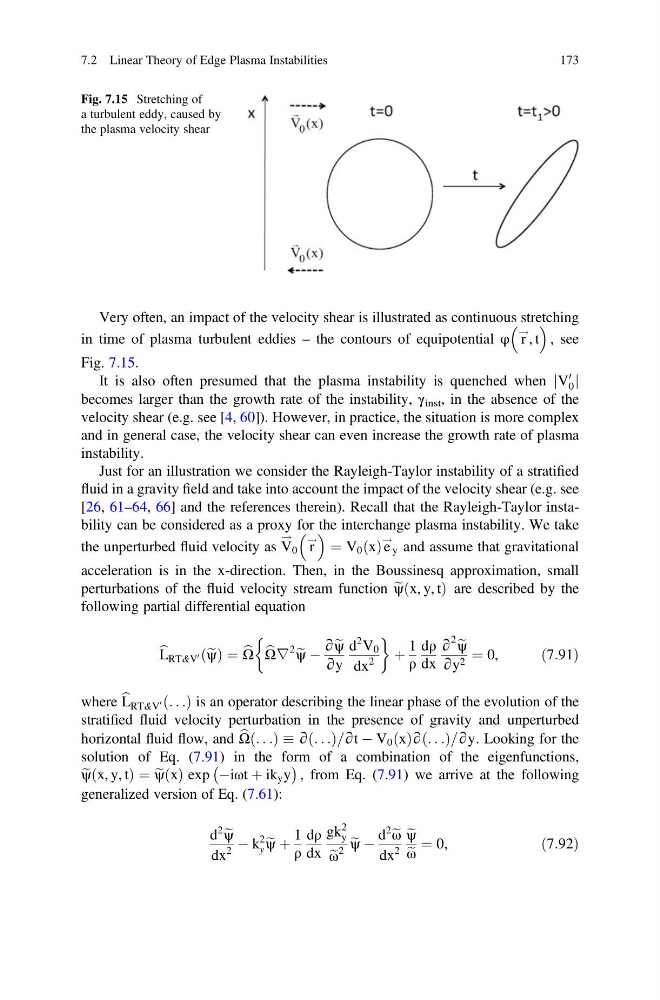
Very often, an impact of the velocity shear is illustrated as continuous stretching
in time of plasma turbulent eddies – the contours of equipotential φ r
!
, t
, see
Fig. 7.15.
It is also often presumed that the plasma instability is quenched when jV
0
0 j
becomes larger than the growth rate of the instability, γ inst , in the absence of the
velocity shear (e.g. see [4, 60]). However, in practice, the situation is more complex
and in general case, the velocity shear can even increase the growth rate of plasma
instability.
Just for an illustration we consider the Rayleigh-Taylor instability of a stratified
fluid in a gravity field and take into account the impact of the velocity shear (e.g. see
[26, 61–64, 66] and the references therein). Recall that the Rayleigh-Taylor instability can be considered as a proxy for the interchange plasma instability. We take
the unperturbed fluid velocity as V
!
0 r
!
¼ V 0 x
ð Þe
!
y and assume that gravitational
acceleration is in the x-direction. Then, in the Boussinesq approximation, small
perturbations of the fluid velocity stream function e
ψ x, y, t
ð
Þ are described by the
following partial differential equation
b
L RT&V
0 e
ψ
ð Þ ¼ b
Ω b
Ω∇
2
e
ψ À
∂e ψ
∂y
d
2 V 0
dx
2
&
'
þ
1
ρ
dρ
dx
∂
2 e
ψ
∂y 2 ¼ 0,
ð7:91Þ
where b
L RT&V
0 . . .
ð Þ is an operator describing the linear phase of the evolution of the
stratified fluid velocity perturbation in the presence of gravity and unperturbed
horizontal fluid flow, and b
Ω . . .
ð Þ ∂ . . .
ð Þ=∂t À V 0 x
ð Þ∂ . . .
ð Þ=∂y. Looking for the
solution of Eq. (7.91) in the form of a combination of the eigenfunctions,
e
ψ x, y, t
ð
Þ¼ e
ψ x
ð Þ exp Àiωt þ ik y y
À
Á
, from Eq. (7.91) we arrive at the following
generalized version of Eq. (7.61):
d
2
e
ψ
dx
2
À k
2
y e
ψ þ
1
ρ
dρ
dx
gk
2
y
e
ω
2
e
ψ À
d
2
e
ω
dx
2
e
ψ
e
ω
¼ 0,
ð7:92Þ
Fig. 7.15 Stretching of
a turbulent eddy, caused by
the plasma velocity shear
7.2 Linear Theory of Edge Plasma Instabilities
173
in time of plasma turbulent eddies – the contours of equipotential φ r
!
, t
, see
Fig. 7.15.
It is also often presumed that the plasma instability is quenched when jV
0
0 j
becomes larger than the growth rate of the instability, γ inst , in the absence of the
velocity shear (e.g. see [4, 60]). However, in practice, the situation is more complex
and in general case, the velocity shear can even increase the growth rate of plasma
instability.
Just for an illustration we consider the Rayleigh-Taylor instability of a stratified
fluid in a gravity field and take into account the impact of the velocity shear (e.g. see
[26, 61–64, 66] and the references therein). Recall that the Rayleigh-Taylor instability can be considered as a proxy for the interchange plasma instability. We take
the unperturbed fluid velocity as V
!
0 r
!
¼ V 0 x
ð Þe
!
y and assume that gravitational
acceleration is in the x-direction. Then, in the Boussinesq approximation, small
perturbations of the fluid velocity stream function e
ψ x, y, t
ð
Þ are described by the
following partial differential equation
b
L RT&V
0 e
ψ
ð Þ ¼ b
Ω b
Ω∇
2
e
ψ À
∂e ψ
∂y
d
2 V 0
dx
2
&
'
þ
1
ρ
dρ
dx
∂
2 e
ψ
∂y 2 ¼ 0,
ð7:91Þ
where b
L RT&V
0 . . .
ð Þ is an operator describing the linear phase of the evolution of the
stratified fluid velocity perturbation in the presence of gravity and unperturbed
horizontal fluid flow, and b
Ω . . .
ð Þ ∂ . . .
ð Þ=∂t À V 0 x
ð Þ∂ . . .
ð Þ=∂y. Looking for the
solution of Eq. (7.91) in the form of a combination of the eigenfunctions,
e
ψ x, y, t
ð
Þ¼ e
ψ x
ð Þ exp Àiωt þ ik y y
À
Á
, from Eq. (7.91) we arrive at the following
generalized version of Eq. (7.61):
d
2
e
ψ
dx
2
À k
2
y e
ψ þ
1
ρ
dρ
dx
gk
2
y
e
ω
2
e
ψ À
d
2
e
ω
dx
2
e
ψ
e
ω
¼ 0,
ð7:92Þ
Fig. 7.15 Stretching of
a turbulent eddy, caused by
the plasma velocity shear
7.2 Linear Theory of Edge Plasma Instabilities
173