

spatial scale that has to be resolved near the X-point brings another complication for
numerical modeling of the X-point effects. As a result, the applicability and validity
of modern numerical studies of the X-point effects on the edge plasma instabilities
and, in particular, turbulence are somewhat questionable. In analytic theory, the
X-point effects are often described with some effective boundary conditions for the
“standard” differential equations for the edge plasma waves at the “entrance” to the
X-point region (see [52–54], and the references therein). These boundary conditions
assume that X-point dissipation results in a fast decrease of the electrostatic potential
in the direction of the X-point, which is usually described as an evanescent wave.
However, even in this case, the models used for such effective closures only cover
extreme cases where the poloidal scale of the electrostatic potential in the wave is
either still larger than ρ i or much smaller than that.
7.2.10 Impact of Plasma “Macro- and Mesoscale” Flows
So far, we considered the waves and instabilities in plasma at rest. However, quite
often some specific, macro- and mesoscale, plasma flows can develop. Such flows
can emerge due to different inherent, nonlinear processes associated with plasma
turbulence, or can be driven by outside effects such as, for example, injection of
neutral beams used for plasma heating. In tokamaks, flows having very low effective
poloidal wave numbers virtually do not contribute to anomalous cross-field plasma
transport since such flows mostly have only poloidal and/or toroidal components of
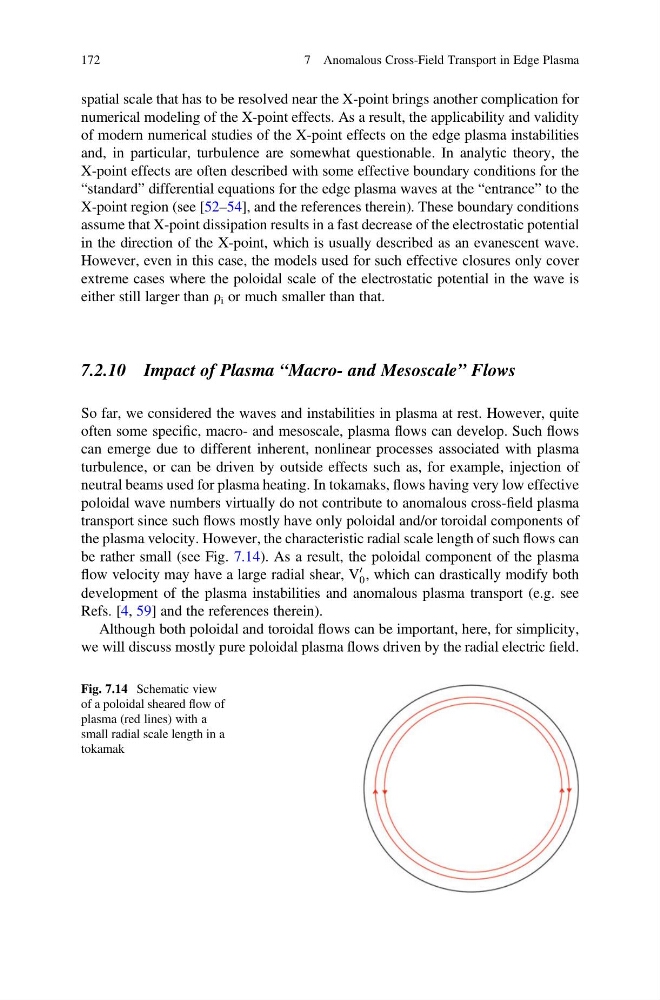
the plasma velocity. However, the characteristic radial scale length of such flows can
be rather small (see Fig. 7.14). As a result, the poloidal component of the plasma
flow velocity may have a large radial shear, V
0
0 , which can drastically modify both
development of the plasma instabilities and anomalous plasma transport (e.g. see
Refs. [4, 59] and the references therein).
Although both poloidal and toroidal flows can be important, here, for simplicity,
we will discuss mostly pure poloidal plasma flows driven by the radial electric field.
Fig. 7.14 Schematic view
of a poloidal sheared flow of
plasma (red lines) with a
small radial scale length in a
tokamak
172
7 Anomalous Cross-Field Transport in Edge Plasma
numerical modeling of the X-point effects. As a result, the applicability and validity
of modern numerical studies of the X-point effects on the edge plasma instabilities
and, in particular, turbulence are somewhat questionable. In analytic theory, the
X-point effects are often described with some effective boundary conditions for the
“standard” differential equations for the edge plasma waves at the “entrance” to the
X-point region (see [52–54], and the references therein). These boundary conditions
assume that X-point dissipation results in a fast decrease of the electrostatic potential
in the direction of the X-point, which is usually described as an evanescent wave.
However, even in this case, the models used for such effective closures only cover
extreme cases where the poloidal scale of the electrostatic potential in the wave is
either still larger than ρ i or much smaller than that.
7.2.10 Impact of Plasma “Macro- and Mesoscale” Flows
So far, we considered the waves and instabilities in plasma at rest. However, quite
often some specific, macro- and mesoscale, plasma flows can develop. Such flows
can emerge due to different inherent, nonlinear processes associated with plasma
turbulence, or can be driven by outside effects such as, for example, injection of
neutral beams used for plasma heating. In tokamaks, flows having very low effective
poloidal wave numbers virtually do not contribute to anomalous cross-field plasma
transport since such flows mostly have only poloidal and/or toroidal components of
the plasma velocity. However, the characteristic radial scale length of such flows can
be rather small (see Fig. 7.14). As a result, the poloidal component of the plasma
flow velocity may have a large radial shear, V
0
0 , which can drastically modify both
development of the plasma instabilities and anomalous plasma transport (e.g. see
Refs. [4, 59] and the references therein).
Although both poloidal and toroidal flows can be important, here, for simplicity,
we will discuss mostly pure poloidal plasma flows driven by the radial electric field.
Fig. 7.14 Schematic view
of a poloidal sheared flow of
plasma (red lines) with a
small radial scale length in a
tokamak
172
7 Anomalous Cross-Field Transport in Edge Plasma