

where ℓ X (0) and ℓ X are the initial and current distances from the X-point, ℓ X (0) ) ℓ X
(the position 0 corresponds to the location farther from the X-point. So for the
magnetic flux coming close to the X-point, we have δℓ p ( δℓ p (0).
In practice, the effect of “poloidal compression” of the flux tubes can be so strong
that even flux tubes originated in the midplane at a distance ~ centimeter from the
separatrix and having a ~ centimeter cross-field radius, are squeezed poloidally to the
scale below the ion gyro-radius in the vicinity of the X-point [50]. Similarly, any
wavy structure originated at the midplane and having a long wavelength parallel to
the magnetic field will experience a strong reduction of the effective poloidal
wavelength in the vicinity of the X-point, which will result in strong dissipation
effects and effectively stop the wave penetration through the X-point region from the
midplane into the divertor region and vice versa [50–52]. Therefore, turbulent
processes in the divertor region and SOL become disconnected. However, strong
dissipative effects near the X-point can play a role somewhat similar to volumetric
dissipation and result in a new type of instabilities (e.g. see [53, 54] and the
references therein).
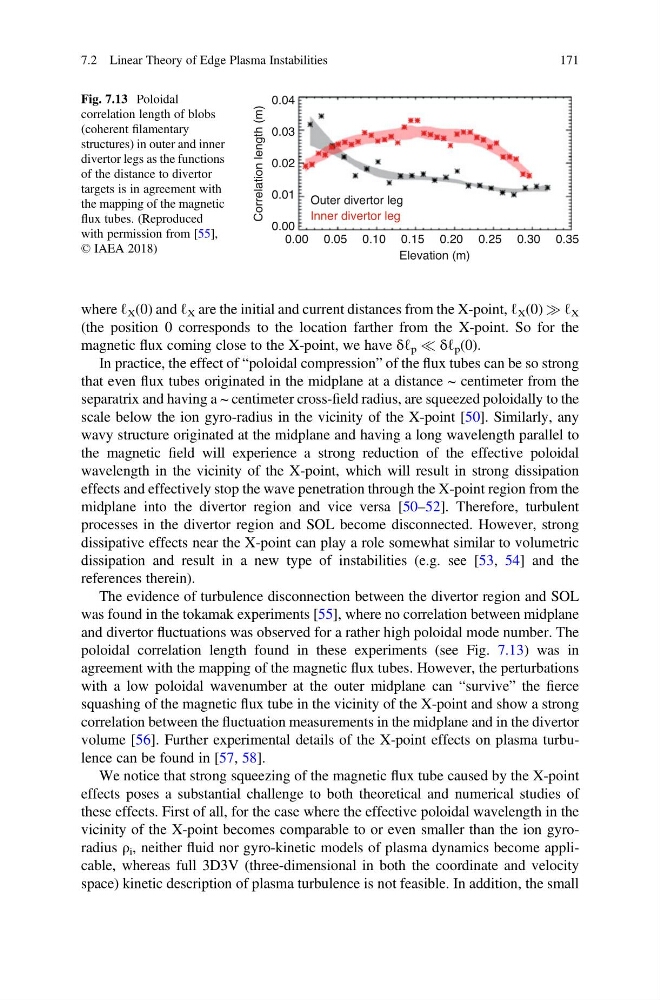
The evidence of turbulence disconnection between the divertor region and SOL
was found in the tokamak experiments [55], where no correlation between midplane
and divertor fluctuations was observed for a rather high poloidal mode number. The
poloidal correlation length found in these experiments (see Fig. 7.13) was in
agreement with the mapping of the magnetic flux tubes. However, the perturbations
with a low poloidal wavenumber at the outer midplane can “survive” the fierce
squashing of the magnetic flux tube in the vicinity of the X-point and show a strong
correlation between the fluctuation measurements in the midplane and in the divertor
volume [56]. Further experimental details of the X-point effects on plasma turbulence can be found in [57, 58].
We notice that strong squeezing of the magnetic flux tube caused by the X-point
effects poses a substantial challenge to both theoretical and numerical studies of
these effects. First of all, for the case where the effective poloidal wavelength in the
vicinity of the X-point becomes comparable to or even smaller than the ion gyroradius ρ i , neither fluid nor gyro-kinetic models of plasma dynamics become applicable, whereas full 3D3V (three-dimensional in both the coordinate and velocity
space) kinetic description of plasma turbulence is not feasible. In addition, the small
0.00
0.00
0.01
0.02
0.03
0.04
0.05 0.10
Elevation (m)
Correlation length (m)
0.15 0.20 0.25 0.30 0.35
Outer divertor leg
Inner divertor leg
Fig. 7.13 Poloidal
correlation length of blobs
(coherent filamentary
structures) in outer and inner
divertor legs as the functions
of the distance to divertor
targets is in agreement with
the mapping of the magnetic
flux tubes. (Reproduced
with permission from [55],
© IAEA 2018)
7.2 Linear Theory of Edge Plasma Instabilities
171
(the position 0 corresponds to the location farther from the X-point. So for the
magnetic flux coming close to the X-point, we have δℓ p ( δℓ p (0).
In practice, the effect of “poloidal compression” of the flux tubes can be so strong
that even flux tubes originated in the midplane at a distance ~ centimeter from the
separatrix and having a ~ centimeter cross-field radius, are squeezed poloidally to the
scale below the ion gyro-radius in the vicinity of the X-point [50]. Similarly, any
wavy structure originated at the midplane and having a long wavelength parallel to
the magnetic field will experience a strong reduction of the effective poloidal
wavelength in the vicinity of the X-point, which will result in strong dissipation
effects and effectively stop the wave penetration through the X-point region from the
midplane into the divertor region and vice versa [50–52]. Therefore, turbulent
processes in the divertor region and SOL become disconnected. However, strong
dissipative effects near the X-point can play a role somewhat similar to volumetric
dissipation and result in a new type of instabilities (e.g. see [53, 54] and the
references therein).
The evidence of turbulence disconnection between the divertor region and SOL
was found in the tokamak experiments [55], where no correlation between midplane
and divertor fluctuations was observed for a rather high poloidal mode number. The
poloidal correlation length found in these experiments (see Fig. 7.13) was in
agreement with the mapping of the magnetic flux tubes. However, the perturbations
with a low poloidal wavenumber at the outer midplane can “survive” the fierce
squashing of the magnetic flux tube in the vicinity of the X-point and show a strong
correlation between the fluctuation measurements in the midplane and in the divertor
volume [56]. Further experimental details of the X-point effects on plasma turbulence can be found in [57, 58].
We notice that strong squeezing of the magnetic flux tube caused by the X-point
effects poses a substantial challenge to both theoretical and numerical studies of
these effects. First of all, for the case where the effective poloidal wavelength in the
vicinity of the X-point becomes comparable to or even smaller than the ion gyroradius ρ i , neither fluid nor gyro-kinetic models of plasma dynamics become applicable, whereas full 3D3V (three-dimensional in both the coordinate and velocity
space) kinetic description of plasma turbulence is not feasible. In addition, the small
0.00
0.00
0.01
0.02
0.03
0.04
0.05 0.10
Elevation (m)
Correlation length (m)
0.15 0.20 0.25 0.30 0.35
Outer divertor leg
Inner divertor leg
Fig. 7.13 Poloidal
correlation length of blobs
(coherent filamentary
structures) in outer and inner
divertor legs as the functions
of the distance to divertor
targets is in agreement with
the mapping of the magnetic
flux tubes. (Reproduced
with permission from [55],
© IAEA 2018)
7.2 Linear Theory of Edge Plasma Instabilities
171