

7.2.8 Effect of “Open” Magnetic Field Lines
Here we consider how a contact of the plasma with material surfaces (e.g. limiters,
divertor targets) in the SOL region can affect plasma stability. As we found, plasma
instabilities, one way or another, result in a fluctuating electric current along the
magnetic field lines. The volumetric resistive effects associated with this current can
cause dissipative plasma instabilities (e.g. recall Eq. (7.32)). However, in Ch. IV it
was shown that the plasma current into a material surface (which we will, for
simplicity, assume perfectly conducting) is related to some variation of the electrostatic potential through the sheath, φ sh , bridging the material surface and the plasma.
Then the expression for the low magnitude of electric current perturbation to the
target, ~ J
tar
k , can be found by linearizing the expression (4.18), which, ignoring
electron emission from the surface and assuming a normal incidence of the magnetic
field onto the target, gives (see also [38, 39]):
~ J
tar
k ¼ en sh C s ðT e Þ
(
e~ φ sh
T e
À
1
2
þ Λ sh
~
T e
sh
T e
)
þ
~ n sh
n sh
þ
1
2
~
T e
sh
T e
!
J
tar
k ,
ð7:78Þ
where Λ sh ¼ eφ sh /T e .
The “boundary” condition Eq. (7.78) can result in a new type of instability and
alter some modes we have considered so far. First, we consider an impact of this
boundary condition on the interchange mode described by Eqs. (7.59 and 7.60). For
simplicity, we analyze the SOL plasma at the outer side of the torus for a double null
magnetic configuration (see Fig. 1.6a). We take the cold ion approximation and
–6
–4
–2
0
2
4
6
5
4
6 7 8 9
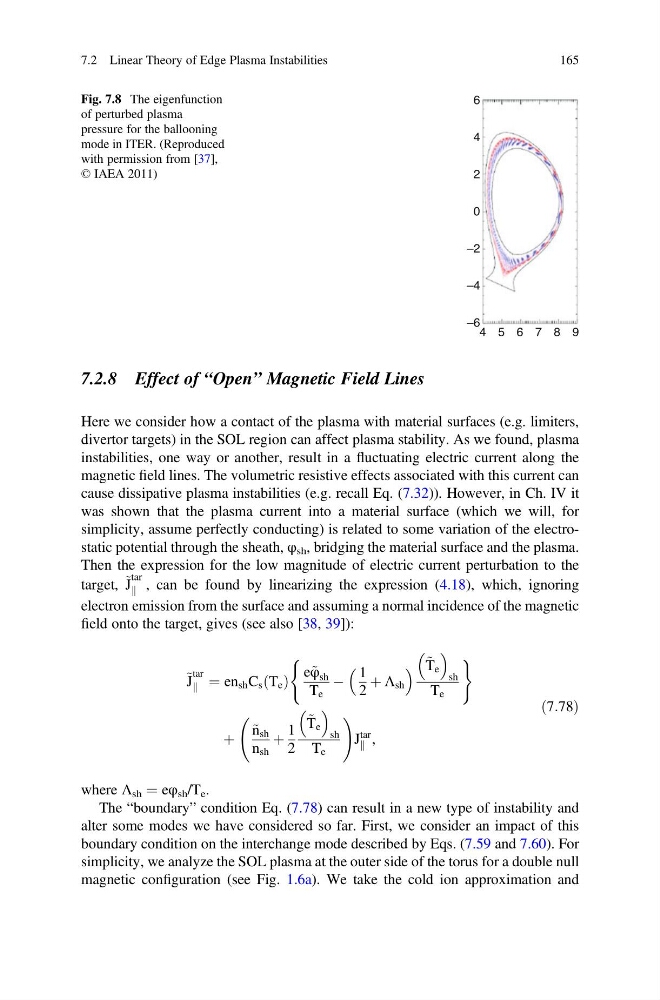
Fig. 7.8 The eigenfunction
of perturbed plasma
pressure for the ballooning
mode in ITER. (Reproduced
with permission from [37],
© IAEA 2011)
7.2 Linear Theory of Edge Plasma Instabilities
165
Here we consider how a contact of the plasma with material surfaces (e.g. limiters,
divertor targets) in the SOL region can affect plasma stability. As we found, plasma
instabilities, one way or another, result in a fluctuating electric current along the
magnetic field lines. The volumetric resistive effects associated with this current can
cause dissipative plasma instabilities (e.g. recall Eq. (7.32)). However, in Ch. IV it
was shown that the plasma current into a material surface (which we will, for
simplicity, assume perfectly conducting) is related to some variation of the electrostatic potential through the sheath, φ sh , bridging the material surface and the plasma.
Then the expression for the low magnitude of electric current perturbation to the
target, ~ J
tar
k , can be found by linearizing the expression (4.18), which, ignoring
electron emission from the surface and assuming a normal incidence of the magnetic
field onto the target, gives (see also [38, 39]):
~ J
tar
k ¼ en sh C s ðT e Þ
(
e~ φ sh
T e
À
1
2
þ Λ sh
~
T e
sh
T e
)
þ
~ n sh
n sh
þ
1
2
~
T e
sh
T e
!
J
tar
k ,
ð7:78Þ
where Λ sh ¼ eφ sh /T e .
The “boundary” condition Eq. (7.78) can result in a new type of instability and
alter some modes we have considered so far. First, we consider an impact of this
boundary condition on the interchange mode described by Eqs. (7.59 and 7.60). For
simplicity, we analyze the SOL plasma at the outer side of the torus for a double null
magnetic configuration (see Fig. 1.6a). We take the cold ion approximation and
–6
–4
–2
0
2
4
6
5
4
6 7 8 9
Fig. 7.8 The eigenfunction
of perturbed plasma
pressure for the ballooning
mode in ITER. (Reproduced
with permission from [37],
© IAEA 2011)
7.2 Linear Theory of Edge Plasma Instabilities
165