

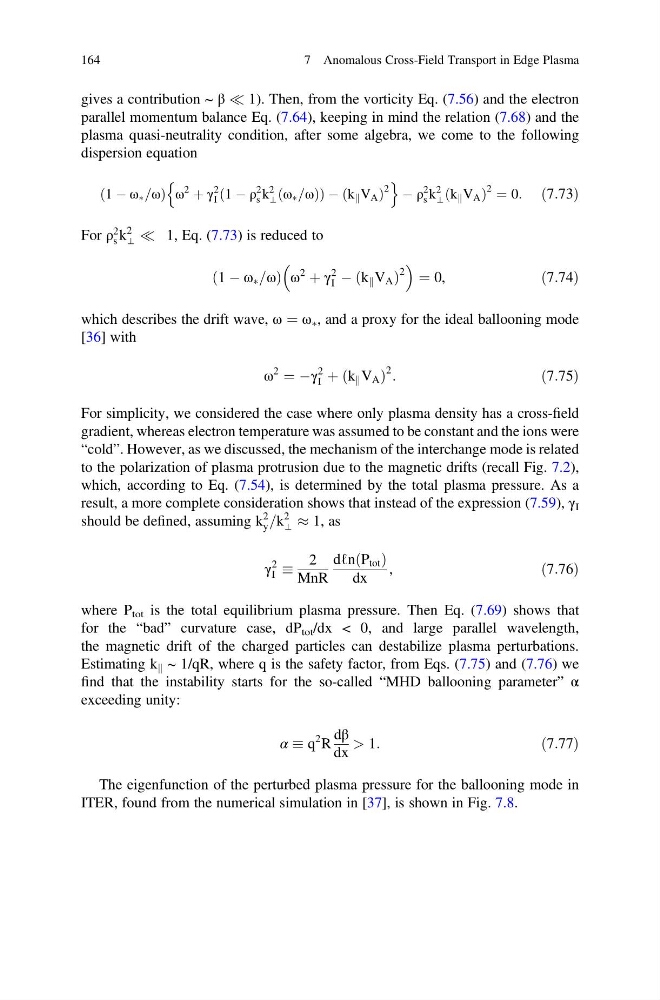
gives a contribution ~ β ( 1). Then, from the vorticity Eq. (7.56) and the electron
parallel momentum balance Eq. (7.64), keeping in mind the relation (7.68) and the
plasma quasi-neutrality condition, after some algebra, we come to the following
dispersion equation
ð1 À ω Ã =ωÞ
n
ω
2
þ γ
2
I ð1 À ρ
2
s k
2
⊥ ðω Ã =ωÞÞ À ðk k V A Þ
2
o
À ρ
2
s k
2
⊥ ðk k V A Þ
2 ¼ 0: ð7:73Þ
For ρ
2
s k
2
⊥ ( 1, Eq. (7.73) is reduced to
ð1 À ω Ã =ωÞ
ω
2
þ γ
2
I À ðk k V A Þ
2
¼ 0,
ð7:74Þ
which describes the drift wave, ω ¼ ω Ã , and a proxy for the ideal ballooning mode
[36] with
ω
2
¼ Àγ
2
I þ ðk k V A Þ
2 :
ð7:75Þ
For simplicity, we considered the case where only plasma density has a cross-field
gradient, whereas electron temperature was assumed to be constant and the ions were
“cold”. However, as we discussed, the mechanism of the interchange mode is related
to the polarization of plasma protrusion due to the magnetic drifts (recall Fig. 7.2),
which, according to Eq. (7.54), is determined by the total plasma pressure. As a
result, a more complete consideration shows that instead of the expression (7.59), γ I
should be defined, assuming k
2
y =k
2
⊥ % 1, as
γ
2
I
2
MnR
dℓn P tot
ð Þ
dx
,
ð7:76Þ
where P tot is the total equilibrium plasma pressure. Then Eq. (7.69) shows that
for the “bad” curvature case, dP tot /dx < 0, and large parallel wavelength,
the magnetic drift of the charged particles can destabilize plasma perturbations.
Estimating k k ~ 1/qR, where q is the safety factor, from Eqs. (7.75) and (7.76) we
find that the instability starts for the so-called “MHD ballooning parameter” α
exceeding unity:
α q
2 R
dβ
dx
> 1:
ð7:77Þ
The eigenfunction of the perturbed plasma pressure for the ballooning mode in
ITER, found from the numerical simulation in [37], is shown in Fig. 7.8.
164
7 Anomalous Cross-Field Transport in Edge Plasma
parallel momentum balance Eq. (7.64), keeping in mind the relation (7.68) and the
plasma quasi-neutrality condition, after some algebra, we come to the following
dispersion equation
ð1 À ω Ã =ωÞ
n
ω
2
þ γ
2
I ð1 À ρ
2
s k
2
⊥ ðω Ã =ωÞÞ À ðk k V A Þ
2
o
À ρ
2
s k
2
⊥ ðk k V A Þ
2 ¼ 0: ð7:73Þ
For ρ
2
s k
2
⊥ ( 1, Eq. (7.73) is reduced to
ð1 À ω Ã =ωÞ
ω
2
þ γ
2
I À ðk k V A Þ
2
¼ 0,
ð7:74Þ
which describes the drift wave, ω ¼ ω Ã , and a proxy for the ideal ballooning mode
[36] with
ω
2
¼ Àγ
2
I þ ðk k V A Þ
2 :
ð7:75Þ
For simplicity, we considered the case where only plasma density has a cross-field
gradient, whereas electron temperature was assumed to be constant and the ions were
“cold”. However, as we discussed, the mechanism of the interchange mode is related
to the polarization of plasma protrusion due to the magnetic drifts (recall Fig. 7.2),
which, according to Eq. (7.54), is determined by the total plasma pressure. As a
result, a more complete consideration shows that instead of the expression (7.59), γ I
should be defined, assuming k
2
y =k
2
⊥ % 1, as
γ
2
I
2
MnR
dℓn P tot
ð Þ
dx
,
ð7:76Þ
where P tot is the total equilibrium plasma pressure. Then Eq. (7.69) shows that
for the “bad” curvature case, dP tot /dx < 0, and large parallel wavelength,
the magnetic drift of the charged particles can destabilize plasma perturbations.
Estimating k k ~ 1/qR, where q is the safety factor, from Eqs. (7.75) and (7.76) we
find that the instability starts for the so-called “MHD ballooning parameter” α
exceeding unity:
α q
2 R
dβ
dx
> 1:
ð7:77Þ
The eigenfunction of the perturbed plasma pressure for the ballooning mode in
ITER, found from the numerical simulation in [37], is shown in Fig. 7.8.
164
7 Anomalous Cross-Field Transport in Edge Plasma