

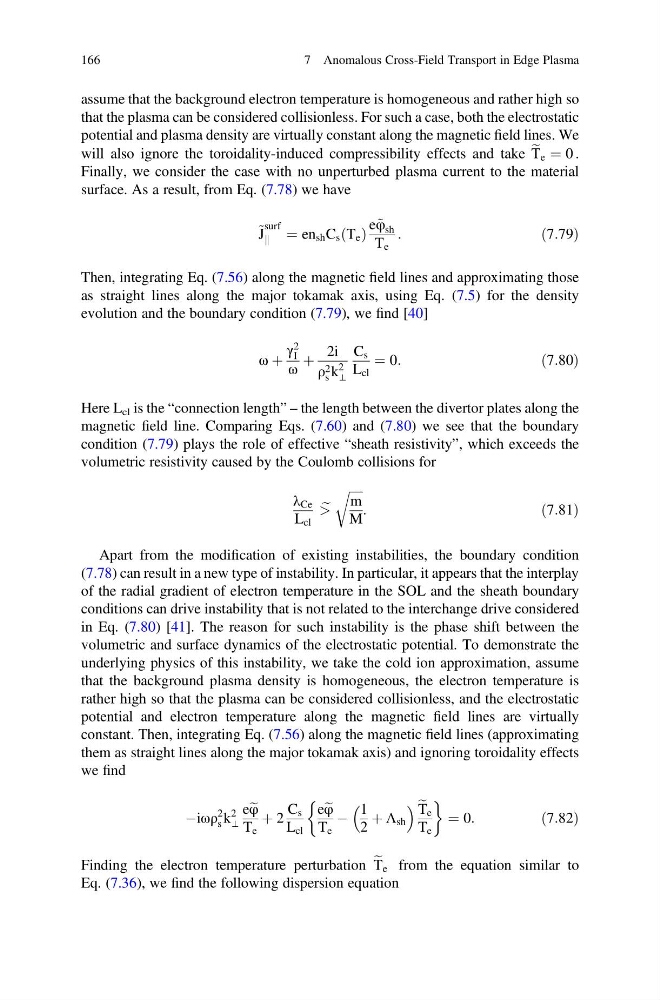
assume that the background electron temperature is homogeneous and rather high so
that the plasma can be considered collisionless. For such a case, both the electrostatic
potential and plasma density are virtually constant along the magnetic field lines. We
will also ignore the toroidality-induced compressibility effects and take e
T e ¼ 0 .
Finally, we consider the case with no unperturbed plasma current to the material
surface. As a result, from Eq. (7.78) we have
~ J
surf
k
¼ en sh C s ðT e Þ
e~ φ sh
T e
:
ð7:79Þ
Then, integrating Eq. (7.56) along the magnetic field lines and approximating those
as straight lines along the major tokamak axis, using Eq. (7.5) for the density
evolution and the boundary condition (7.79), we find [40]
ω þ
γ
2
I
ω
þ
2i
ρ 2
s k
2
⊥
C s
L cl
¼ 0:
ð7:80Þ
Here L cl is the “connection length” – the length between the divertor plates along the
magnetic field line. Comparing Eqs. (7.60) and (7.80) we see that the boundary
condition (7.79) plays the role of effective “sheath resistivity”, which exceeds the
volumetric resistivity caused by the Coulomb collisions for
λ Ce
L cl
e
>
ffiffiffiffi ffi
m
M
r
:
ð7:81Þ
Apart from the modification of existing instabilities, the boundary condition
(7.78) can result in a new type of instability. In particular, it appears that the interplay
of the radial gradient of electron temperature in the SOL and the sheath boundary
conditions can drive instability that is not related to the interchange drive considered
in Eq. (7.80) [41]. The reason for such instability is the phase shift between the
volumetric and surface dynamics of the electrostatic potential. To demonstrate the
underlying physics of this instability, we take the cold ion approximation, assume
that the background plasma density is homogeneous, the electron temperature is
rather high so that the plasma can be considered collisionless, and the electrostatic
potential and electron temperature along the magnetic field lines are virtually
constant. Then, integrating Eq. (7.56) along the magnetic field lines (approximating
them as straight lines along the major tokamak axis) and ignoring toroidality effects
we find
Àiωρ
2
s k
2
⊥
ee φ
T e
þ 2
C s
L cl
ee φ
T e
À
1
2
þ Λ sh
e
T e
T e
&
'
¼ 0:
ð7:82Þ
Finding the electron temperature perturbation e
T e from the equation similar to
Eq. (7.36), we find the following dispersion equation
166
7 Anomalous Cross-Field Transport in Edge Plasma
that the plasma can be considered collisionless. For such a case, both the electrostatic
potential and plasma density are virtually constant along the magnetic field lines. We
will also ignore the toroidality-induced compressibility effects and take e
T e ¼ 0 .
Finally, we consider the case with no unperturbed plasma current to the material
surface. As a result, from Eq. (7.78) we have
~ J
surf
k
¼ en sh C s ðT e Þ
e~ φ sh
T e
:
ð7:79Þ
Then, integrating Eq. (7.56) along the magnetic field lines and approximating those
as straight lines along the major tokamak axis, using Eq. (7.5) for the density
evolution and the boundary condition (7.79), we find [40]
ω þ
γ
2
I
ω
þ
2i
ρ 2
s k
2
⊥
C s
L cl
¼ 0:
ð7:80Þ
Here L cl is the “connection length” – the length between the divertor plates along the
magnetic field line. Comparing Eqs. (7.60) and (7.80) we see that the boundary
condition (7.79) plays the role of effective “sheath resistivity”, which exceeds the
volumetric resistivity caused by the Coulomb collisions for
λ Ce
L cl
e
>
ffiffiffiffi ffi
m
M
r
:
ð7:81Þ
Apart from the modification of existing instabilities, the boundary condition
(7.78) can result in a new type of instability. In particular, it appears that the interplay
of the radial gradient of electron temperature in the SOL and the sheath boundary
conditions can drive instability that is not related to the interchange drive considered
in Eq. (7.80) [41]. The reason for such instability is the phase shift between the
volumetric and surface dynamics of the electrostatic potential. To demonstrate the
underlying physics of this instability, we take the cold ion approximation, assume
that the background plasma density is homogeneous, the electron temperature is
rather high so that the plasma can be considered collisionless, and the electrostatic
potential and electron temperature along the magnetic field lines are virtually
constant. Then, integrating Eq. (7.56) along the magnetic field lines (approximating
them as straight lines along the major tokamak axis) and ignoring toroidality effects
we find
Àiωρ
2
s k
2
⊥
ee φ
T e
þ 2
C s
L cl
ee φ
T e
À
1
2
þ Λ sh
e
T e
T e
&
'
¼ 0:
ð7:82Þ
Finding the electron temperature perturbation e
T e from the equation similar to
Eq. (7.36), we find the following dispersion equation
166
7 Anomalous Cross-Field Transport in Edge Plasma