

~ n e
n
¼ ~
ɸ
&
1 þ i
ω À ω Ã
ν k
1 þ
1 þ α T
κ
'
:
ð7:31Þ
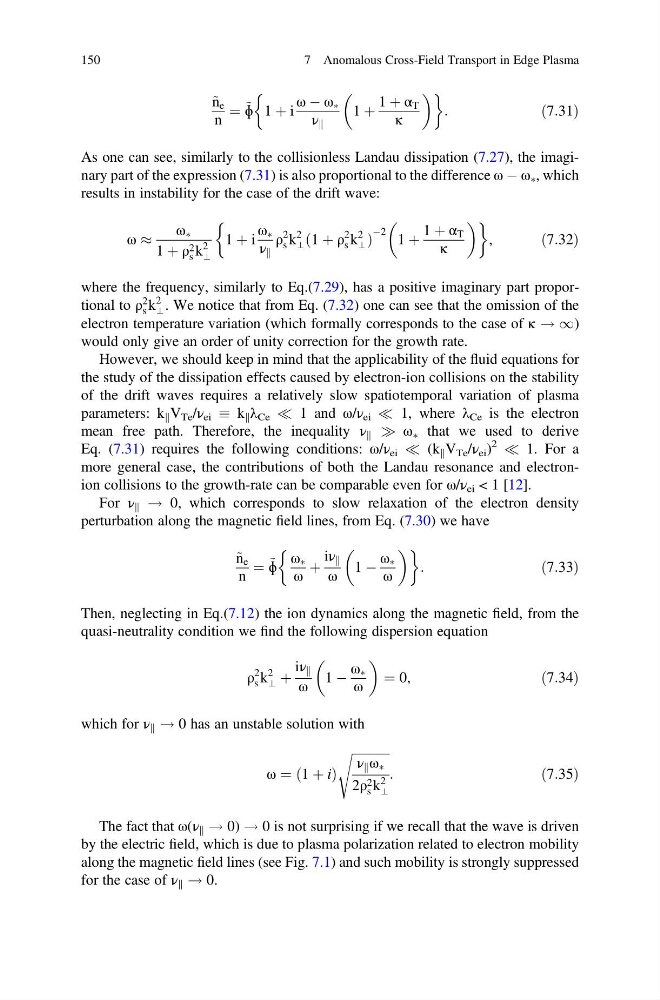
As one can see, similarly to the collisionless Landau dissipation (7.27), the imaginary part of the expression (7.31) is also proportional to the difference ω À ω Ã , which
results in instability for the case of the drift wave:
ω %
ω Ã
1 þ ρ 2
s k
2
⊥
&
1 þ i
ω Ã
ν k
ρ
2
s k
2
⊥ ð1 þ ρ
2
s k
2
⊥ Þ
À2
1 þ
1 þ α T
κ
'
,
ð7:32Þ
where the frequency, similarly to Eq.(7.29), has a positive imaginary part proportional to ρ
2
s k
2
⊥ . We notice that from Eq. (7.32) one can see that the omission of the
electron temperature variation (which formally corresponds to the case of κ ! 1)
would only give an order of unity correction for the growth rate.
However, we should keep in mind that the applicability of the fluid equations for
the study of the dissipation effects caused by electron-ion collisions on the stability
of the drift waves requires a relatively slow spatiotemporal variation of plasma
parameters: k k V Te /ν ei k k λ Ce ( 1 and ω/ν ei ( 1, where λ Ce is the electron
mean free path. Therefore, the inequality ν k ) ω Ã that we used to derive
Eq. (7.31) requires the following conditions: ω/ν ei ( (k k V Te /ν ei )
2
( 1. For a
more general case, the contributions of both the Landau resonance and electronion collisions to the growth-rate can be comparable even for ω/ν ei < 1 [12].
For ν k ! 0, which corresponds to slow relaxation of the electron density
perturbation along the magnetic field lines, from Eq. (7.30) we have
~ n e
n
¼ ~
ɸ
& ω Ã
ω
þ
iν k
ω
1 À
ω Ã
ω
'
:
ð7:33Þ
Then, neglecting in Eq.(7.12) the ion dynamics along the magnetic field, from the
quasi-neutrality condition we find the following dispersion equation
ρ
2
s k
2
⊥ þ
iν k
ω
1 À
ω Ã
ω
¼ 0,
ð7:34Þ
which for ν k ! 0 has an unstable solution with
ω ¼ ð1 þ iÞ
ffiffiffiffiffiffiffiffiffiffiffiffi
ν k ω Ã
2ρ 2
s k
2
⊥
s
:
ð7:35Þ
The fact that ω(ν k ! 0) ! 0 is not surprising if we recall that the wave is driven
by the electric field, which is due to plasma polarization related to electron mobility
along the magnetic field lines (see Fig. 7.1) and such mobility is strongly suppressed
for the case of ν k ! 0.
150
7 Anomalous Cross-Field Transport in Edge Plasma
n
¼ ~
ɸ
&
1 þ i
ω À ω Ã
ν k
1 þ
1 þ α T
κ
'
:
ð7:31Þ
As one can see, similarly to the collisionless Landau dissipation (7.27), the imaginary part of the expression (7.31) is also proportional to the difference ω À ω Ã , which
results in instability for the case of the drift wave:
ω %
ω Ã
1 þ ρ 2
s k
2
⊥
&
1 þ i
ω Ã
ν k
ρ
2
s k
2
⊥ ð1 þ ρ
2
s k
2
⊥ Þ
À2
1 þ
1 þ α T
κ
'
,
ð7:32Þ
where the frequency, similarly to Eq.(7.29), has a positive imaginary part proportional to ρ
2
s k
2
⊥ . We notice that from Eq. (7.32) one can see that the omission of the
electron temperature variation (which formally corresponds to the case of κ ! 1)
would only give an order of unity correction for the growth rate.
However, we should keep in mind that the applicability of the fluid equations for
the study of the dissipation effects caused by electron-ion collisions on the stability
of the drift waves requires a relatively slow spatiotemporal variation of plasma
parameters: k k V Te /ν ei k k λ Ce ( 1 and ω/ν ei ( 1, where λ Ce is the electron
mean free path. Therefore, the inequality ν k ) ω Ã that we used to derive
Eq. (7.31) requires the following conditions: ω/ν ei ( (k k V Te /ν ei )
2
( 1. For a
more general case, the contributions of both the Landau resonance and electronion collisions to the growth-rate can be comparable even for ω/ν ei < 1 [12].
For ν k ! 0, which corresponds to slow relaxation of the electron density
perturbation along the magnetic field lines, from Eq. (7.30) we have
~ n e
n
¼ ~
ɸ
& ω Ã
ω
þ
iν k
ω
1 À
ω Ã
ω
'
:
ð7:33Þ
Then, neglecting in Eq.(7.12) the ion dynamics along the magnetic field, from the
quasi-neutrality condition we find the following dispersion equation
ρ
2
s k
2
⊥ þ
iν k
ω
1 À
ω Ã
ω
¼ 0,
ð7:34Þ
which for ν k ! 0 has an unstable solution with
ω ¼ ð1 þ iÞ
ffiffiffiffiffiffiffiffiffiffiffiffi
ν k ω Ã
2ρ 2
s k
2
⊥
s
:
ð7:35Þ
The fact that ω(ν k ! 0) ! 0 is not surprising if we recall that the wave is driven
by the electric field, which is due to plasma polarization related to electron mobility
along the magnetic field lines (see Fig. 7.1) and such mobility is strongly suppressed
for the case of ν k ! 0.
150
7 Anomalous Cross-Field Transport in Edge Plasma