

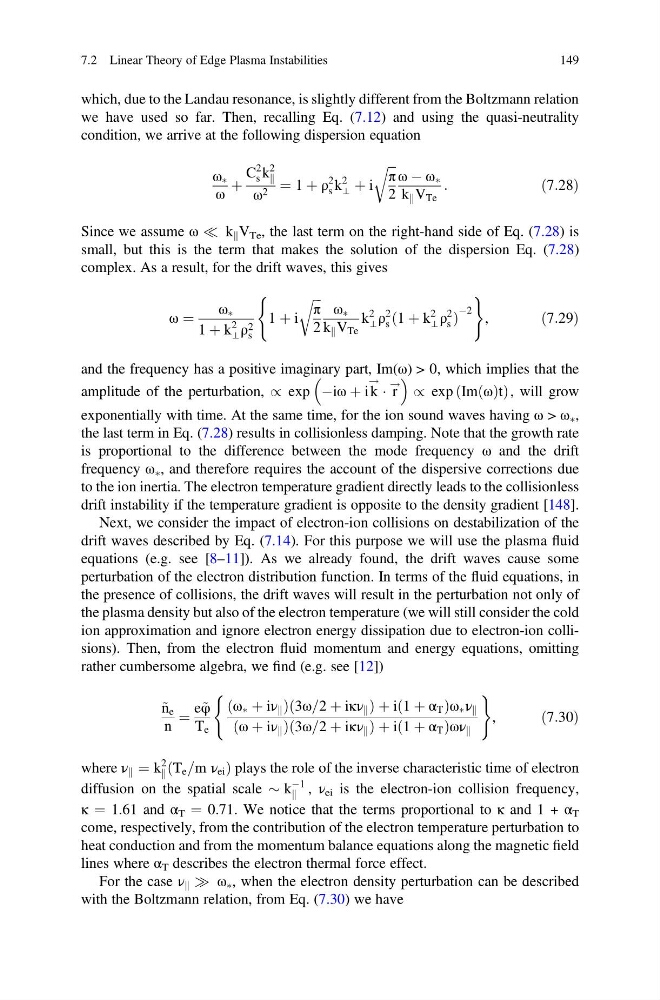
which, due to the Landau resonance, is slightly different from the Boltzmann relation
we have used so far. Then, recalling Eq. (7.12) and using the quasi-neutrality
condition, we arrive at the following dispersion equation
ω Ã
ω
þ
C
2
s k
2
k
ω 2 ¼ 1 þ ρ
2
s k
2
⊥ þ i
ffiffi ffi
π
2
r ω À ω Ã
k k V Te
:
ð7:28Þ
Since we assume ω ( k k V Te , the last term on the right-hand side of Eq. (7.28) is
small, but this is the term that makes the solution of the dispersion Eq. (7.28)
complex. As a result, for the drift waves, this gives
ω ¼
ω Ã
1 þ k
2
⊥ ρ 2
s
(
1 þ i
ffiffi ffi
π
2
r ω Ã
k k V Te
k
2
⊥ ρ
2
s ð1 þ k
2
⊥ ρ
2
s Þ
À2
)
,
ð7:29Þ
and the frequency has a positive imaginary part, Im(ω) > 0, which implies that the
amplitude of the perturbation, / exp Àiω þ ik
! Á r
!
/ exp Im ω
ð Þt
ð
Þ, will grow
exponentially with time. At the same time, for the ion sound waves having ω > ω Ã ,
the last term in Eq. (7.28) results in collisionless damping. Note that the growth rate
is proportional to the difference between the mode frequency ω and the drift
frequency ω Ã , and therefore requires the account of the dispersive corrections due
to the ion inertia. The electron temperature gradient directly leads to the collisionless
drift instability if the temperature gradient is opposite to the density gradient [148].
Next, we consider the impact of electron-ion collisions on destabilization of the
drift waves described by Eq. (7.14). For this purpose we will use the plasma fluid
equations (e.g. see [8–11]). As we already found, the drift waves cause some
perturbation of the electron distribution function. In terms of the fluid equations, in
the presence of collisions, the drift waves will result in the perturbation not only of
the plasma density but also of the electron temperature (we will still consider the cold
ion approximation and ignore electron energy dissipation due to electron-ion collisions). Then, from the electron fluid momentum and energy equations, omitting
rather cumbersome algebra, we find (e.g. see [12])
~ n e
n
¼
e~ φ
T e
(
ðω Ã þ iν k Þð3ω=2 þ iκν k Þ þ ið1 þ α T Þω Ã ν k
ðω þ iν k Þð3ω=2 þ iκν k Þ þ ið1 þ α T Þων k
)
,
ð7:30Þ
where ν k ¼ k
2
k ðT e =m ν ei Þ plays the role of the inverse characteristic time of electron
diffusion on the spatial scale $ k
À1
k , ν ei is the electron-ion collision frequency,
κ ¼ 1.61 and α T ¼ 0.71. We notice that the terms proportional to κ and 1 + α T
come, respectively, from the contribution of the electron temperature perturbation to
heat conduction and from the momentum balance equations along the magnetic field
lines where α T describes the electron thermal force effect.
For the case ν k ) ω Ã , when the electron density perturbation can be described
with the Boltzmann relation, from Eq. (7.30) we have
7.2 Linear Theory of Edge Plasma Instabilities
149
we have used so far. Then, recalling Eq. (7.12) and using the quasi-neutrality
condition, we arrive at the following dispersion equation
ω Ã
ω
þ
C
2
s k
2
k
ω 2 ¼ 1 þ ρ
2
s k
2
⊥ þ i
ffiffi ffi
π
2
r ω À ω Ã
k k V Te
:
ð7:28Þ
Since we assume ω ( k k V Te , the last term on the right-hand side of Eq. (7.28) is
small, but this is the term that makes the solution of the dispersion Eq. (7.28)
complex. As a result, for the drift waves, this gives
ω ¼
ω Ã
1 þ k
2
⊥ ρ 2
s
(
1 þ i
ffiffi ffi
π
2
r ω Ã
k k V Te
k
2
⊥ ρ
2
s ð1 þ k
2
⊥ ρ
2
s Þ
À2
)
,
ð7:29Þ
and the frequency has a positive imaginary part, Im(ω) > 0, which implies that the
amplitude of the perturbation, / exp Àiω þ ik
! Á r
!
/ exp Im ω
ð Þt
ð
Þ, will grow
exponentially with time. At the same time, for the ion sound waves having ω > ω Ã ,
the last term in Eq. (7.28) results in collisionless damping. Note that the growth rate
is proportional to the difference between the mode frequency ω and the drift
frequency ω Ã , and therefore requires the account of the dispersive corrections due
to the ion inertia. The electron temperature gradient directly leads to the collisionless
drift instability if the temperature gradient is opposite to the density gradient [148].
Next, we consider the impact of electron-ion collisions on destabilization of the
drift waves described by Eq. (7.14). For this purpose we will use the plasma fluid
equations (e.g. see [8–11]). As we already found, the drift waves cause some
perturbation of the electron distribution function. In terms of the fluid equations, in
the presence of collisions, the drift waves will result in the perturbation not only of
the plasma density but also of the electron temperature (we will still consider the cold
ion approximation and ignore electron energy dissipation due to electron-ion collisions). Then, from the electron fluid momentum and energy equations, omitting
rather cumbersome algebra, we find (e.g. see [12])
~ n e
n
¼
e~ φ
T e
(
ðω Ã þ iν k Þð3ω=2 þ iκν k Þ þ ið1 þ α T Þω Ã ν k
ðω þ iν k Þð3ω=2 þ iκν k Þ þ ið1 þ α T Þων k
)
,
ð7:30Þ
where ν k ¼ k
2
k ðT e =m ν ei Þ plays the role of the inverse characteristic time of electron
diffusion on the spatial scale $ k
À1
k , ν ei is the electron-ion collision frequency,
κ ¼ 1.61 and α T ¼ 0.71. We notice that the terms proportional to κ and 1 + α T
come, respectively, from the contribution of the electron temperature perturbation to
heat conduction and from the momentum balance equations along the magnetic field
lines where α T describes the electron thermal force effect.
For the case ν k ) ω Ã , when the electron density perturbation can be described
with the Boltzmann relation, from Eq. (7.30) we have
7.2 Linear Theory of Edge Plasma Instabilities
149