

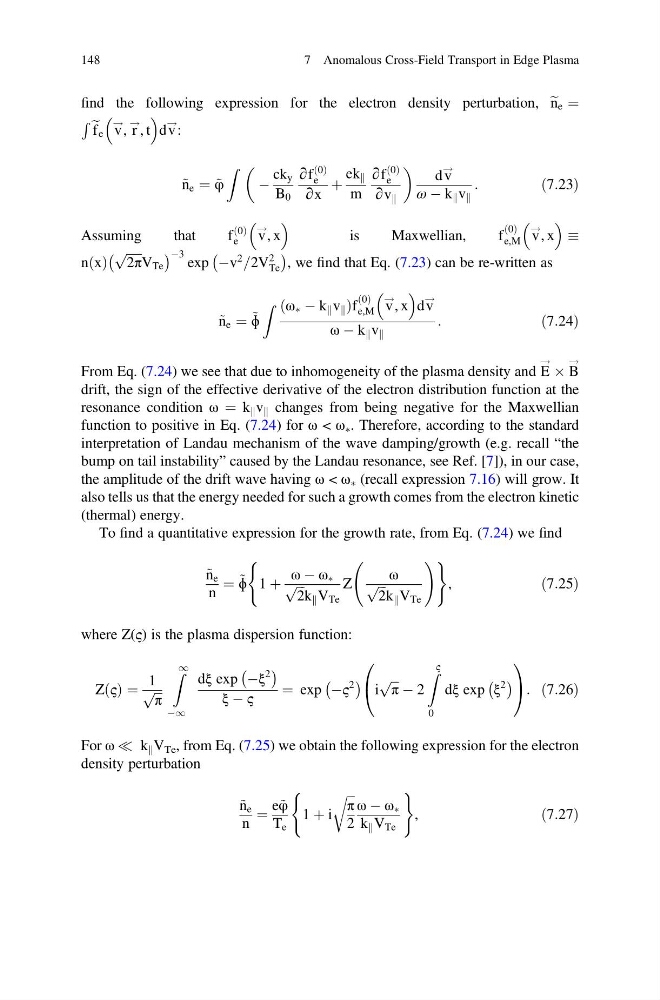
find the following expression for the electron density perturbation, e n e ¼
R e f e v
!
, r
!
, t
dv
!
:
~ n e ¼ ~
φ
Z
À
ck y
B 0
∂f
ð0Þ
e
∂x
þ
ek k
m
∂f
ð0Þ
e
∂v k
dv
!
ω À k k v k
:
ð7:23Þ
Assuming
that
f
0
ð Þ
e
v
!
, x
is
Maxwellian,
f
0
ð Þ
e,M v
! , x
n x
ð Þ
ffiffiffiffiffi
2π
p
V Te
À
Á À3 exp Àv
2
=2V
2
Te
À
Á
, we find that Eq. (7.23) can be re-written as
~ n e ¼ ~
ɸ
Z ðω Ã À k k v k Þf
ð0Þ
e,M
v
!
, x
dv
!
ω À k k v k
:
ð7:24Þ
From Eq. (7.24) we see that due to inhomogeneity of the plasma density and E
! Â B
!
drift, the sign of the effective derivative of the electron distribution function at the
resonance condition ω ¼ k k v k changes from being negative for the Maxwellian
function to positive in Eq. (7.24) for ω < ω Ã . Therefore, according to the standard
interpretation of Landau mechanism of the wave damping/growth (e.g. recall “the
bump on tail instability” caused by the Landau resonance, see Ref. [7]), in our case,
the amplitude of the drift wave having ω < ω Ã (recall expression 7.16) will grow. It
also tells us that the energy needed for such a growth comes from the electron kinetic
(thermal) energy.
To find a quantitative expression for the growth rate, from Eq. (7.24) we find
~ n e
n
¼ ~
ɸ
(
1 þ
ω À ω Ã
ffiffi ffi
2
p
k k V Te
Z
ω
ffiffi ffi
2
p
k k V Te
!)
,
ð7:25Þ
where Z(ς) is the plasma dispersion function:
Z ς
ð Þ ¼
1
ffiffi ffi
π
p
Z 1
À1
dξ exp Àξ
2
À
Á
ξ À ς
¼ exp Àς
2
À
Á
i
ffiffi ffi
π
p À 2
Z ς
0
dξ exp ξ
2
À Á
0
@
1
A : ð7:26Þ
For ω ( k k V Te , from Eq. (7.25) we obtain the following expression for the electron
density perturbation
~ n e
n
¼
e~ φ
T e
(
1 þ i
ffiffi ffi
π
2
r ω À ω Ã
k k V Te
)
,
ð7:27Þ
148
7 Anomalous Cross-Field Transport in Edge Plasma
R e f e v
!
, r
!
, t
dv
!
:
~ n e ¼ ~
φ
Z
À
ck y
B 0
∂f
ð0Þ
e
∂x
þ
ek k
m
∂f
ð0Þ
e
∂v k
dv
!
ω À k k v k
:
ð7:23Þ
Assuming
that
f
0
ð Þ
e
v
!
, x
is
Maxwellian,
f
0
ð Þ
e,M v
! , x
n x
ð Þ
ffiffiffiffiffi
2π
p
V Te
À
Á À3 exp Àv
2
=2V
2
Te
À
Á
, we find that Eq. (7.23) can be re-written as
~ n e ¼ ~
ɸ
Z ðω Ã À k k v k Þf
ð0Þ
e,M
v
!
, x
dv
!
ω À k k v k
:
ð7:24Þ
From Eq. (7.24) we see that due to inhomogeneity of the plasma density and E
! Â B
!
drift, the sign of the effective derivative of the electron distribution function at the
resonance condition ω ¼ k k v k changes from being negative for the Maxwellian
function to positive in Eq. (7.24) for ω < ω Ã . Therefore, according to the standard
interpretation of Landau mechanism of the wave damping/growth (e.g. recall “the
bump on tail instability” caused by the Landau resonance, see Ref. [7]), in our case,
the amplitude of the drift wave having ω < ω Ã (recall expression 7.16) will grow. It
also tells us that the energy needed for such a growth comes from the electron kinetic
(thermal) energy.
To find a quantitative expression for the growth rate, from Eq. (7.24) we find
~ n e
n
¼ ~
ɸ
(
1 þ
ω À ω Ã
ffiffi ffi
2
p
k k V Te
Z
ω
ffiffi ffi
2
p
k k V Te
!)
,
ð7:25Þ
where Z(ς) is the plasma dispersion function:
Z ς
ð Þ ¼
1
ffiffi ffi
π
p
Z 1
À1
dξ exp Àξ
2
À
Á
ξ À ς
¼ exp Àς
2
À
Á
i
ffiffi ffi
π
p À 2
Z ς
0
dξ exp ξ
2
À Á
0
@
1
A : ð7:26Þ
For ω ( k k V Te , from Eq. (7.25) we obtain the following expression for the electron
density perturbation
~ n e
n
¼
e~ φ
T e
(
1 þ i
ffiffi ffi
π
2
r ω À ω Ã
k k V Te
)
,
ð7:27Þ
148
7 Anomalous Cross-Field Transport in Edge Plasma