

The basic features of both the collisionless and collisional drift waves in a
non-tokamak environment were extensively studied in the 1960th–1970th (e.g. see
Ref. [13–17] and the references therein). Due to relatively quiescent and controllable
plasmas in the devices used in those studies (in many cases these were the
Q-machines, with the straight magnetic field lines where the plasma was created
by ionization of cesium or potassium atoms at the surface of a hot plate), a
reasonable agreement was found between the theoretical expectations and the
experimental data for the case of low wave amplitudes, where the linear wave theory
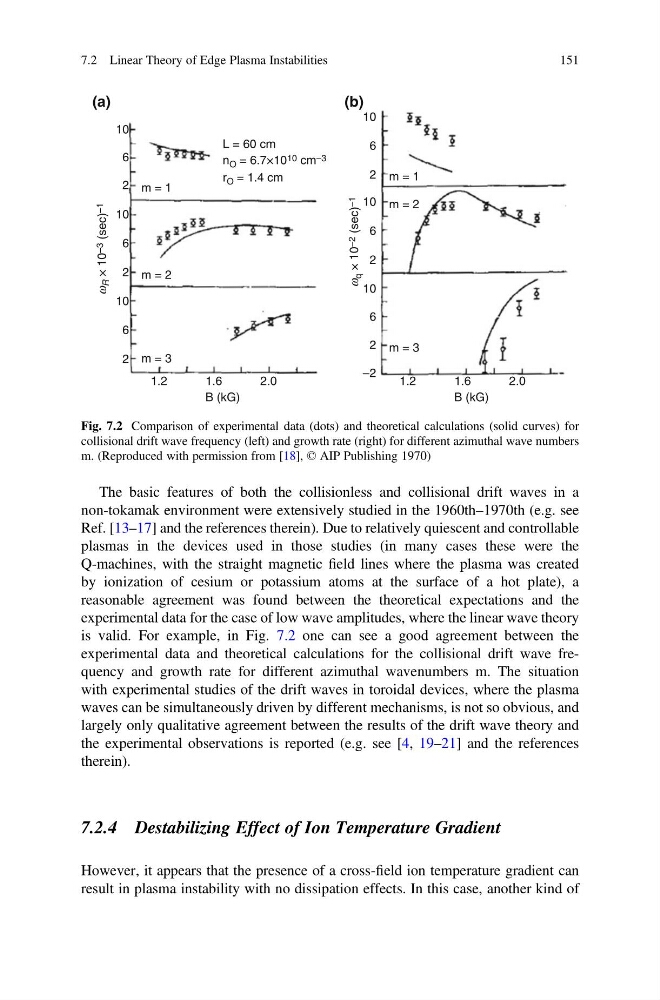
is valid. For example, in Fig. 7.2 one can see a good agreement between the
experimental data and theoretical calculations for the collisional drift wave frequency and growth rate for different azimuthal wavenumbers m. The situation
with experimental studies of the drift waves in toroidal devices, where the plasma
waves can be simultaneously driven by different mechanisms, is not so obvious, and
largely only qualitative agreement between the results of the drift wave theory and
the experimental observations is reported (e.g. see [4, 19–21] and the references
therein).
7.2.4 Destabilizing Effect of Ion Temperature Gradient
However, it appears that the presence of a cross-field ion temperature gradient can
result in plasma instability with no dissipation effects. In this case, another kind of
m = 2
m = 2
m = 1
L = 60 cm
n O = 6.7×10 10 cm –3
r O = 1.4 cm
w
R × 10 –3
(sec) –1
w
q × 10 –2
(sec) –1
(a)
B (kG)
(b)
m = 1
m = 3
m = 3
1.2
2
6
10
2
6
10
2
6
10
2
–2
6
10
2
6
10
2
6
10
1.6
2.0
B (kG)
1.2
1.6
2.0
Fig. 7.2 Comparison of experimental data (dots) and theoretical calculations (solid curves) for
collisional drift wave frequency (left) and growth rate (right) for different azimuthal wave numbers
m. (Reproduced with permission from [18], © AIP Publishing 1970)
7.2 Linear Theory of Edge Plasma Instabilities
151
non-tokamak environment were extensively studied in the 1960th–1970th (e.g. see
Ref. [13–17] and the references therein). Due to relatively quiescent and controllable
plasmas in the devices used in those studies (in many cases these were the
Q-machines, with the straight magnetic field lines where the plasma was created
by ionization of cesium or potassium atoms at the surface of a hot plate), a
reasonable agreement was found between the theoretical expectations and the
experimental data for the case of low wave amplitudes, where the linear wave theory
is valid. For example, in Fig. 7.2 one can see a good agreement between the
experimental data and theoretical calculations for the collisional drift wave frequency and growth rate for different azimuthal wavenumbers m. The situation
with experimental studies of the drift waves in toroidal devices, where the plasma
waves can be simultaneously driven by different mechanisms, is not so obvious, and
largely only qualitative agreement between the results of the drift wave theory and
the experimental observations is reported (e.g. see [4, 19–21] and the references
therein).
7.2.4 Destabilizing Effect of Ion Temperature Gradient
However, it appears that the presence of a cross-field ion temperature gradient can
result in plasma instability with no dissipation effects. In this case, another kind of
m = 2
m = 2
m = 1
L = 60 cm
n O = 6.7×10 10 cm –3
r O = 1.4 cm
w
R × 10 –3
(sec) –1
w
q × 10 –2
(sec) –1
(a)
B (kG)
(b)
m = 1
m = 3
m = 3
1.2
2
6
10
2
6
10
2
6
10
2
–2
6
10
2
6
10
2
6
10
1.6
2.0
B (kG)
1.2
1.6
2.0
Fig. 7.2 Comparison of experimental data (dots) and theoretical calculations (solid curves) for
collisional drift wave frequency (left) and growth rate (right) for different azimuthal wave numbers
m. (Reproduced with permission from [18], © AIP Publishing 1970)
7.2 Linear Theory of Edge Plasma Instabilities
151