

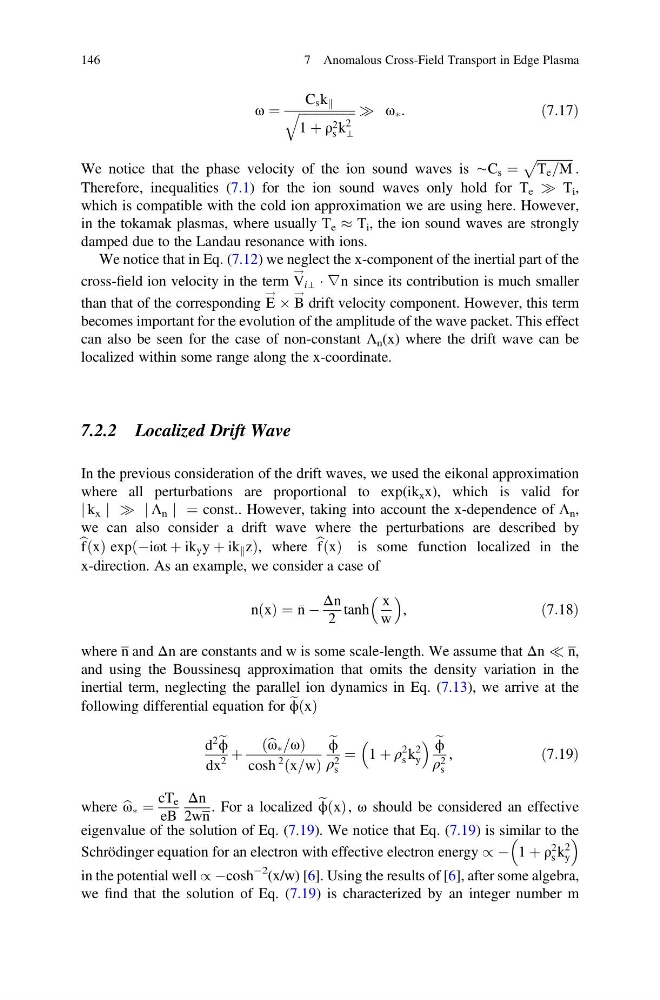
ω ¼
C s k k
ffiffiffiffiffiffiffiffiffiffiffiffiffiffiffiffiffiffi
1 þ ρ 2
s k
2
⊥
q
) ω Ã :
ð7:17Þ
We notice that the phase velocity of the ion sound waves is ∼C s ¼
ffiffiffiffiffiffiffiffiffiffiffi ffi
T e =M
p
.
Therefore, inequalities (7.1) for the ion sound waves only hold for T e ) T i ,
which is compatible with the cold ion approximation we are using here. However,
in the tokamak plasmas, where usually T e % T i , the ion sound waves are strongly
damped due to the Landau resonance with ions.
We notice that in Eq. (7.12) we neglect the x-component of the inertial part of the
cross-field ion velocity in the term V
!
i⊥ Á ∇n since its contribution is much smaller
than that of the corresponding E
! Â B
!
drift velocity component. However, this term
becomes important for the evolution of the amplitude of the wave packet. This effect
can also be seen for the case of non-constant Λ n (x) where the drift wave can be
localized within some range along the x-coordinate.
7.2.2 Localized Drift Wave
In the previous consideration of the drift waves, we used the eikonal approximation
where all perturbations are proportional to exp(ik x x), which is valid for
j k x j ) j Λ n j ¼ const.. However, taking into account the x-dependence of Λ n ,
we can also consider a drift wave where the perturbations are described by
b fðxÞ expðÀiωt þ ik y y þ ik k zÞ, where b f x
ð Þ is some function localized in the
x-direction. As an example, we consider a case of
nðxÞ ¼ n À
Δn
2
tanh
x
w
,
ð7:18Þ
where n and Δn are constants and w is some scale-length. We assume that Δn ( n,
and using the Boussinesq approximation that omits the density variation in the
inertial term, neglecting the parallel ion dynamics in Eq. (7.13), we arrive at the
following differential equation for e
ϕ x
ð Þ
d
2 e
ϕ
dx
2
þ
b
ω Ã =ω
ð
Þ
cosh
2 x=w
ð
Þ
e
ϕ
ρ 2
s
¼ 1 þ ρ
2
s k
2
y
e
ϕ
ρ 2
s
,
ð7:19Þ
where b
ω Ã ¼
cT e
eB
Δn
2wn
. For a localized e
ϕ x
ð Þ, ω should be considered an effective
eigenvalue of the solution of Eq. (7.19). We notice that Eq. (7.19) is similar to the
Schrödinger equation for an electron with effective electron energy / À 1 þ ρ
2
s k
2
y
in the potential well / Àcosh
À2 (x/w) [6]. Using the results of [6], after some algebra,
we find that the solution of Eq. (7.19) is characterized by an integer number m
146
7 Anomalous Cross-Field Transport in Edge Plasma
C s k k
ffiffiffiffiffiffiffiffiffiffiffiffiffiffiffiffiffiffi
1 þ ρ 2
s k
2
⊥
q
) ω Ã :
ð7:17Þ
We notice that the phase velocity of the ion sound waves is ∼C s ¼
ffiffiffiffiffiffiffiffiffiffiffi ffi
T e =M
p
.
Therefore, inequalities (7.1) for the ion sound waves only hold for T e ) T i ,
which is compatible with the cold ion approximation we are using here. However,
in the tokamak plasmas, where usually T e % T i , the ion sound waves are strongly
damped due to the Landau resonance with ions.
We notice that in Eq. (7.12) we neglect the x-component of the inertial part of the
cross-field ion velocity in the term V
!
i⊥ Á ∇n since its contribution is much smaller
than that of the corresponding E
! Â B
!
drift velocity component. However, this term
becomes important for the evolution of the amplitude of the wave packet. This effect
can also be seen for the case of non-constant Λ n (x) where the drift wave can be
localized within some range along the x-coordinate.
7.2.2 Localized Drift Wave
In the previous consideration of the drift waves, we used the eikonal approximation
where all perturbations are proportional to exp(ik x x), which is valid for
j k x j ) j Λ n j ¼ const.. However, taking into account the x-dependence of Λ n ,
we can also consider a drift wave where the perturbations are described by
b fðxÞ expðÀiωt þ ik y y þ ik k zÞ, where b f x
ð Þ is some function localized in the
x-direction. As an example, we consider a case of
nðxÞ ¼ n À
Δn
2
tanh
x
w
,
ð7:18Þ
where n and Δn are constants and w is some scale-length. We assume that Δn ( n,
and using the Boussinesq approximation that omits the density variation in the
inertial term, neglecting the parallel ion dynamics in Eq. (7.13), we arrive at the
following differential equation for e
ϕ x
ð Þ
d
2 e
ϕ
dx
2
þ
b
ω Ã =ω
ð
Þ
cosh
2 x=w
ð
Þ
e
ϕ
ρ 2
s
¼ 1 þ ρ
2
s k
2
y
e
ϕ
ρ 2
s
,
ð7:19Þ
where b
ω Ã ¼
cT e
eB
Δn
2wn
. For a localized e
ϕ x
ð Þ, ω should be considered an effective
eigenvalue of the solution of Eq. (7.19). We notice that Eq. (7.19) is similar to the
Schrödinger equation for an electron with effective electron energy / À 1 þ ρ
2
s k
2
y
in the potential well / Àcosh
À2 (x/w) [6]. Using the results of [6], after some algebra,
we find that the solution of Eq. (7.19) is characterized by an integer number m
146
7 Anomalous Cross-Field Transport in Edge Plasma