

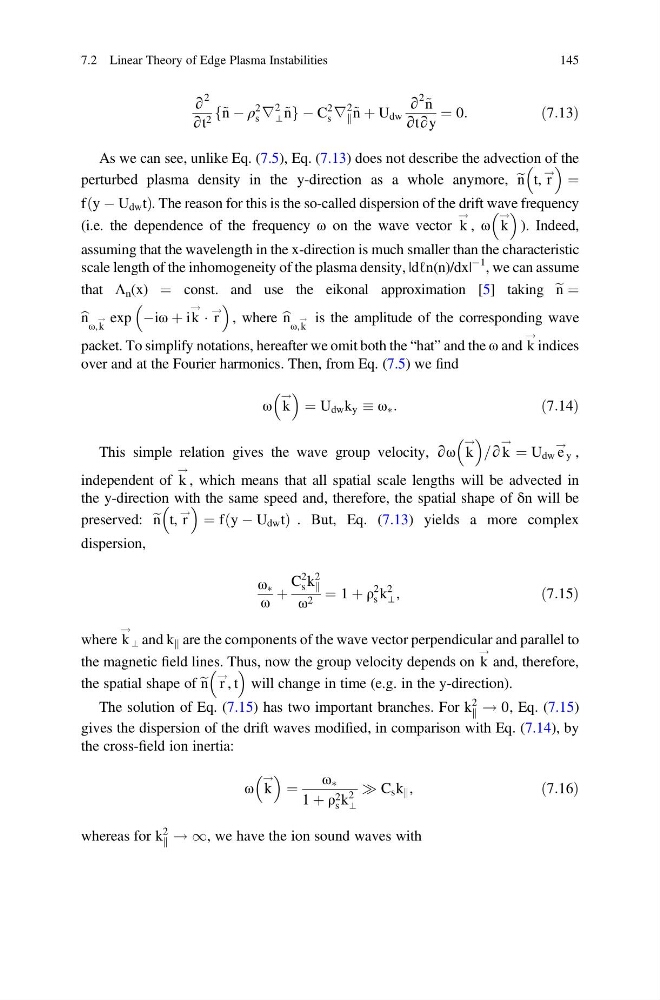
∂
2
∂t 2 f~ n À ρ
2
s ∇
2
⊥ ~ ng À C
2
s ∇
2
k ~ n þ U dw
∂
2 ~ n
∂t∂y
¼ 0:
ð7:13Þ
As we can see, unlike Eq. (7.5), Eq. (7.13) does not describe the advection of the
perturbed plasma density in the y-direction as a whole anymore, e n t, r
!
¼
f y À U dw t
ð
Þ . The reason for this is the so-called dispersion of the drift wave frequency
(i.e. the dependence of the frequency ω on the wave vector k
!
, ω k
!
). Indeed,
assuming that the wavelength in the x-direction is much smaller than the characteristic
scale length of the inhomogeneity of the plasma density, |dℓn(n)/dx|
À1
, we can assume
that Λ n (x) ¼ const. and use the eikonal approximation [5] taking e n ¼
b n ω,k
! exp Àiω þ ik
! Á r
!
, where b n ω,k
! is the amplitude of the corresponding wave
packet. To simplify notations, hereafter we omit both the “hat” and the ω and k
!
indices
over and at the Fourier harmonics. Then, from Eq. (7.5) we find
ω k
!
¼ U dw k y ω Ã :
ð7:14Þ
This simple relation gives the wave group velocity, ∂ω k
!
=∂ k
! ¼ U dw e
!
y ,
independent of k
!
, which means that all spatial scale lengths will be advected in
the y-direction with the same speed and, therefore, the spatial shape of δn will be
preserved: e n t, r
!
¼ f y À U dw t
ð
Þ. But, Eq. (7.13) yields a more complex
dispersion,
ω Ã
ω
þ
C
2
s k
2
k
ω 2 ¼ 1 þ ρ
2
s k
2
⊥ ,
ð7:15Þ
where k
!
⊥ and k k are the components of the wave vector perpendicular and parallel to
the magnetic field lines. Thus, now the group velocity depends on k
!
and, therefore,
the spatial shape of e n r
!
, t
will change in time (e.g. in the y-direction).
The solution of Eq. (7.15) has two important branches. For k
2
k ! 0, Eq. (7.15)
gives the dispersion of the drift waves modified, in comparison with Eq. (7.14), by
the cross-field ion inertia:
ω
k
!
¼
ω Ã
1 þ ρ 2
s k
2
⊥
) C s k k ,
ð7:16Þ
whereas for k
2
k ! 1, we have the ion sound waves with
7.2 Linear Theory of Edge Plasma Instabilities
145
2
∂t 2 f~ n À ρ
2
s ∇
2
⊥ ~ ng À C
2
s ∇
2
k ~ n þ U dw
∂
2 ~ n
∂t∂y
¼ 0:
ð7:13Þ
As we can see, unlike Eq. (7.5), Eq. (7.13) does not describe the advection of the
perturbed plasma density in the y-direction as a whole anymore, e n t, r
!
¼
f y À U dw t
ð
Þ . The reason for this is the so-called dispersion of the drift wave frequency
(i.e. the dependence of the frequency ω on the wave vector k
!
, ω k
!
). Indeed,
assuming that the wavelength in the x-direction is much smaller than the characteristic
scale length of the inhomogeneity of the plasma density, |dℓn(n)/dx|
À1
, we can assume
that Λ n (x) ¼ const. and use the eikonal approximation [5] taking e n ¼
b n ω,k
! exp Àiω þ ik
! Á r
!
, where b n ω,k
! is the amplitude of the corresponding wave
packet. To simplify notations, hereafter we omit both the “hat” and the ω and k
!
indices
over and at the Fourier harmonics. Then, from Eq. (7.5) we find
ω k
!
¼ U dw k y ω Ã :
ð7:14Þ
This simple relation gives the wave group velocity, ∂ω k
!
=∂ k
! ¼ U dw e
!
y ,
independent of k
!
, which means that all spatial scale lengths will be advected in
the y-direction with the same speed and, therefore, the spatial shape of δn will be
preserved: e n t, r
!
¼ f y À U dw t
ð
Þ. But, Eq. (7.13) yields a more complex
dispersion,
ω Ã
ω
þ
C
2
s k
2
k
ω 2 ¼ 1 þ ρ
2
s k
2
⊥ ,
ð7:15Þ
where k
!
⊥ and k k are the components of the wave vector perpendicular and parallel to
the magnetic field lines. Thus, now the group velocity depends on k
!
and, therefore,
the spatial shape of e n r
!
, t
will change in time (e.g. in the y-direction).
The solution of Eq. (7.15) has two important branches. For k
2
k ! 0, Eq. (7.15)
gives the dispersion of the drift waves modified, in comparison with Eq. (7.14), by
the cross-field ion inertia:
ω
k
!
¼
ω Ã
1 þ ρ 2
s k
2
⊥
) C s k k ,
ð7:16Þ
whereas for k
2
k ! 1, we have the ion sound waves with
7.2 Linear Theory of Edge Plasma Instabilities
145