

M
dV
!
i
dt
¼ Àe∇φ þ
eB
c
V
!
i  e
!
z
,
ð7:8Þ
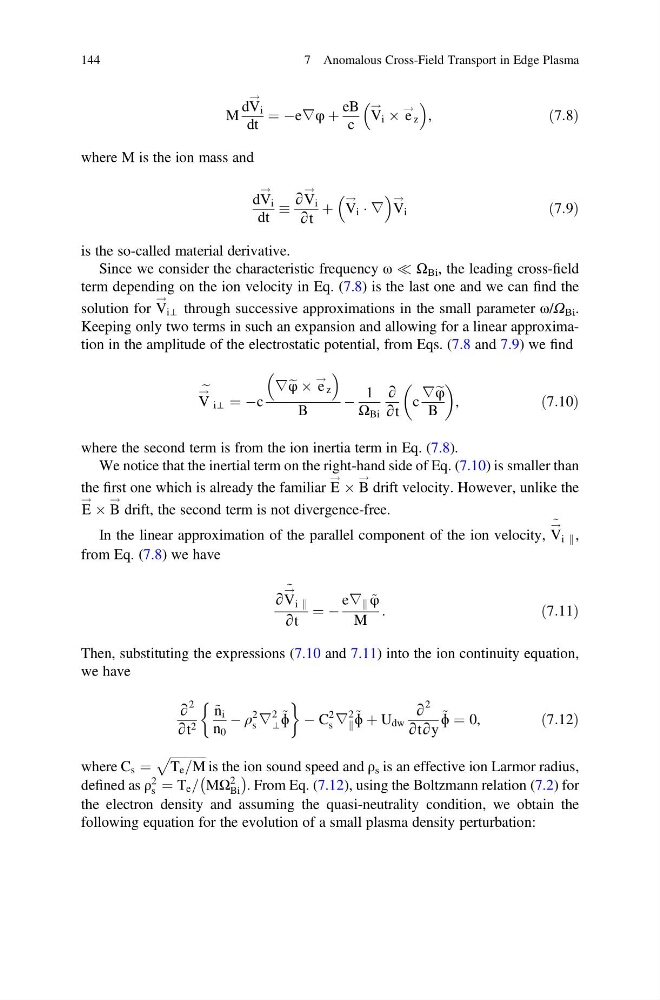
where M is the ion mass and
dV
!
i
dt
∂V
!
i
∂t
þ V
!
i Á ∇
V
!
i
ð7:9Þ
is the so-called material derivative.
Since we consider the characteristic frequency ω ( Ω Bi , the leading cross-field
term depending on the ion velocity in Eq. (7.8) is the last one and we can find the
solution for V
!
i⊥ through successive approximations in the small parameter ω/Ω Bi .
Keeping only two terms in such an expansion and allowing for a linear approximation in the amplitude of the electrostatic potential, from Eqs. (7.8 and 7.9) we find
e
V
!
i⊥ ¼ Àc
∇e φ Â e
!
z
B
À
1
Ω Bi
∂
∂t
c
∇e φ
B
,
ð7:10Þ
where the second term is from the ion inertia term in Eq. (7.8).
We notice that the inertial term on the right-hand side of Eq. (7.10) is smaller than
the first one which is already the familiar E
! Â B
!
drift velocity. However, unlike the
E
! Â B
!
drift, the second term is not divergence-free.
In the linear approximation of the parallel component of the ion velocity,
~
V
!
i k ,
from Eq. (7.8) we have
∂
~
V
!
i k
∂t
¼ À
e∇ k ~
φ
M
:
ð7:11Þ
Then, substituting the expressions (7.10 and 7.11) into the ion continuity equation,
we have
∂
2
∂t 2
& ~ n i
n 0
À ρ
2
s ∇
2
⊥
~
ɸ
'
À C
2
s ∇
2
k
~
ɸ þ U dw
∂
2
∂t∂y
~
ɸ ¼ 0,
ð7:12Þ
where C s ¼
ffiffiffiffiffiffiffiffiffiffiffi ffi
T e =M
p
is the ion sound speed and ρ s is an effective ion Larmor radius,
defined as ρ
2
s ¼ T e = MΩ
2
Bi
À
Á
. From Eq. (7.12), using the Boltzmann relation (7.2) for
the electron density and assuming the quasi-neutrality condition, we obtain the
following equation for the evolution of a small plasma density perturbation:
144
7 Anomalous Cross-Field Transport in Edge Plasma
dV
!
i
dt
¼ Àe∇φ þ
eB
c
V
!
i  e
!
z
,
ð7:8Þ
where M is the ion mass and
dV
!
i
dt
∂V
!
i
∂t
þ V
!
i Á ∇
V
!
i
ð7:9Þ
is the so-called material derivative.
Since we consider the characteristic frequency ω ( Ω Bi , the leading cross-field
term depending on the ion velocity in Eq. (7.8) is the last one and we can find the
solution for V
!
i⊥ through successive approximations in the small parameter ω/Ω Bi .
Keeping only two terms in such an expansion and allowing for a linear approximation in the amplitude of the electrostatic potential, from Eqs. (7.8 and 7.9) we find
e
V
!
i⊥ ¼ Àc
∇e φ Â e
!
z
B
À
1
Ω Bi
∂
∂t
c
∇e φ
B
,
ð7:10Þ
where the second term is from the ion inertia term in Eq. (7.8).
We notice that the inertial term on the right-hand side of Eq. (7.10) is smaller than
the first one which is already the familiar E
! Â B
!
drift velocity. However, unlike the
E
! Â B
!
drift, the second term is not divergence-free.
In the linear approximation of the parallel component of the ion velocity,
~
V
!
i k ,
from Eq. (7.8) we have
∂
~
V
!
i k
∂t
¼ À
e∇ k ~
φ
M
:
ð7:11Þ
Then, substituting the expressions (7.10 and 7.11) into the ion continuity equation,
we have
∂
2
∂t 2
& ~ n i
n 0
À ρ
2
s ∇
2
⊥
~
ɸ
'
À C
2
s ∇
2
k
~
ɸ þ U dw
∂
2
∂t∂y
~
ɸ ¼ 0,
ð7:12Þ
where C s ¼
ffiffiffiffiffiffiffiffiffiffiffi ffi
T e =M
p
is the ion sound speed and ρ s is an effective ion Larmor radius,
defined as ρ
2
s ¼ T e = MΩ
2
Bi
À
Á
. From Eq. (7.12), using the Boltzmann relation (7.2) for
the electron density and assuming the quasi-neutrality condition, we obtain the
following equation for the evolution of a small plasma density perturbation:
144
7 Anomalous Cross-Field Transport in Edge Plasma