

where S iN describes the impact of the plasma-neutral interactions and includes both
the ion-neutral elastic collisions and neutral ionization. The anomalous terms in the
momentum conservation originate from several terms involving averaging of the
plasma density, parallel velocity, and the E
! Â B
!
drift fluctuations, and may also
involve pressure fluctuations, e.g. see Eq. (6.33). Eq. (6.54) includes also the
collisionless first order E
! Â B
!
and diamagnetic fluxes shown in Eq. (6.33).
Overall, turbulent transport is parameterized by anomalous density transport and
anomalous viscosity. The turbulent momentum transport may also involve the pinch
and “residual” terms, which do not depend on the velocity gradients and velocity but
are rather driven by gradients of other plasma parameters.
Alternatively, only the ion momentum balance equation can be considered (see
[10, 11]) although for this case, one should also solve the vorticity equation (6.52) to
find the electrostatic potential.
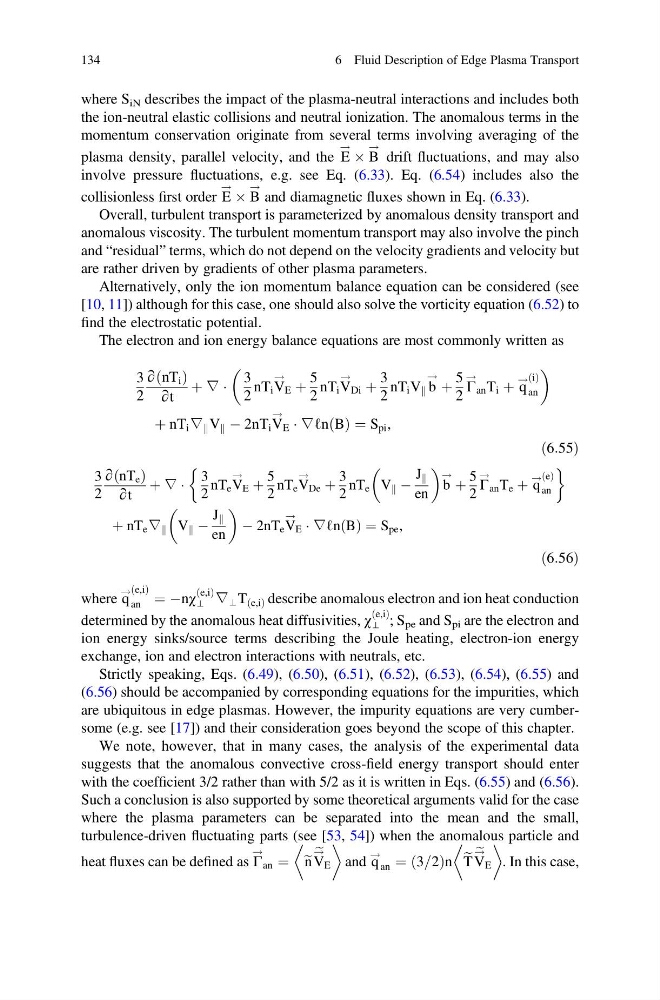
The electron and ion energy balance equations are most commonly written as
3
2
∂ðnT i Þ
∂t
þ ∇ Á
3
2
nT i V
!
E þ
5
2
nT i V
!
Di þ
3
2
nT i V k b
! þ
5
2
Γ
!
an T i þ q
! ðiÞ
an
þ nT i ∇ k V k À 2nT i V
!
E Á ∇ℓnðBÞ ¼ S pi ,
ð6:55Þ
3
2
∂ðnT e Þ
∂t
þ ∇ Á
&
3
2
nT e V
!
E þ
5
2
nT e V
!
De þ
3
2
nT e
V k À
J k
en
b
! þ
5
2
Γ
!
an T e þ q
! ðeÞ
an
'
þ nT e ∇ k
V k À
J k
en
À 2nT e V
!
E Á ∇ℓnðBÞ ¼ S pe ,
ð6:56Þ
where q
! e,i
ð Þ
an ¼ Ànχ
e,i
ð Þ
⊥ ∇ ⊥ T e,i
ð Þ describe anomalous electron and ion heat conduction
determined by the anomalous heat diffusivities, χ
e,i
ð Þ
⊥ ; S pe and S pi are the electron and
ion energy sinks/source terms describing the Joule heating, electron-ion energy
exchange, ion and electron interactions with neutrals, etc.
Strictly speaking, Eqs. (6.49), (6.50), (6.51), (6.52), (6.53), (6.54), (6.55) and
(6.56) should be accompanied by corresponding equations for the impurities, which
are ubiquitous in edge plasmas. However, the impurity equations are very cumbersome (e.g. see [17]) and their consideration goes beyond the scope of this chapter.
We note, however, that in many cases, the analysis of the experimental data
suggests that the anomalous convective cross-field energy transport should enter
with the coefficient 3/2 rather than with 5/2 as it is written in Eqs. (6.55) and (6.56).
Such a conclusion is also supported by some theoretical arguments valid for the case
where the plasma parameters can be separated into the mean and the small,
turbulence-driven fluctuating parts (see [53, 54]) when the anomalous particle and
heat fluxes can be defined as Γ
!
an ¼ e n
e
V
!
E
(
)
and q
!
an ¼ 3=2
ð
Þn e
T
e
V
!
E
(
)
. In this case,
134
6 Fluid Description of Edge Plasma Transport
the ion-neutral elastic collisions and neutral ionization. The anomalous terms in the
momentum conservation originate from several terms involving averaging of the
plasma density, parallel velocity, and the E
! Â B
!
drift fluctuations, and may also
involve pressure fluctuations, e.g. see Eq. (6.33). Eq. (6.54) includes also the
collisionless first order E
! Â B
!
and diamagnetic fluxes shown in Eq. (6.33).
Overall, turbulent transport is parameterized by anomalous density transport and
anomalous viscosity. The turbulent momentum transport may also involve the pinch
and “residual” terms, which do not depend on the velocity gradients and velocity but
are rather driven by gradients of other plasma parameters.
Alternatively, only the ion momentum balance equation can be considered (see
[10, 11]) although for this case, one should also solve the vorticity equation (6.52) to
find the electrostatic potential.
The electron and ion energy balance equations are most commonly written as
3
2
∂ðnT i Þ
∂t
þ ∇ Á
3
2
nT i V
!
E þ
5
2
nT i V
!
Di þ
3
2
nT i V k b
! þ
5
2
Γ
!
an T i þ q
! ðiÞ
an
þ nT i ∇ k V k À 2nT i V
!
E Á ∇ℓnðBÞ ¼ S pi ,
ð6:55Þ
3
2
∂ðnT e Þ
∂t
þ ∇ Á
&
3
2
nT e V
!
E þ
5
2
nT e V
!
De þ
3
2
nT e
V k À
J k
en
b
! þ
5
2
Γ
!
an T e þ q
! ðeÞ
an
'
þ nT e ∇ k
V k À
J k
en
À 2nT e V
!
E Á ∇ℓnðBÞ ¼ S pe ,
ð6:56Þ
where q
! e,i
ð Þ
an ¼ Ànχ
e,i
ð Þ
⊥ ∇ ⊥ T e,i
ð Þ describe anomalous electron and ion heat conduction
determined by the anomalous heat diffusivities, χ
e,i
ð Þ
⊥ ; S pe and S pi are the electron and
ion energy sinks/source terms describing the Joule heating, electron-ion energy
exchange, ion and electron interactions with neutrals, etc.
Strictly speaking, Eqs. (6.49), (6.50), (6.51), (6.52), (6.53), (6.54), (6.55) and
(6.56) should be accompanied by corresponding equations for the impurities, which
are ubiquitous in edge plasmas. However, the impurity equations are very cumbersome (e.g. see [17]) and their consideration goes beyond the scope of this chapter.
We note, however, that in many cases, the analysis of the experimental data
suggests that the anomalous convective cross-field energy transport should enter
with the coefficient 3/2 rather than with 5/2 as it is written in Eqs. (6.55) and (6.56).
Such a conclusion is also supported by some theoretical arguments valid for the case
where the plasma parameters can be separated into the mean and the small,
turbulence-driven fluctuating parts (see [53, 54]) when the anomalous particle and
heat fluxes can be defined as Γ
!
an ¼ e n
e
V
!
E
(
)
and q
!
an ¼ 3=2
ð
Þn e
T
e
V
!
E
(
)
. In this case,
134
6 Fluid Description of Edge Plasma Transport