

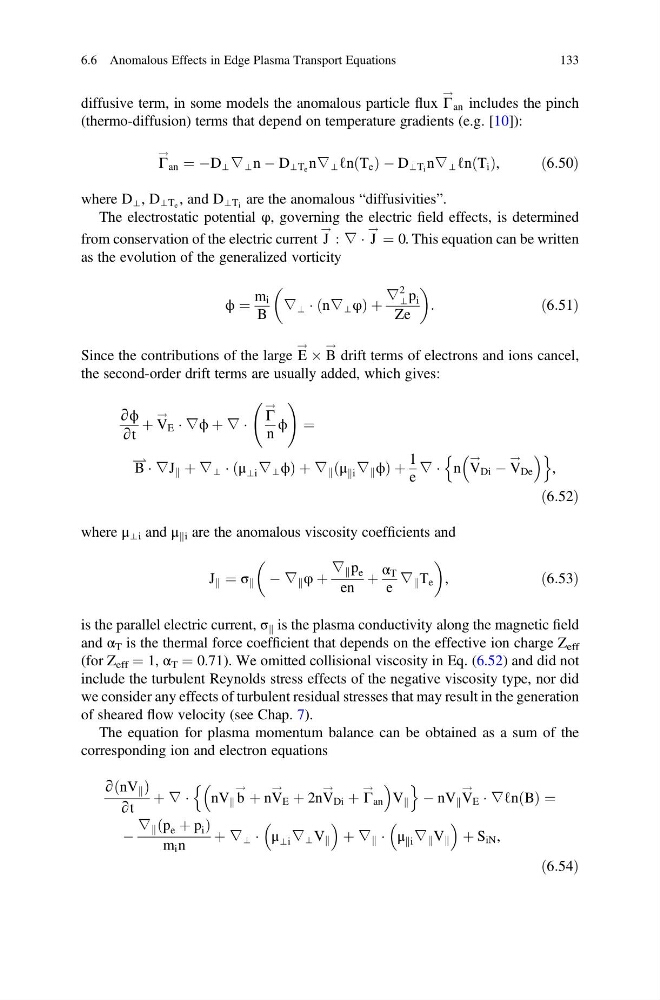
diffusive term, in some models the anomalous particle flux Γ
!
an includes the pinch
(thermo-diffusion) terms that depend on temperature gradients (e.g. [10]):
Γ
!
an ¼ ÀD ⊥ ∇ ⊥ n À D ⊥T e n∇ ⊥ ℓn T e
ð Þ À D ⊥T i n∇ ⊥ ℓn T i
ð Þ,
ð6:50Þ
where D ⊥ , D ⊥T e , and D ⊥T i are the anomalous “diffusivities”.
The electrostatic potential φ, governing the electric field effects, is determined
from conservation of the electric current J
! : ∇ Á J
! ¼ 0. This equation can be written
as the evolution of the generalized vorticity
ϕ ¼
m i
B
∇ ⊥ Á n∇ ⊥ φ
ð
Þþ
∇
2
⊥ p i
Ze
:
ð6:51Þ
Since the contributions of the large E
! Â B
!
drift terms of electrons and ions cancel,
the second-order drift terms are usually added, which gives:
∂ϕ
∂t
þ V
!
E Á ∇ϕ þ ∇ Á
Γ
!
n
ϕ
!
¼
*
B Á ∇J k þ ∇ ⊥ Á ðμ ⊥i ∇ ⊥ ϕÞ þ ∇ k ðμ ki ∇ k ϕÞ þ
1
e
∇ Á
n
n
V
!
Di À V
!
De
o
,
ð6:52Þ
where μ ⊥i and μ ki are the anomalous viscosity coefficients and
J k ¼ σ k
À ∇ k φ þ
∇ k p e
en
þ
α T
e
∇ k T e
,
ð6:53Þ
is the parallel electric current, σ k is the plasma conductivity along the magnetic field
and α T is the thermal force coefficient that depends on the effective ion charge Z eff
(for Z eff ¼ 1, α T ¼ 0.71). We omitted collisional viscosity in Eq. (6.52) and did not
include the turbulent Reynolds stress effects of the negative viscosity type, nor did
we consider any effects of turbulent residual stresses that may result in the generation
of sheared flow velocity (see Chap. 7).
The equation for plasma momentum balance can be obtained as a sum of the
corresponding ion and electron equations
∂ðnV k Þ
∂t
þ ∇ Á
n
nV k b
! þ nV
!
E þ 2nV
!
Di þ Γ
!
an
V k
o
À nV k V
!
E Á ∇ℓnðBÞ ¼
À
∇ k ðp e þ p i Þ
m i n
þ ∇ ⊥ Á
μ ⊥i ∇ ⊥ V k
þ ∇ k Á
μ ki ∇ k V k
þ S iN ,
ð6:54Þ
6.6 Anomalous Effects in Edge Plasma Transport Equations
133
!
an includes the pinch
(thermo-diffusion) terms that depend on temperature gradients (e.g. [10]):
Γ
!
an ¼ ÀD ⊥ ∇ ⊥ n À D ⊥T e n∇ ⊥ ℓn T e
ð Þ À D ⊥T i n∇ ⊥ ℓn T i
ð Þ,
ð6:50Þ
where D ⊥ , D ⊥T e , and D ⊥T i are the anomalous “diffusivities”.
The electrostatic potential φ, governing the electric field effects, is determined
from conservation of the electric current J
! : ∇ Á J
! ¼ 0. This equation can be written
as the evolution of the generalized vorticity
ϕ ¼
m i
B
∇ ⊥ Á n∇ ⊥ φ
ð
Þþ
∇
2
⊥ p i
Ze
:
ð6:51Þ
Since the contributions of the large E
! Â B
!
drift terms of electrons and ions cancel,
the second-order drift terms are usually added, which gives:
∂ϕ
∂t
þ V
!
E Á ∇ϕ þ ∇ Á
Γ
!
n
ϕ
!
¼
*
B Á ∇J k þ ∇ ⊥ Á ðμ ⊥i ∇ ⊥ ϕÞ þ ∇ k ðμ ki ∇ k ϕÞ þ
1
e
∇ Á
n
n
V
!
Di À V
!
De
o
,
ð6:52Þ
where μ ⊥i and μ ki are the anomalous viscosity coefficients and
J k ¼ σ k
À ∇ k φ þ
∇ k p e
en
þ
α T
e
∇ k T e
,
ð6:53Þ
is the parallel electric current, σ k is the plasma conductivity along the magnetic field
and α T is the thermal force coefficient that depends on the effective ion charge Z eff
(for Z eff ¼ 1, α T ¼ 0.71). We omitted collisional viscosity in Eq. (6.52) and did not
include the turbulent Reynolds stress effects of the negative viscosity type, nor did
we consider any effects of turbulent residual stresses that may result in the generation
of sheared flow velocity (see Chap. 7).
The equation for plasma momentum balance can be obtained as a sum of the
corresponding ion and electron equations
∂ðnV k Þ
∂t
þ ∇ Á
n
nV k b
! þ nV
!
E þ 2nV
!
Di þ Γ
!
an
V k
o
À nV k V
!
E Á ∇ℓnðBÞ ¼
À
∇ k ðp e þ p i Þ
m i n
þ ∇ ⊥ Á
μ ⊥i ∇ ⊥ V k
þ ∇ k Á
μ ki ∇ k V k
þ S iN ,
ð6:54Þ
6.6 Anomalous Effects in Edge Plasma Transport Equations
133