

divertor plasma to sub-eV temperature, promoting plasma recombination effects
important in the divertor plasma detachment process (see Chap.9).
To avoid the unphysical contribution of neutrals in the edge plasma regions where
λ CX e
> L i , the neutral diffusive fluxes are majorized by corresponding free-streaming
expressions similar to Eq. (6.42). Unfortunately, fluid description of the hydrogen
molecules, which have a mean free path for the collisions with hydrogen ions much
longer than that of the hydrogen atoms, strictly speaking, cannot be used for the
plasma parameters of interest. In addition, vibrational excitation of molecules can
play an important role in both plasma energy dissipation at low (~1 eV) temperatures
and in plasma recombination processes (see Chap. 2). The incorporation of vibrational excitation of molecules in fluid models would significantly complicate them.
6.6 Anomalous Effects in Edge Plasma Transport
Equations
Here we overview the basic structure of the transport equations used in edge plasma
simulations. We should note that existing formulations of the transport equations
often differ in various details and effects included (e.g. see [10–12]). Here we only
describe the most essential elements and comment on various additional effects.
Technically, either electron or ion continuity equations can be used to describe the
evolution of the plasma density. Most often, the ion continuity equation is used.
Keeping only the first-order terms in the ion velocity and adding an ad hoc
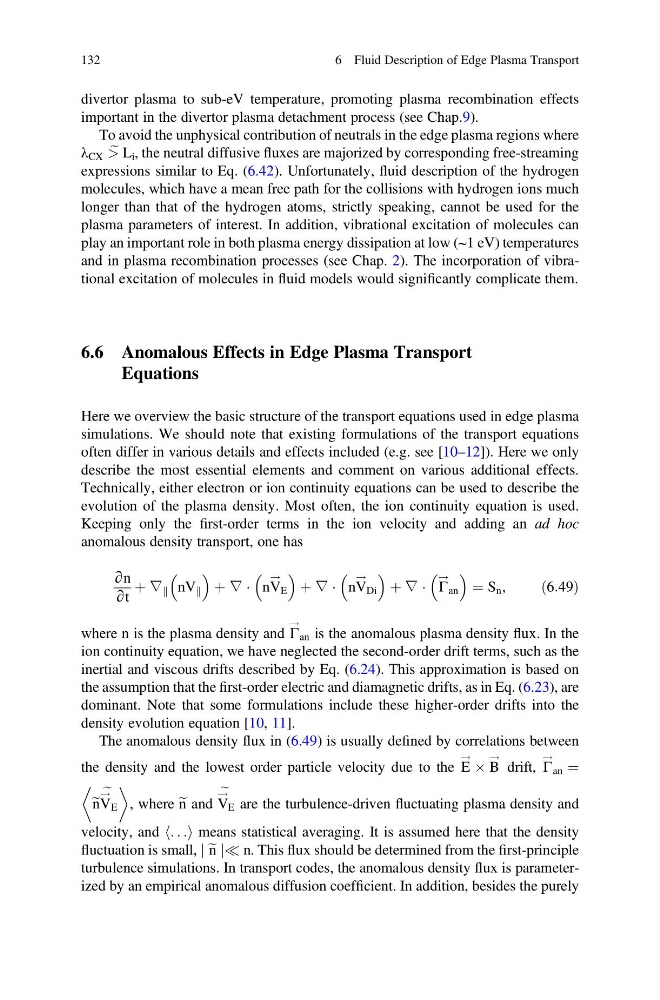
anomalous density transport, one has
∂n
∂t
þ ∇ k
nV k
þ ∇ Á
nV
!
E
þ ∇ Á
nV
!
Di
þ ∇ Á
Γ
!
an
¼ S n ,
ð6:49Þ
where n is the plasma density and Γ
!
an is the anomalous plasma density flux. In the
ion continuity equation, we have neglected the second-order drift terms, such as the
inertial and viscous drifts described by Eq. (6.24). This approximation is based on
the assumption that the first-order electric and diamagnetic drifts, as in Eq. (6.23), are
dominant. Note that some formulations include these higher-order drifts into the
density evolution equation [10, 11].
The anomalous density flux in (6.49) is usually defined by correlations between
the density and the lowest order particle velocity due to the E
! Â B
!
drift, Γ
!
an ¼
e n
e
V
!
E
(
)
, where e n and
e
V
!
E are the turbulence-driven fluctuating plasma density and
velocity, and h. . .i means statistical averaging. It is assumed here that the density
fluctuation is small, j e n j( n. This flux should be determined from the first-principle
turbulence simulations. In transport codes, the anomalous density flux is parameterized by an empirical anomalous diffusion coefficient. In addition, besides the purely
132
6 Fluid Description of Edge Plasma Transport
important in the divertor plasma detachment process (see Chap.9).
To avoid the unphysical contribution of neutrals in the edge plasma regions where
λ CX e
> L i , the neutral diffusive fluxes are majorized by corresponding free-streaming
expressions similar to Eq. (6.42). Unfortunately, fluid description of the hydrogen
molecules, which have a mean free path for the collisions with hydrogen ions much
longer than that of the hydrogen atoms, strictly speaking, cannot be used for the
plasma parameters of interest. In addition, vibrational excitation of molecules can
play an important role in both plasma energy dissipation at low (~1 eV) temperatures
and in plasma recombination processes (see Chap. 2). The incorporation of vibrational excitation of molecules in fluid models would significantly complicate them.
6.6 Anomalous Effects in Edge Plasma Transport
Equations
Here we overview the basic structure of the transport equations used in edge plasma
simulations. We should note that existing formulations of the transport equations
often differ in various details and effects included (e.g. see [10–12]). Here we only
describe the most essential elements and comment on various additional effects.
Technically, either electron or ion continuity equations can be used to describe the
evolution of the plasma density. Most often, the ion continuity equation is used.
Keeping only the first-order terms in the ion velocity and adding an ad hoc
anomalous density transport, one has
∂n
∂t
þ ∇ k
nV k
þ ∇ Á
nV
!
E
þ ∇ Á
nV
!
Di
þ ∇ Á
Γ
!
an
¼ S n ,
ð6:49Þ
where n is the plasma density and Γ
!
an is the anomalous plasma density flux. In the
ion continuity equation, we have neglected the second-order drift terms, such as the
inertial and viscous drifts described by Eq. (6.24). This approximation is based on
the assumption that the first-order electric and diamagnetic drifts, as in Eq. (6.23), are
dominant. Note that some formulations include these higher-order drifts into the
density evolution equation [10, 11].
The anomalous density flux in (6.49) is usually defined by correlations between
the density and the lowest order particle velocity due to the E
! Â B
!
drift, Γ
!
an ¼
e n
e
V
!
E
(
)
, where e n and
e
V
!
E are the turbulence-driven fluctuating plasma density and
velocity, and h. . .i means statistical averaging. It is assumed here that the density
fluctuation is small, j e n j( n. This flux should be determined from the first-principle
turbulence simulations. In transport codes, the anomalous density flux is parameterized by an empirical anomalous diffusion coefficient. In addition, besides the purely
132
6 Fluid Description of Edge Plasma Transport