

hydrogen (see Chap. 2). But, in contrast to the like-particles (e.g. ion-ion) collisions,
such charge-exchange collisions do not result in the “Maxwellization” of the atomic
hydrogen velocity distribution function, f a v
!
. Instead, they “drive” f a v
!
toward
similarity to the ion (proton) distribution function, f i v
!
: f a v
!
/ f i v
!
. One
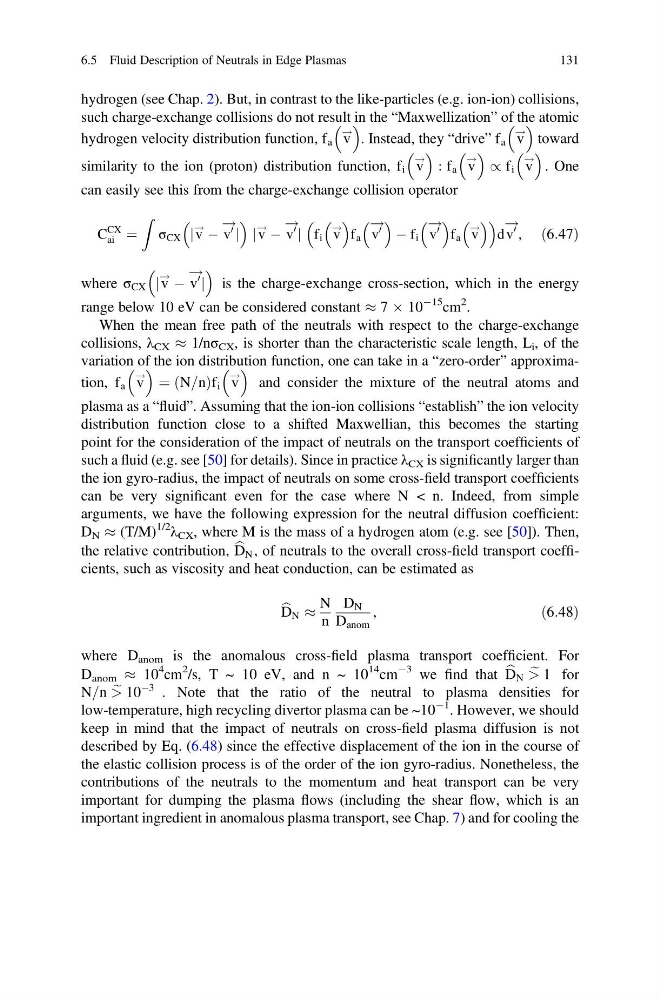
can easily see this from the charge-exchange collision operator
C
CX
ai ¼
Z
σ CX jv
! À v
0
!
j
j v
! À v
0
!
j f i v
!
f a v
0
!
À f i v
0
!
f a v
!
dv
0
!
, ð6:47Þ
where σ CX j v
! À v
0
!
j
is the charge-exchange cross-section, which in the energy
range below 10 eV can be considered constant % 7 Â 10
À15 cm
2 .
When the mean free path of the neutrals with respect to the charge-exchange
collisions, λ CX % 1/nσ CX , is shorter than the characteristic scale length, L i , of the
variation of the ion distribution function, one can take in a “zero-order” approximation, f a v
!
¼ N=n
ð
Þf i v
!
and consider the mixture of the neutral atoms and
plasma as a “fluid”. Assuming that the ion-ion collisions “establish” the ion velocity
distribution function close to a shifted Maxwellian, this becomes the starting
point for the consideration of the impact of neutrals on the transport coefficients of
such a fluid (e.g. see [50] for details). Since in practice λ CX is significantly larger than
the ion gyro-radius, the impact of neutrals on some cross-field transport coefficients
can be very significant even for the case where N < n. Indeed, from simple
arguments, we have the following expression for the neutral diffusion coefficient:
D N % (T/M)
1/2
λ CX , where M is the mass of a hydrogen atom (e.g. see [50]). Then,
the relative contribution, b
D N , of neutrals to the overall cross-field transport coefficients, such as viscosity and heat conduction, can be estimated as
b
D N %
N
n
D N
D anom
,
ð6:48Þ
where D anom is the anomalous cross-field plasma transport coefficient. For
D anom % 10
4 cm
2 /s, T ~ 10 eV, and n ~ 10
14 cm
À3 we find that b
D N e
> 1 for
N=n e
> 10
À3 . Note that the ratio of the neutral to plasma densities for
low-temperature, high recycling divertor plasma can be ~10
À1 . However, we should
keep in mind that the impact of neutrals on cross-field plasma diffusion is not
described by Eq. (6.48) since the effective displacement of the ion in the course of
the elastic collision process is of the order of the ion gyro-radius. Nonetheless, the
contributions of the neutrals to the momentum and heat transport can be very
important for dumping the plasma flows (including the shear flow, which is an
important ingredient in anomalous plasma transport, see Chap. 7) and for cooling the
6.5 Fluid Description of Neutrals in Edge Plasmas
131
such charge-exchange collisions do not result in the “Maxwellization” of the atomic
hydrogen velocity distribution function, f a v
!
. Instead, they “drive” f a v
!
toward
similarity to the ion (proton) distribution function, f i v
!
: f a v
!
/ f i v
!
. One
can easily see this from the charge-exchange collision operator
C
CX
ai ¼
Z
σ CX jv
! À v
0
!
j
j v
! À v
0
!
j f i v
!
f a v
0
!
À f i v
0
!
f a v
!
dv
0
!
, ð6:47Þ
where σ CX j v
! À v
0
!
j
is the charge-exchange cross-section, which in the energy
range below 10 eV can be considered constant % 7 Â 10
À15 cm
2 .
When the mean free path of the neutrals with respect to the charge-exchange
collisions, λ CX % 1/nσ CX , is shorter than the characteristic scale length, L i , of the
variation of the ion distribution function, one can take in a “zero-order” approximation, f a v
!
¼ N=n
ð
Þf i v
!
and consider the mixture of the neutral atoms and
plasma as a “fluid”. Assuming that the ion-ion collisions “establish” the ion velocity
distribution function close to a shifted Maxwellian, this becomes the starting
point for the consideration of the impact of neutrals on the transport coefficients of
such a fluid (e.g. see [50] for details). Since in practice λ CX is significantly larger than
the ion gyro-radius, the impact of neutrals on some cross-field transport coefficients
can be very significant even for the case where N < n. Indeed, from simple
arguments, we have the following expression for the neutral diffusion coefficient:
D N % (T/M)
1/2
λ CX , where M is the mass of a hydrogen atom (e.g. see [50]). Then,
the relative contribution, b
D N , of neutrals to the overall cross-field transport coefficients, such as viscosity and heat conduction, can be estimated as
b
D N %
N
n
D N
D anom
,
ð6:48Þ
where D anom is the anomalous cross-field plasma transport coefficient. For
D anom % 10
4 cm
2 /s, T ~ 10 eV, and n ~ 10
14 cm
À3 we find that b
D N e
> 1 for
N=n e
> 10
À3 . Note that the ratio of the neutral to plasma densities for
low-temperature, high recycling divertor plasma can be ~10
À1 . However, we should
keep in mind that the impact of neutrals on cross-field plasma diffusion is not
described by Eq. (6.48) since the effective displacement of the ion in the course of
the elastic collision process is of the order of the ion gyro-radius. Nonetheless, the
contributions of the neutrals to the momentum and heat transport can be very
important for dumping the plasma flows (including the shear flow, which is an
important ingredient in anomalous plasma transport, see Chap. 7) and for cooling the
6.5 Fluid Description of Neutrals in Edge Plasmas
131