

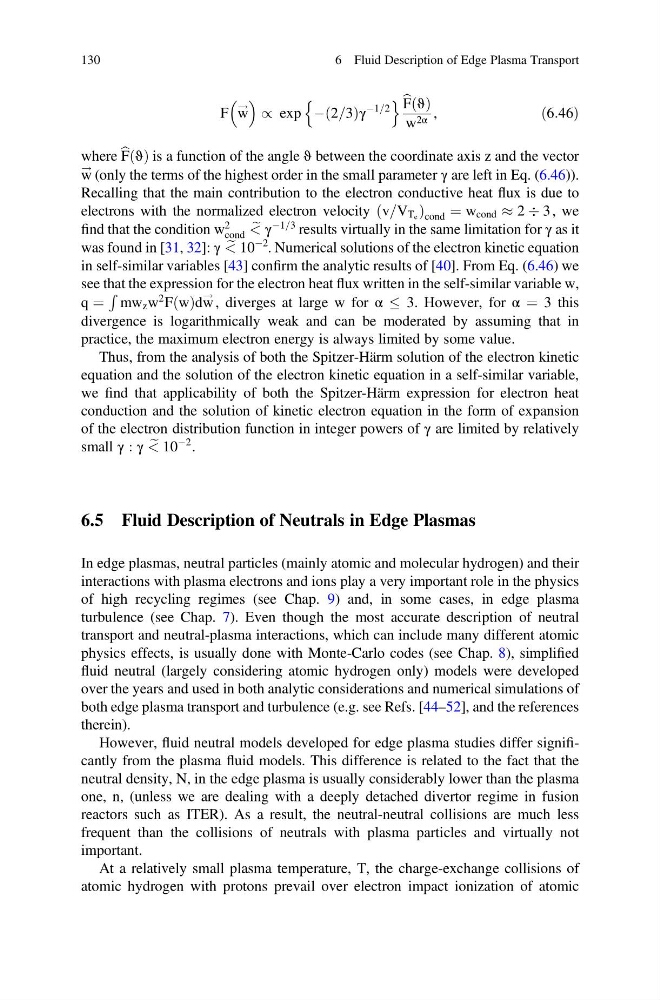
F w
!
/ exp À 2=3
ð
Þγ
À1=2
n
o b F ϑ
ð Þ
w 2α ,
ð6:46Þ
where b F ϑ
ð Þ is a function of the angle ϑ between the coordinate axis z and the vector
w
! (only the terms of the highest order in the small parameter γ are left in Eq. (6.46)).
Recalling that the main contribution to the electron conductive heat flux is due to
electrons with the normalized electron velocity v=V T e
ð
Þ cond ¼ w cond % 2 Ä 3 , we
find that the condition w
2
cond
e
< γ
À1=3 results virtually in the same limitation for γ as it
was found in [31, 32]: γ e
< 10
À2
. Numerical solutions of the electron kinetic equation
in self-similar variables [43] confirm the analytic results of [40]. From Eq. (6.46) we
see that the expression for the electron heat flux written in the self-similar variable w,
q ¼
R
mw z w
2 F w
ð Þdw
! , diverges at large w for α
3. However, for α ¼ 3 this
divergence is logarithmically weak and can be moderated by assuming that in
practice, the maximum electron energy is always limited by some value.
Thus, from the analysis of both the Spitzer-Härm solution of the electron kinetic
equation and the solution of the electron kinetic equation in a self-similar variable,
we find that applicability of both the Spitzer-Härm expression for electron heat
conduction and the solution of kinetic electron equation in the form of expansion
of the electron distribution function in integer powers of γ are limited by relatively
small γ : γ e
< 10
À2 .
6.5 Fluid Description of Neutrals in Edge Plasmas
In edge plasmas, neutral particles (mainly atomic and molecular hydrogen) and their
interactions with plasma electrons and ions play a very important role in the physics
of high recycling regimes (see Chap. 9) and, in some cases, in edge plasma
turbulence (see Chap. 7). Even though the most accurate description of neutral
transport and neutral-plasma interactions, which can include many different atomic
physics effects, is usually done with Monte-Carlo codes (see Chap. 8), simplified
fluid neutral (largely considering atomic hydrogen only) models were developed
over the years and used in both analytic considerations and numerical simulations of
both edge plasma transport and turbulence (e.g. see Refs. [44–52], and the references
therein).
However, fluid neutral models developed for edge plasma studies differ significantly from the plasma fluid models. This difference is related to the fact that the
neutral density, N, in the edge plasma is usually considerably lower than the plasma
one, n, (unless we are dealing with a deeply detached divertor regime in fusion
reactors such as ITER). As a result, the neutral-neutral collisions are much less
frequent than the collisions of neutrals with plasma particles and virtually not
important.
At a relatively small plasma temperature, T, the charge-exchange collisions of
atomic hydrogen with protons prevail over electron impact ionization of atomic
130
6 Fluid Description of Edge Plasma Transport
!
/ exp À 2=3
ð
Þγ
À1=2
n
o b F ϑ
ð Þ
w 2α ,
ð6:46Þ
where b F ϑ
ð Þ is a function of the angle ϑ between the coordinate axis z and the vector
w
! (only the terms of the highest order in the small parameter γ are left in Eq. (6.46)).
Recalling that the main contribution to the electron conductive heat flux is due to
electrons with the normalized electron velocity v=V T e
ð
Þ cond ¼ w cond % 2 Ä 3 , we
find that the condition w
2
cond
e
< γ
À1=3 results virtually in the same limitation for γ as it
was found in [31, 32]: γ e
< 10
À2
. Numerical solutions of the electron kinetic equation
in self-similar variables [43] confirm the analytic results of [40]. From Eq. (6.46) we
see that the expression for the electron heat flux written in the self-similar variable w,
q ¼
R
mw z w
2 F w
ð Þdw
! , diverges at large w for α
3. However, for α ¼ 3 this
divergence is logarithmically weak and can be moderated by assuming that in
practice, the maximum electron energy is always limited by some value.
Thus, from the analysis of both the Spitzer-Härm solution of the electron kinetic
equation and the solution of the electron kinetic equation in a self-similar variable,
we find that applicability of both the Spitzer-Härm expression for electron heat
conduction and the solution of kinetic electron equation in the form of expansion
of the electron distribution function in integer powers of γ are limited by relatively
small γ : γ e
< 10
À2 .
6.5 Fluid Description of Neutrals in Edge Plasmas
In edge plasmas, neutral particles (mainly atomic and molecular hydrogen) and their
interactions with plasma electrons and ions play a very important role in the physics
of high recycling regimes (see Chap. 9) and, in some cases, in edge plasma
turbulence (see Chap. 7). Even though the most accurate description of neutral
transport and neutral-plasma interactions, which can include many different atomic
physics effects, is usually done with Monte-Carlo codes (see Chap. 8), simplified
fluid neutral (largely considering atomic hydrogen only) models were developed
over the years and used in both analytic considerations and numerical simulations of
both edge plasma transport and turbulence (e.g. see Refs. [44–52], and the references
therein).
However, fluid neutral models developed for edge plasma studies differ significantly from the plasma fluid models. This difference is related to the fact that the
neutral density, N, in the edge plasma is usually considerably lower than the plasma
one, n, (unless we are dealing with a deeply detached divertor regime in fusion
reactors such as ITER). As a result, the neutral-neutral collisions are much less
frequent than the collisions of neutrals with plasma particles and virtually not
important.
At a relatively small plasma temperature, T, the charge-exchange collisions of
atomic hydrogen with protons prevail over electron impact ionization of atomic
130
6 Fluid Description of Edge Plasma Transport