

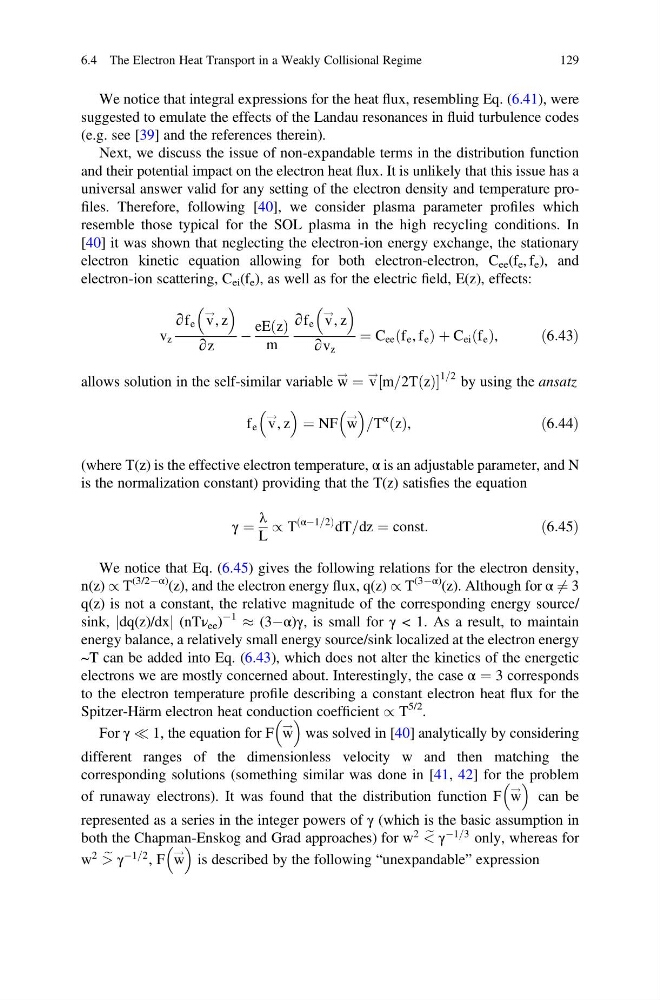
We notice that integral expressions for the heat flux, resembling Eq. (6.41), were
suggested to emulate the effects of the Landau resonances in fluid turbulence codes
(e.g. see [39] and the references therein).
Next, we discuss the issue of non-expandable terms in the distribution function
and their potential impact on the electron heat flux. It is unlikely that this issue has a
universal answer valid for any setting of the electron density and temperature profiles. Therefore, following [40], we consider plasma parameter profiles which
resemble those typical for the SOL plasma in the high recycling conditions. In
[40] it was shown that neglecting the electron-ion energy exchange, the stationary
electron kinetic equation allowing for both electron-electron, C ee (f e , f e ), and
electron-ion scattering, C ei (f e ), as well as for the electric field, E(z), effects:
v z
∂f e v
!
, z
∂z
À
eE z
ð Þ
m
∂f e v
!
, z
∂v z
¼ C ee f e , f e
ð
ÞþC ei f e
ð Þ,
ð6:43Þ
allows solution in the self-similar variable w
! ¼ v
! m=2T z
ð Þ
½
1=2 by using the ansatz
f e v
!
, z
¼ NF w
!
=T
α z
ð Þ,
ð6:44Þ
(where T(z) is the effective electron temperature, α is an adjustable parameter, and N
is the normalization constant) providing that the T(z) satisfies the equation
γ ¼
λ
L
/ T
αÀ1=2
ð
Þ dT=dz ¼ const:
ð6:45Þ
We notice that Eq. (6.45) gives the following relations for the electron density,
n(z) / T
(3/2Àα)
(z), and the electron energy flux, q(z) / T
(3Àα)
(z). Although for α 6 ¼ 3
q(z) is not a constant, the relative magnitude of the corresponding energy source/
sink, jdq(z)/dxj (nTν ee )
À1
% (3Àα)γ, is small for γ < 1. As a result, to maintain
energy balance, a relatively small energy source/sink localized at the electron energy
~T can be added into Eq. (6.43), which does not alter the kinetics of the energetic
electrons we are mostly concerned about. Interestingly, the case α ¼ 3 corresponds
to the electron temperature profile describing a constant electron heat flux for the
Spitzer-Härm electron heat conduction coefficient / T
5/2 .
For γ ( 1, the equation for F w
!
was solved in [40] analytically by considering
different ranges of the dimensionless velocity w and then matching the
corresponding solutions (something similar was done in [41, 42] for the problem
of runaway electrons). It was found that the distribution function F w
!
can be
represented as a series in the integer powers of γ (which is the basic assumption in
both the Chapman-Enskog and Grad approaches) for w
2 e
< γ
À1=3 only, whereas for
w
2 e
> γ
À1=2 , F w
!
is described by the following “unexpandable” expression
6.4 The Electron Heat Transport in a Weakly Collisional Regime
129
suggested to emulate the effects of the Landau resonances in fluid turbulence codes
(e.g. see [39] and the references therein).
Next, we discuss the issue of non-expandable terms in the distribution function
and their potential impact on the electron heat flux. It is unlikely that this issue has a
universal answer valid for any setting of the electron density and temperature profiles. Therefore, following [40], we consider plasma parameter profiles which
resemble those typical for the SOL plasma in the high recycling conditions. In
[40] it was shown that neglecting the electron-ion energy exchange, the stationary
electron kinetic equation allowing for both electron-electron, C ee (f e , f e ), and
electron-ion scattering, C ei (f e ), as well as for the electric field, E(z), effects:
v z
∂f e v
!
, z
∂z
À
eE z
ð Þ
m
∂f e v
!
, z
∂v z
¼ C ee f e , f e
ð
ÞþC ei f e
ð Þ,
ð6:43Þ
allows solution in the self-similar variable w
! ¼ v
! m=2T z
ð Þ
½
1=2 by using the ansatz
f e v
!
, z
¼ NF w
!
=T
α z
ð Þ,
ð6:44Þ
(where T(z) is the effective electron temperature, α is an adjustable parameter, and N
is the normalization constant) providing that the T(z) satisfies the equation
γ ¼
λ
L
/ T
αÀ1=2
ð
Þ dT=dz ¼ const:
ð6:45Þ
We notice that Eq. (6.45) gives the following relations for the electron density,
n(z) / T
(3/2Àα)
(z), and the electron energy flux, q(z) / T
(3Àα)
(z). Although for α 6 ¼ 3
q(z) is not a constant, the relative magnitude of the corresponding energy source/
sink, jdq(z)/dxj (nTν ee )
À1
% (3Àα)γ, is small for γ < 1. As a result, to maintain
energy balance, a relatively small energy source/sink localized at the electron energy
~T can be added into Eq. (6.43), which does not alter the kinetics of the energetic
electrons we are mostly concerned about. Interestingly, the case α ¼ 3 corresponds
to the electron temperature profile describing a constant electron heat flux for the
Spitzer-Härm electron heat conduction coefficient / T
5/2 .
For γ ( 1, the equation for F w
!
was solved in [40] analytically by considering
different ranges of the dimensionless velocity w and then matching the
corresponding solutions (something similar was done in [41, 42] for the problem
of runaway electrons). It was found that the distribution function F w
!
can be
represented as a series in the integer powers of γ (which is the basic assumption in
both the Chapman-Enskog and Grad approaches) for w
2 e
< γ
À1=3 only, whereas for
w
2 e
> γ
À1=2 , F w
!
is described by the following “unexpandable” expression
6.4 The Electron Heat Transport in a Weakly Collisional Regime
129