

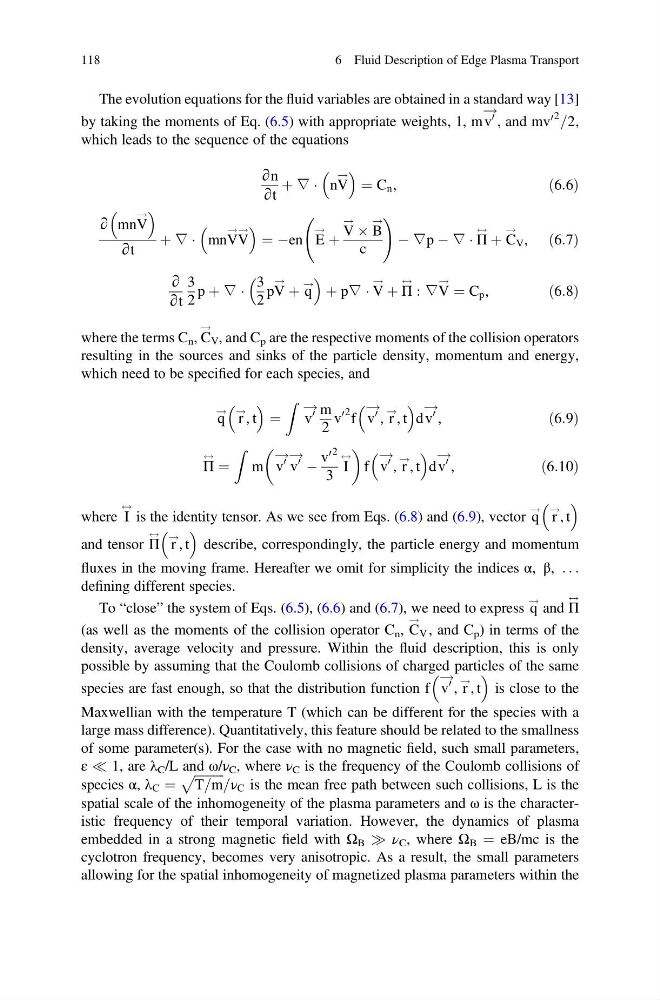
The evolution equations for the fluid variables are obtained in a standard way [13]
by taking the moments of Eq. (6.5) with appropriate weights, 1, m v
0
!
, and mv
0 2 =2,
which leads to the sequence of the equations
∂n
∂t
þ ∇ Á nV
!
¼ C n ,
ð6:6Þ
∂ mnV
!
∂t
þ ∇ Á mnV
!
V
!
¼ Àen E
! þ
V
! Â B
!
c
!
À ∇p À ∇ Á Π
$ þ C
!
V , ð6:7Þ
∂
∂t
3
2
p þ ∇ Á
3
2
pV
! þ q
!
þ p∇ Á V
! þ Π
$ : ∇V
! ¼ C p ,
ð6:8Þ
where the terms C n , C
!
V , and C p are the respective moments of the collision operators
resulting in the sources and sinks of the particle density, momentum and energy,
which need to be specified for each species, and
q
! r
!
, t
¼
Z
v
0
! m
2
v
0 2 f v
0
!
, r
!
, t
d v
0
!
,
ð6:9Þ
Π
$ ¼
Z
m v
0
!
v
0
! À
v
0 2
3
I
$
f v
0
!
, r
!
, t
dv
0
!
,
ð6:10Þ
where I
$
is the identity tensor. As we see from Eqs. (6.8) and (6.9), vector q
! r
! , t
and tensor Π
$
r
!
, t
describe, correspondingly, the particle energy and momentum
fluxes in the moving frame. Hereafter we omit for simplicity the indices α, β, . . .
defining different species.
To “close” the system of Eqs. (6.5), (6.6) and (6.7), we need to express q
! and Π
$
(as well as the moments of the collision operator C n , C
!
V , and C p ) in terms of the
density, average velocity and pressure. Within the fluid description, this is only
possible by assuming that the Coulomb collisions of charged particles of the same
species are fast enough, so that the distribution function f v
0
!
, r
! , t
is close to the
Maxwellian with the temperature T (which can be different for the species with a
large mass difference). Quantitatively, this feature should be related to the smallness
of some parameter(s). For the case with no magnetic field, such small parameters,
ε ( 1, are λ C /L and ω/ν C , where ν C is the frequency of the Coulomb collisions of
species α, λ C ¼
ffiffiffiffiffiffiffiffiffi ffi
T=m
p
=ν C is the mean free path between such collisions, L is the
spatial scale of the inhomogeneity of the plasma parameters and ω is the characteristic frequency of their temporal variation. However, the dynamics of plasma
embedded in a strong magnetic field with Ω B ) ν C , where Ω B ¼ eB/mc is the
cyclotron frequency, becomes very anisotropic. As a result, the small parameters
allowing for the spatial inhomogeneity of magnetized plasma parameters within the
118
6 Fluid Description of Edge Plasma Transport
by taking the moments of Eq. (6.5) with appropriate weights, 1, m v
0
!
, and mv
0 2 =2,
which leads to the sequence of the equations
∂n
∂t
þ ∇ Á nV
!
¼ C n ,
ð6:6Þ
∂ mnV
!
∂t
þ ∇ Á mnV
!
V
!
¼ Àen E
! þ
V
! Â B
!
c
!
À ∇p À ∇ Á Π
$ þ C
!
V , ð6:7Þ
∂
∂t
3
2
p þ ∇ Á
3
2
pV
! þ q
!
þ p∇ Á V
! þ Π
$ : ∇V
! ¼ C p ,
ð6:8Þ
where the terms C n , C
!
V , and C p are the respective moments of the collision operators
resulting in the sources and sinks of the particle density, momentum and energy,
which need to be specified for each species, and
q
! r
!
, t
¼
Z
v
0
! m
2
v
0 2 f v
0
!
, r
!
, t
d v
0
!
,
ð6:9Þ
Π
$ ¼
Z
m v
0
!
v
0
! À
v
0 2
3
I
$
f v
0
!
, r
!
, t
dv
0
!
,
ð6:10Þ
where I
$
is the identity tensor. As we see from Eqs. (6.8) and (6.9), vector q
! r
! , t
and tensor Π
$
r
!
, t
describe, correspondingly, the particle energy and momentum
fluxes in the moving frame. Hereafter we omit for simplicity the indices α, β, . . .
defining different species.
To “close” the system of Eqs. (6.5), (6.6) and (6.7), we need to express q
! and Π
$
(as well as the moments of the collision operator C n , C
!
V , and C p ) in terms of the
density, average velocity and pressure. Within the fluid description, this is only
possible by assuming that the Coulomb collisions of charged particles of the same
species are fast enough, so that the distribution function f v
0
!
, r
! , t
is close to the
Maxwellian with the temperature T (which can be different for the species with a
large mass difference). Quantitatively, this feature should be related to the smallness
of some parameter(s). For the case with no magnetic field, such small parameters,
ε ( 1, are λ C /L and ω/ν C , where ν C is the frequency of the Coulomb collisions of
species α, λ C ¼
ffiffiffiffiffiffiffiffiffi ffi
T=m
p
=ν C is the mean free path between such collisions, L is the
spatial scale of the inhomogeneity of the plasma parameters and ω is the characteristic frequency of their temporal variation. However, the dynamics of plasma
embedded in a strong magnetic field with Ω B ) ν C , where Ω B ¼ eB/mc is the
cyclotron frequency, becomes very anisotropic. As a result, the small parameters
allowing for the spatial inhomogeneity of magnetized plasma parameters within the
118
6 Fluid Description of Edge Plasma Transport