

5.3 Conclusions
As we have seen, the study of the dust in fusion devices brings together the edge
plasma physics and the material and surface physics of the PFC materials. In the last
10–15 years, the study of the dust physics in fusion devices has developed into a
separate research area, which is recognized by the plasma fusion community as
important for future magnetic fusion reactors. Over that time, many new diagnostic
tools for in situ dust studies have been developed and implemented on the magnetic
fusion devices (e.g. laser scattering, pattern recognition with fast cameras, etc.).
Theoretical study of the dust dynamics in fusion devices greatly benefits from the
models of the dust-plasma interactions developed previously for different applications (e.g. see Refs. [56–58] and the references therein). These models have been
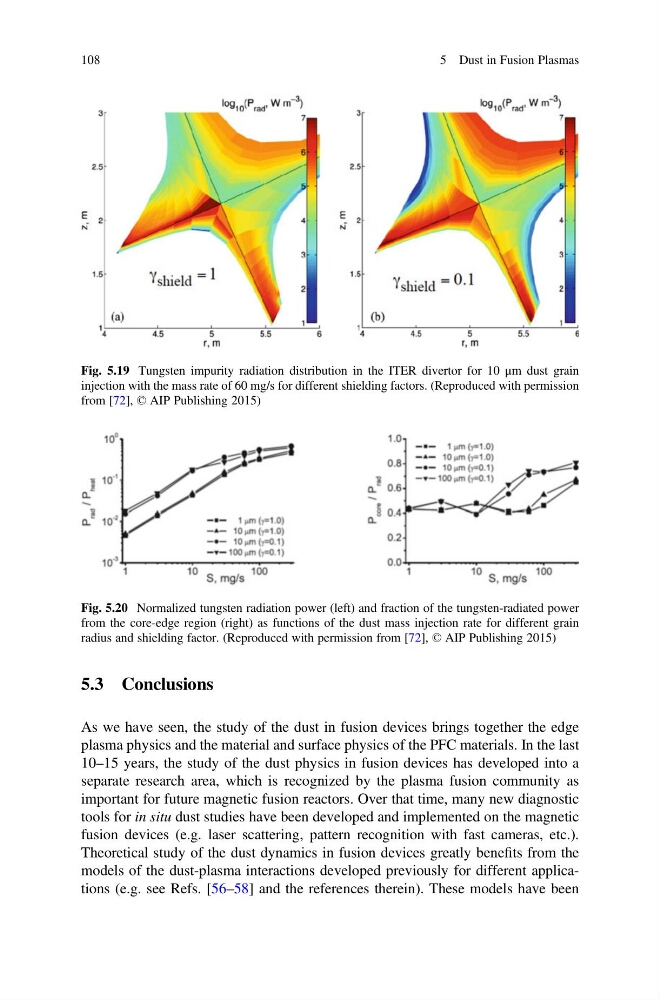
Fig. 5.19 Tungsten impurity radiation distribution in the ITER divertor for 10 μm dust grain
injection with the mass rate of 60 mg/s for different shielding factors. (Reproduced with permission
from [72], © AIP Publishing 2015)
Fig. 5.20 Normalized tungsten radiation power (left) and fraction of the tungsten-radiated power
from the core-edge region (right) as functions of the dust mass injection rate for different grain
radius and shielding factor. (Reproduced with permission from [72], © AIP Publishing 2015)
108
5 Dust in Fusion Plasmas
As we have seen, the study of the dust in fusion devices brings together the edge
plasma physics and the material and surface physics of the PFC materials. In the last
10–15 years, the study of the dust physics in fusion devices has developed into a
separate research area, which is recognized by the plasma fusion community as
important for future magnetic fusion reactors. Over that time, many new diagnostic
tools for in situ dust studies have been developed and implemented on the magnetic
fusion devices (e.g. laser scattering, pattern recognition with fast cameras, etc.).
Theoretical study of the dust dynamics in fusion devices greatly benefits from the
models of the dust-plasma interactions developed previously for different applications (e.g. see Refs. [56–58] and the references therein). These models have been
Fig. 5.19 Tungsten impurity radiation distribution in the ITER divertor for 10 μm dust grain
injection with the mass rate of 60 mg/s for different shielding factors. (Reproduced with permission
from [72], © AIP Publishing 2015)
Fig. 5.20 Normalized tungsten radiation power (left) and fraction of the tungsten-radiated power
from the core-edge region (right) as functions of the dust mass injection rate for different grain
radius and shielding factor. (Reproduced with permission from [72], © AIP Publishing 2015)
108
5 Dust in Fusion Plasmas