

high dust injection rate, one should take into account the self-consistent variation of
both the plasma parameters, caused by the impurity provided by the dust, and the
dust dynamics and transport in dust impurity-modified plasma environment.
Such self-consistent consideration became possible after the coupling of the dust
and edge plasma transport codes DUSTT and UEDGE into DUSTT-UEDGE package [55]. This package allows considering different scenarios of dust injection into
plasma. For example, all designated dust grains can be injected within a short time,
simulating a “spark” event shown in Fig. 5.1, or the grains can be injected into the
plasma continuously. We notice that the DUSTT-UEDGE package allows choosing
the distribution of dust injection location over the PFC surfaces and distribution of
the dust grains in the injection velocity and size.
In Figs. 5.19 and 5.20 one can see the results of simulations with the DUSTTUEDGE package of continuous injection of tungsten dust into the ITER plasma [72].
As one can see from Fig. 5.19b, the tungsten radiation loss strongly increases at
the core-edge interface as a result of deeper penetration of dust into the core plasma
when the shielding effects are taken into account. Another illustration of shielding
effects can be found in Fig. 5.20. Taking into account that ITER assumes to use
impurity seeding to reach the semi-detached state in the outer divertor, the data from
Fig. 5.20 suggest that to avoid possible termination of the discharge due to thermal
collapse, the mass rate by continuous injection of tungsten dust into ITER plasma
should not exceed ~30 mg/s.
However, to this moment we have no simulation results on the tolerable amount
of the tungsten dust injected into the ITER plasma on a short (e.g. ~1 ms) time scale.
The reason for this is the computational challenge related to the fast and spatially
localized change of the plasma parameters, which accompanies such a dust injection
scenario.
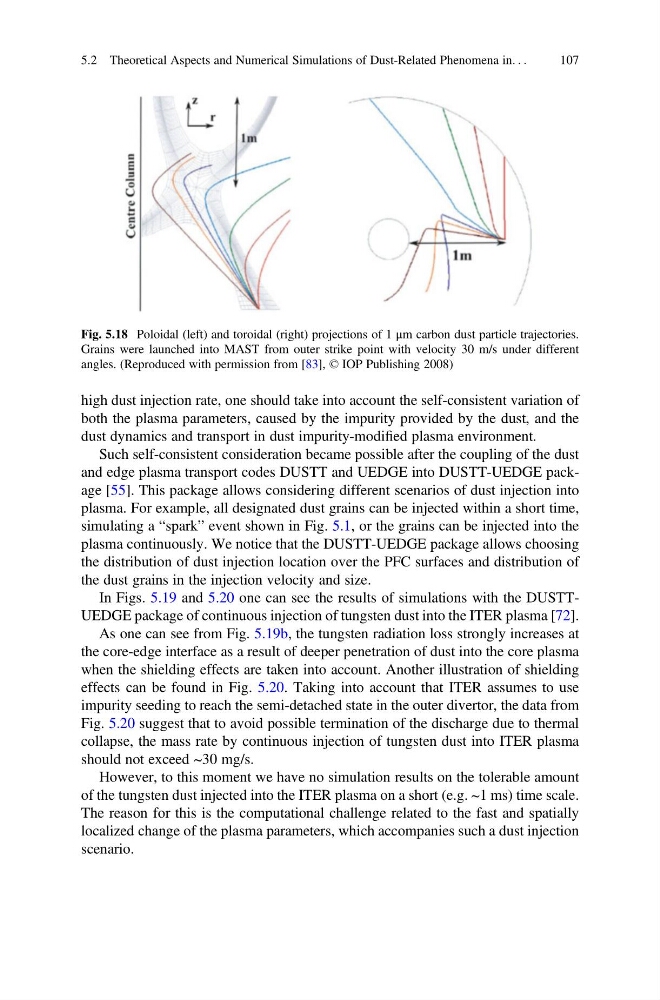
Fig. 5.18 Poloidal (left) and toroidal (right) projections of 1 μm carbon dust particle trajectories.
Grains were launched into MAST from outer strike point with velocity 30 m/s under different
angles. (Reproduced with permission from [83], © IOP Publishing 2008)
5.2 Theoretical Aspects and Numerical Simulations of Dust-Related Phenomena in. . .
107
both the plasma parameters, caused by the impurity provided by the dust, and the
dust dynamics and transport in dust impurity-modified plasma environment.
Such self-consistent consideration became possible after the coupling of the dust
and edge plasma transport codes DUSTT and UEDGE into DUSTT-UEDGE package [55]. This package allows considering different scenarios of dust injection into
plasma. For example, all designated dust grains can be injected within a short time,
simulating a “spark” event shown in Fig. 5.1, or the grains can be injected into the
plasma continuously. We notice that the DUSTT-UEDGE package allows choosing
the distribution of dust injection location over the PFC surfaces and distribution of
the dust grains in the injection velocity and size.
In Figs. 5.19 and 5.20 one can see the results of simulations with the DUSTTUEDGE package of continuous injection of tungsten dust into the ITER plasma [72].
As one can see from Fig. 5.19b, the tungsten radiation loss strongly increases at
the core-edge interface as a result of deeper penetration of dust into the core plasma
when the shielding effects are taken into account. Another illustration of shielding
effects can be found in Fig. 5.20. Taking into account that ITER assumes to use
impurity seeding to reach the semi-detached state in the outer divertor, the data from
Fig. 5.20 suggest that to avoid possible termination of the discharge due to thermal
collapse, the mass rate by continuous injection of tungsten dust into ITER plasma
should not exceed ~30 mg/s.
However, to this moment we have no simulation results on the tolerable amount
of the tungsten dust injected into the ITER plasma on a short (e.g. ~1 ms) time scale.
The reason for this is the computational challenge related to the fast and spatially
localized change of the plasma parameters, which accompanies such a dust injection
scenario.
Fig. 5.18 Poloidal (left) and toroidal (right) projections of 1 μm carbon dust particle trajectories.
Grains were launched into MAST from outer strike point with velocity 30 m/s under different
angles. (Reproduced with permission from [83], © IOP Publishing 2008)
5.2 Theoretical Aspects and Numerical Simulations of Dust-Related Phenomena in. . .
107