

ablation rate is high. Although the analysis was performed for the carbon dust, this
conclusion has robust physics arguments and seems to be very generic.
As of today, there are many photos and movies from virtually all major magnetic
fusion devices [4, 6, 14, 17, 27, 38, 47–52] showing dust traces in the plasma volume
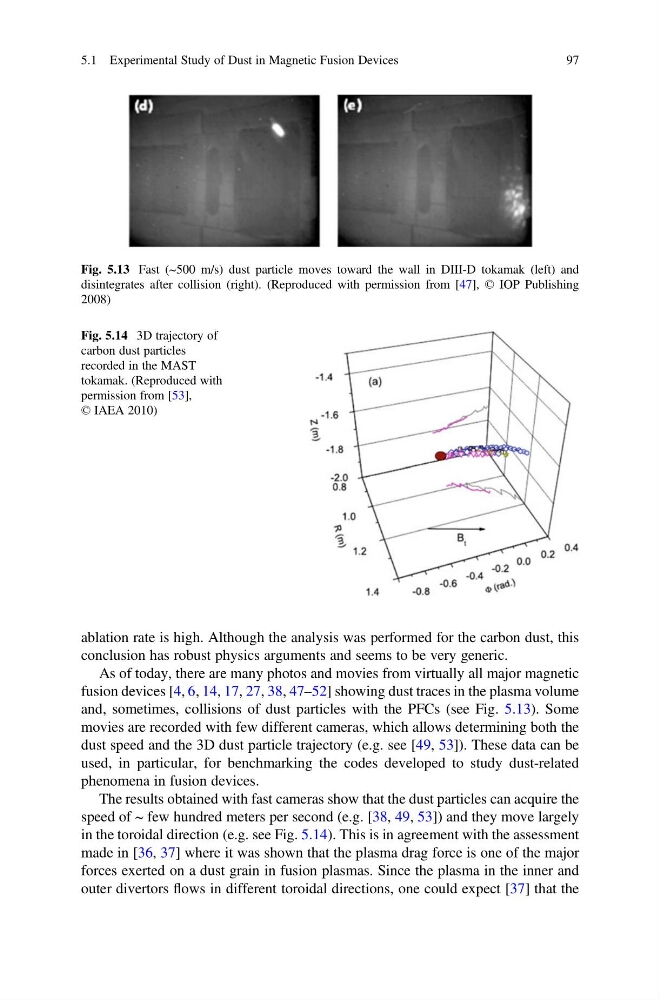
and, sometimes, collisions of dust particles with the PFCs (see Fig. 5.13). Some
movies are recorded with few different cameras, which allows determining both the
dust speed and the 3D dust particle trajectory (e.g. see [49, 53]). These data can be
used, in particular, for benchmarking the codes developed to study dust-related
phenomena in fusion devices.
The results obtained with fast cameras show that the dust particles can acquire the
speed of ~ few hundred meters per second (e.g. [38, 49, 53]) and they move largely
in the toroidal direction (e.g. see Fig. 5.14). This is in agreement with the assessment
made in [36, 37] where it was shown that the plasma drag force is one of the major
forces exerted on a dust grain in fusion plasmas. Since the plasma in the inner and
outer divertors flows in different toroidal directions, one could expect [37] that the
Fig. 5.13 Fast (~500 m/s) dust particle moves toward the wall in DIII-D tokamak (left) and
disintegrates after collision (right). (Reproduced with permission from [47], © IOP Publishing
2008)
Fig. 5.14 3D trajectory of
carbon dust particles
recorded in the MAST
tokamak. (Reproduced with
permission from [53],
© IAEA 2010)
5.1 Experimental Study of Dust in Magnetic Fusion Devices
97
conclusion has robust physics arguments and seems to be very generic.
As of today, there are many photos and movies from virtually all major magnetic
fusion devices [4, 6, 14, 17, 27, 38, 47–52] showing dust traces in the plasma volume
and, sometimes, collisions of dust particles with the PFCs (see Fig. 5.13). Some
movies are recorded with few different cameras, which allows determining both the
dust speed and the 3D dust particle trajectory (e.g. see [49, 53]). These data can be
used, in particular, for benchmarking the codes developed to study dust-related
phenomena in fusion devices.
The results obtained with fast cameras show that the dust particles can acquire the
speed of ~ few hundred meters per second (e.g. [38, 49, 53]) and they move largely
in the toroidal direction (e.g. see Fig. 5.14). This is in agreement with the assessment
made in [36, 37] where it was shown that the plasma drag force is one of the major
forces exerted on a dust grain in fusion plasmas. Since the plasma in the inner and
outer divertors flows in different toroidal directions, one could expect [37] that the
Fig. 5.13 Fast (~500 m/s) dust particle moves toward the wall in DIII-D tokamak (left) and
disintegrates after collision (right). (Reproduced with permission from [47], © IOP Publishing
2008)
Fig. 5.14 3D trajectory of
carbon dust particles
recorded in the MAST
tokamak. (Reproduced with
permission from [53],
© IAEA 2010)
5.1 Experimental Study of Dust in Magnetic Fusion Devices
97