

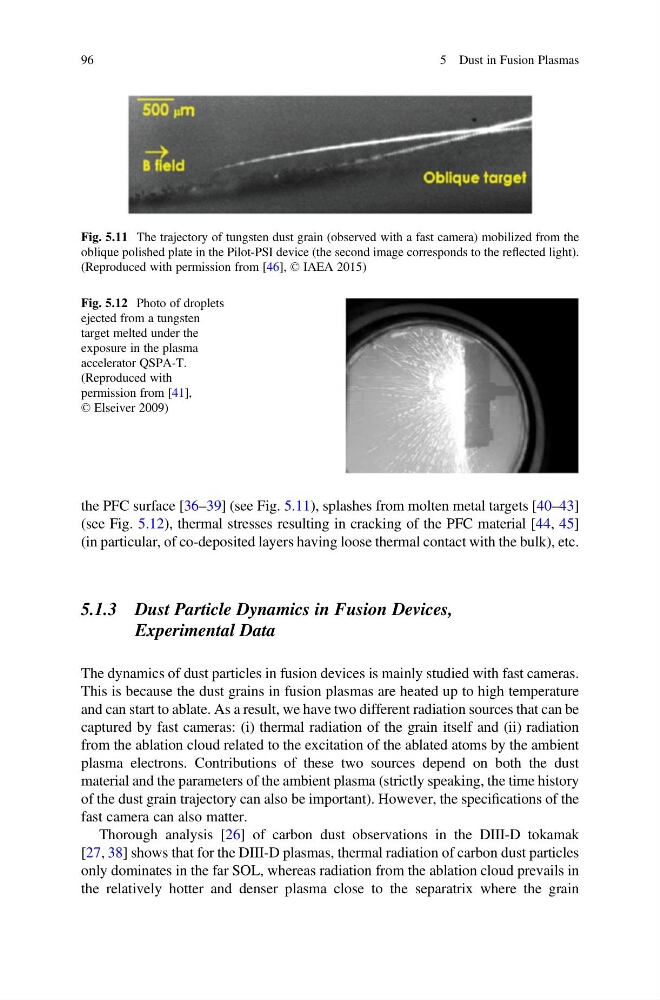
the PFC surface [36–39] (see Fig. 5.11), splashes from molten metal targets [40–43]
(see Fig. 5.12), thermal stresses resulting in cracking of the PFC material [44, 45]
(in particular, of co-deposited layers having loose thermal contact with the bulk), etc.
5.1.3 Dust Particle Dynamics in Fusion Devices,
Experimental Data
The dynamics of dust particles in fusion devices is mainly studied with fast cameras.
This is because the dust grains in fusion plasmas are heated up to high temperature
and can start to ablate. As a result, we have two different radiation sources that can be
captured by fast cameras: (i) thermal radiation of the grain itself and (ii) radiation
from the ablation cloud related to the excitation of the ablated atoms by the ambient
plasma electrons. Contributions of these two sources depend on both the dust
material and the parameters of the ambient plasma (strictly speaking, the time history
of the dust grain trajectory can also be important). However, the specifications of the
fast camera can also matter.
Thorough analysis [26] of carbon dust observations in the DIII-D tokamak
[27, 38] shows that for the DIII-D plasmas, thermal radiation of carbon dust particles
only dominates in the far SOL, whereas radiation from the ablation cloud prevails in
the relatively hotter and denser plasma close to the separatrix where the grain
Fig. 5.11 The trajectory of tungsten dust grain (observed with a fast camera) mobilized from the
oblique polished plate in the Pilot-PSI device (the second image corresponds to the reflected light).
(Reproduced with permission from [46], © IAEA 2015)
Fig. 5.12 Photo of droplets
ejected from a tungsten
target melted under the
exposure in the plasma
accelerator QSPA-T.
(Reproduced with
permission from [41],
© Elseiver 2009)
96
5 Dust in Fusion Plasmas
(see Fig. 5.12), thermal stresses resulting in cracking of the PFC material [44, 45]
(in particular, of co-deposited layers having loose thermal contact with the bulk), etc.
5.1.3 Dust Particle Dynamics in Fusion Devices,
Experimental Data
The dynamics of dust particles in fusion devices is mainly studied with fast cameras.
This is because the dust grains in fusion plasmas are heated up to high temperature
and can start to ablate. As a result, we have two different radiation sources that can be
captured by fast cameras: (i) thermal radiation of the grain itself and (ii) radiation
from the ablation cloud related to the excitation of the ablated atoms by the ambient
plasma electrons. Contributions of these two sources depend on both the dust
material and the parameters of the ambient plasma (strictly speaking, the time history
of the dust grain trajectory can also be important). However, the specifications of the
fast camera can also matter.
Thorough analysis [26] of carbon dust observations in the DIII-D tokamak
[27, 38] shows that for the DIII-D plasmas, thermal radiation of carbon dust particles
only dominates in the far SOL, whereas radiation from the ablation cloud prevails in
the relatively hotter and denser plasma close to the separatrix where the grain
Fig. 5.11 The trajectory of tungsten dust grain (observed with a fast camera) mobilized from the
oblique polished plate in the Pilot-PSI device (the second image corresponds to the reflected light).
(Reproduced with permission from [46], © IAEA 2015)
Fig. 5.12 Photo of droplets
ejected from a tungsten
target melted under the
exposure in the plasma
accelerator QSPA-T.
(Reproduced with
permission from [41],
© Elseiver 2009)
96
5 Dust in Fusion Plasmas