

toroidal components of the dust velocities in the inner and outer divertors should be
opposite, which was indeed observed in the experiments (see Refs. [12, 49]).
However, in [54] it was shown that toroidal plasma rotation can also be important
in dragging the dust particles.
Although fast cameras show that the majority of dust particles demonstrate rather
smooth trajectories, some of the dust grains exhibit jitter-like deviation from the
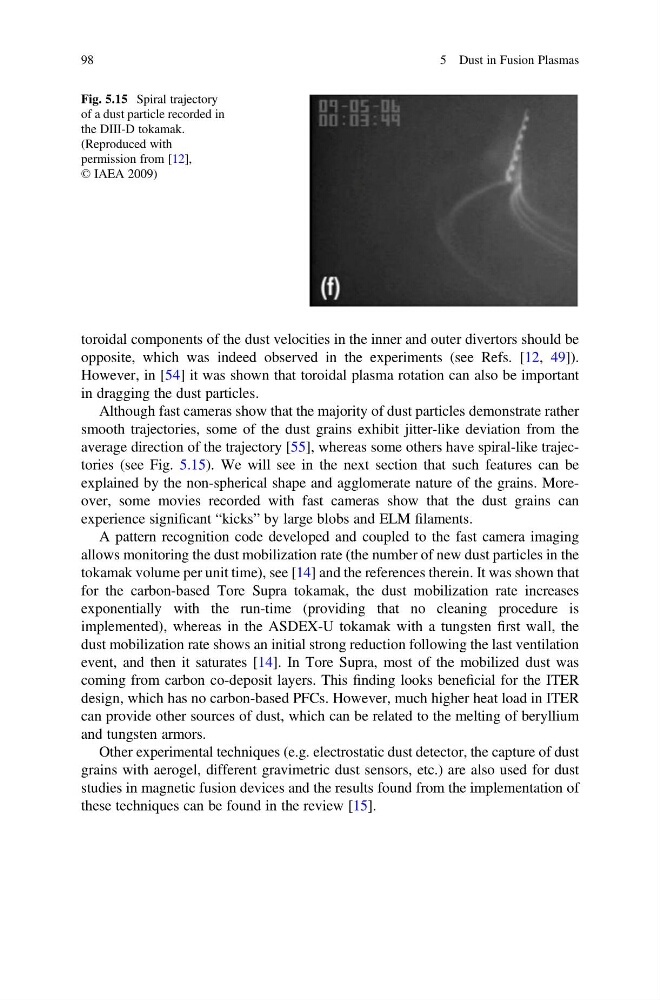
average direction of the trajectory [55], whereas some others have spiral-like trajectories (see Fig. 5.15). We will see in the next section that such features can be
explained by the non-spherical shape and agglomerate nature of the grains. Moreover, some movies recorded with fast cameras show that the dust grains can
experience significant “kicks” by large blobs and ELM filaments.
A pattern recognition code developed and coupled to the fast camera imaging
allows monitoring the dust mobilization rate (the number of new dust particles in the
tokamak volume per unit time), see [14] and the references therein. It was shown that
for the carbon-based Tore Supra tokamak, the dust mobilization rate increases
exponentially with the run-time (providing that no cleaning procedure is
implemented), whereas in the ASDEX-U tokamak with a tungsten first wall, the
dust mobilization rate shows an initial strong reduction following the last ventilation
event, and then it saturates [14]. In Tore Supra, most of the mobilized dust was
coming from carbon co-deposit layers. This finding looks beneficial for the ITER
design, which has no carbon-based PFCs. However, much higher heat load in ITER
can provide other sources of dust, which can be related to the melting of beryllium
and tungsten armors.
Other experimental techniques (e.g. electrostatic dust detector, the capture of dust
grains with aerogel, different gravimetric dust sensors, etc.) are also used for dust
studies in magnetic fusion devices and the results found from the implementation of
these techniques can be found in the review [15].
Fig. 5.15 Spiral trajectory
of a dust particle recorded in
the DIII-D tokamak.
(Reproduced with
permission from [12],
© IAEA 2009)
98
5 Dust in Fusion Plasmas
opposite, which was indeed observed in the experiments (see Refs. [12, 49]).
However, in [54] it was shown that toroidal plasma rotation can also be important
in dragging the dust particles.
Although fast cameras show that the majority of dust particles demonstrate rather
smooth trajectories, some of the dust grains exhibit jitter-like deviation from the
average direction of the trajectory [55], whereas some others have spiral-like trajectories (see Fig. 5.15). We will see in the next section that such features can be
explained by the non-spherical shape and agglomerate nature of the grains. Moreover, some movies recorded with fast cameras show that the dust grains can
experience significant “kicks” by large blobs and ELM filaments.
A pattern recognition code developed and coupled to the fast camera imaging
allows monitoring the dust mobilization rate (the number of new dust particles in the
tokamak volume per unit time), see [14] and the references therein. It was shown that
for the carbon-based Tore Supra tokamak, the dust mobilization rate increases
exponentially with the run-time (providing that no cleaning procedure is
implemented), whereas in the ASDEX-U tokamak with a tungsten first wall, the
dust mobilization rate shows an initial strong reduction following the last ventilation
event, and then it saturates [14]. In Tore Supra, most of the mobilized dust was
coming from carbon co-deposit layers. This finding looks beneficial for the ITER
design, which has no carbon-based PFCs. However, much higher heat load in ITER
can provide other sources of dust, which can be related to the melting of beryllium
and tungsten armors.
Other experimental techniques (e.g. electrostatic dust detector, the capture of dust
grains with aerogel, different gravimetric dust sensors, etc.) are also used for dust
studies in magnetic fusion devices and the results found from the implementation of
these techniques can be found in the review [15].
Fig. 5.15 Spiral trajectory
of a dust particle recorded in
the DIII-D tokamak.
(Reproduced with
permission from [12],
© IAEA 2009)
98
5 Dust in Fusion Plasmas