

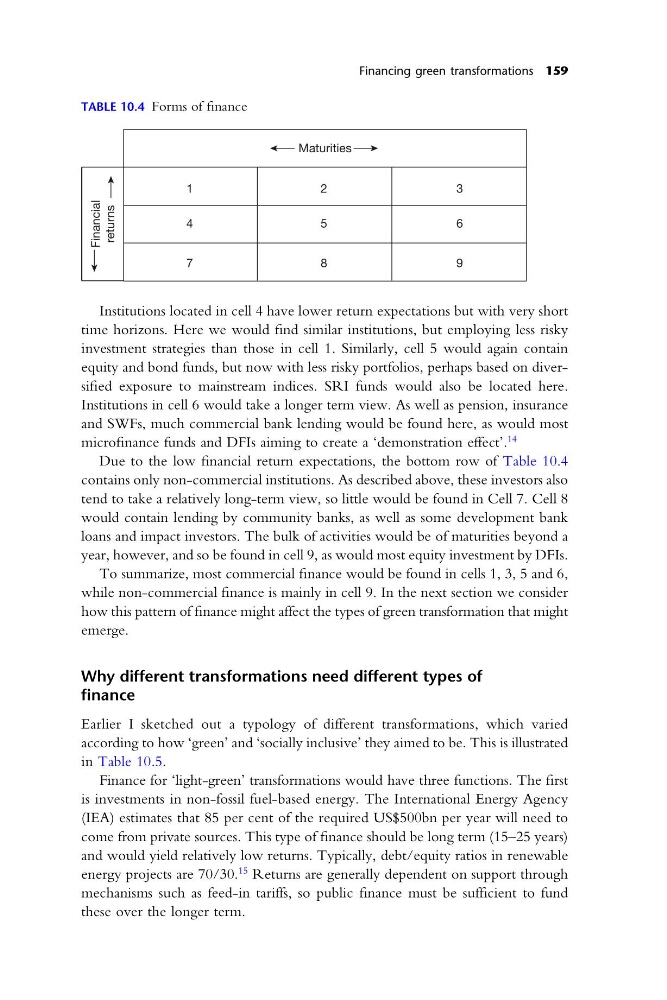
Institutions located in cell 4 have lower return expectations but with very short
time horizons. Here we would find similar institutions, but employing less risky
investment strategies than those in cell 1. Similarly, cell 5 would again contain
equity and bond funds, but now with less risky portfolios, perhaps based on diversified exposure to mainstream indices. SRI funds would also be located here.
Institutions in cell 6 would take a longer term view. As well as pension, insurance
and SWFs, much commercial bank lending would be found here, as would most
microfinance funds and DFIs aiming to create a ‘demonstration effect’.
14
Due to the low financial return expectations, the bottom row of Table 10.4
contains only non-commercial institutions. As described above, these investors also
tend to take a relatively long-term view, so little would be found in Cell 7. Cell 8
would contain lending by community banks, as well as some development bank
loans and impact investors. The bulk of activities would be of maturities beyond a
year, however, and so be found in cell 9, as would most equity investment by DFIs.
To summarize, most commercial finance would be found in cells 1, 3, 5 and 6,
while non-commercial finance is mainly in cell 9. In the next section we consider
how this pattern of finance might affect the types of green transformation that might
emerge.
Why different transformations need different types of
finance
Earlier I sketched out a typology of different transformations, which varied
according to how ‘green’ and ‘socially inclusive’ they aimed to be. This is illustrated
in Table 10.5.
Finance for ‘light-green’ transformations would have three functions. The first
is investments in non-fossil fuel-based energy. The International Energy Agency
(IEA) estimates that 85 per cent of the required US$500bn per year will need to
come from private sources. This type of finance should be long term (15–25 years)
and would yield relatively low returns. Typically, debt/equity ratios in renewable
energy projects are 70/30.
15 Returns are generally dependent on support through
mechanisms such as feed-in tariffs, so public finance must be sufficient to fund
these over the longer term.
Financing green transformations 159
Financial
returns
1
3
2
4
Maturities
5
6
7
8
9
TABLE 10.4 Forms of finance
time horizons. Here we would find similar institutions, but employing less risky
investment strategies than those in cell 1. Similarly, cell 5 would again contain
equity and bond funds, but now with less risky portfolios, perhaps based on diversified exposure to mainstream indices. SRI funds would also be located here.
Institutions in cell 6 would take a longer term view. As well as pension, insurance
and SWFs, much commercial bank lending would be found here, as would most
microfinance funds and DFIs aiming to create a ‘demonstration effect’.
14
Due to the low financial return expectations, the bottom row of Table 10.4
contains only non-commercial institutions. As described above, these investors also
tend to take a relatively long-term view, so little would be found in Cell 7. Cell 8
would contain lending by community banks, as well as some development bank
loans and impact investors. The bulk of activities would be of maturities beyond a
year, however, and so be found in cell 9, as would most equity investment by DFIs.
To summarize, most commercial finance would be found in cells 1, 3, 5 and 6,
while non-commercial finance is mainly in cell 9. In the next section we consider
how this pattern of finance might affect the types of green transformation that might
emerge.
Why different transformations need different types of
finance
Earlier I sketched out a typology of different transformations, which varied
according to how ‘green’ and ‘socially inclusive’ they aimed to be. This is illustrated
in Table 10.5.
Finance for ‘light-green’ transformations would have three functions. The first
is investments in non-fossil fuel-based energy. The International Energy Agency
(IEA) estimates that 85 per cent of the required US$500bn per year will need to
come from private sources. This type of finance should be long term (15–25 years)
and would yield relatively low returns. Typically, debt/equity ratios in renewable
energy projects are 70/30.
15 Returns are generally dependent on support through
mechanisms such as feed-in tariffs, so public finance must be sufficient to fund
these over the longer term.
Financing green transformations 159
Financial
returns
1
3
2
4
Maturities
5
6
7
8
9
TABLE 10.4 Forms of finance