

The second function is to fund energy efficiency. Again, the sums are very large.
Farrell and Remes (2009) estimate that US$90 billion of energy efficiency investment is needed per year in developing countries alone. Energy efficiency projects
range from ‘low-hanging fruit’ yielding good returns in short periods of time, to
longer term measures generating lower returns. Investors with different maturity
(i.e. 2–10 years) and return expectations would thus be needed. Longer term, ‘patient
capital’ fits well with the requirements of ‘deeper’ forms of energy efficiency, while
providers of debt finance with shorter time horizons could provide the capital to
finance ‘quick wins’ (Spratt et al., 2013).
The third function is to finance the transition to a circular economy. These are
higher risk (and potentially higher return) investments suited, in principle, to venture
capital and private equity. Given the record of such institutions, however, there
are good reasons to doubt this will happen (Mazzucato, this book). There are two
alternative sources of finance. First, products could be developed by current
producers of related products. Second, the public sector could invest directly in
innovation through public development banks, and/or incentivize the private sector
to do so (Mazzucato, 2013b).
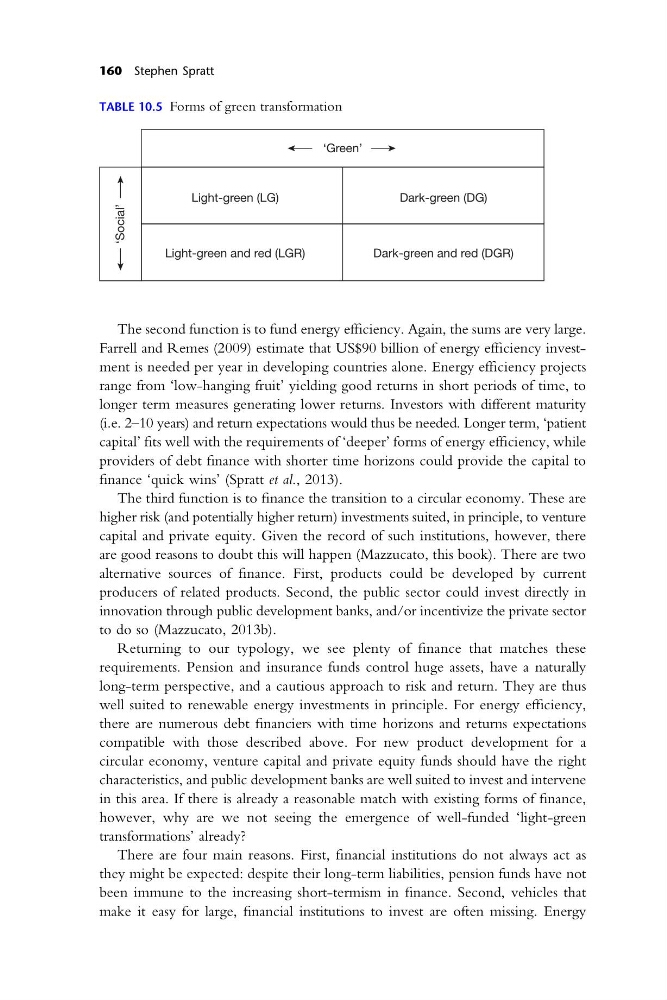
Returning to our typology, we see plenty of finance that matches these
requirements. Pension and insurance funds control huge assets, have a naturally
long-term perspective, and a cautious approach to risk and return. They are thus
well suited to renewable energy investments in principle. For energy efficiency,
there are numerous debt financiers with time horizons and returns expectations
compatible with those described above. For new product development for a
circular economy, venture capital and private equity funds should have the right
characteristics, and public development banks are well suited to invest and intervene
in this area. If there is already a reasonable match with existing forms of finance,
however, why are we not seeing the emergence of well-funded ‘light-green
transformations’ already?
There are four main reasons. First, financial institutions do not always act as
they might be expected: despite their long-term liabilities, pension funds have not
been immune to the increasing short-termism in finance. Second, vehicles that
make it easy for large, financial institutions to invest are often missing. Energy
160 Stephen Spratt
‘Social’
Light-green (LG)
Dark-green and red (DGR)
Dark-green (DG)
Light-green and red (LGR)
‘Green’
TABLE 10.5 Forms of green transformation
Farrell and Remes (2009) estimate that US$90 billion of energy efficiency investment is needed per year in developing countries alone. Energy efficiency projects
range from ‘low-hanging fruit’ yielding good returns in short periods of time, to
longer term measures generating lower returns. Investors with different maturity
(i.e. 2–10 years) and return expectations would thus be needed. Longer term, ‘patient
capital’ fits well with the requirements of ‘deeper’ forms of energy efficiency, while
providers of debt finance with shorter time horizons could provide the capital to
finance ‘quick wins’ (Spratt et al., 2013).
The third function is to finance the transition to a circular economy. These are
higher risk (and potentially higher return) investments suited, in principle, to venture
capital and private equity. Given the record of such institutions, however, there
are good reasons to doubt this will happen (Mazzucato, this book). There are two
alternative sources of finance. First, products could be developed by current
producers of related products. Second, the public sector could invest directly in
innovation through public development banks, and/or incentivize the private sector
to do so (Mazzucato, 2013b).
Returning to our typology, we see plenty of finance that matches these
requirements. Pension and insurance funds control huge assets, have a naturally
long-term perspective, and a cautious approach to risk and return. They are thus
well suited to renewable energy investments in principle. For energy efficiency,
there are numerous debt financiers with time horizons and returns expectations
compatible with those described above. For new product development for a
circular economy, venture capital and private equity funds should have the right
characteristics, and public development banks are well suited to invest and intervene
in this area. If there is already a reasonable match with existing forms of finance,
however, why are we not seeing the emergence of well-funded ‘light-green
transformations’ already?
There are four main reasons. First, financial institutions do not always act as
they might be expected: despite their long-term liabilities, pension funds have not
been immune to the increasing short-termism in finance. Second, vehicles that
make it easy for large, financial institutions to invest are often missing. Energy
160 Stephen Spratt
‘Social’
Light-green (LG)
Dark-green and red (DGR)
Dark-green (DG)
Light-green and red (LGR)
‘Green’
TABLE 10.5 Forms of green transformation