

4.3 Julian Date
49
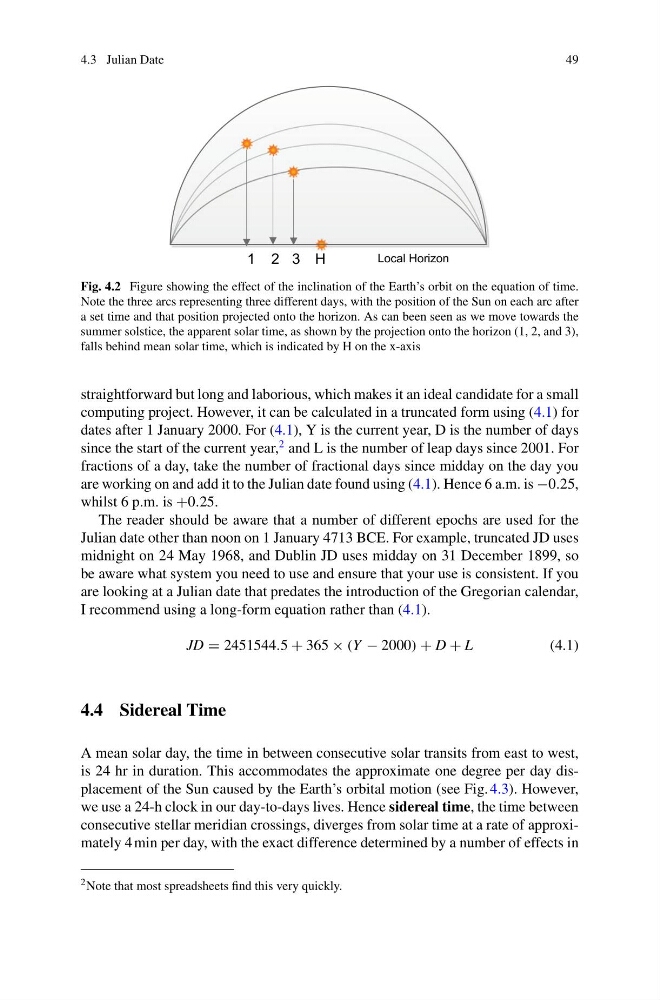
Fig. 4.2 Figure showing the effect of the inclination of the Earth’s orbit on the equation of time.
Note the three arcs representing three different days, with the position of the Sun on each arc after
a set time and that position projected onto the horizon. As can been seen as we move towards the
summer solstice, the apparent solar time, as shown by the projection onto the horizon (1, 2, and 3),
falls behind mean solar time, which is indicated by H on the x-axis
straightforward but long and laborious, which makes it an ideal candidate for a small
computing project. However, it can be calculated in a truncated form using (4.1) for
dates after 1 January 2000. For (4.1), Y is the current year, D is the number of days
since the start of the current year,
2 and L is the number of leap days since 2001. For
fractions of a day, take the number of fractional days since midday on the day you
are working on and add it to the Julian date found using (4.1). Hence 6 a.m. is −0.25,
whilst 6 p.m. is +0.25.
The reader should be aware that a number of different epochs are used for the
Julian date other than noon on 1 January 4713 BCE. For example, truncated JD uses
midnight on 24 May 1968, and Dublin JD uses midday on 31 December 1899, so
be aware what system you need to use and ensure that your use is consistent. If you
are looking at a Julian date that predates the introduction of the Gregorian calendar,
I recommend using a long-form equation rather than (4.1).
JD = 2451544.5 + 365 × (Y − 2000) + D + L
(4.1)
4.4 Sidereal Time
A mean solar day, the time in between consecutive solar transits from east to west,
is 24 hr in duration. This accommodates the approximate one degree per day displacement of the Sun caused by the Earth’s orbital motion (see Fig. 4.3). However,
we use a 24-h clock in our day-to-days lives. Hence sidereal time, the time between
consecutive stellar meridian crossings, diverges from solar time at a rate of approximately 4 min per day, with the exact difference determined by a number of effects in
2 Note that most spreadsheets find this very quickly.
49
Fig. 4.2 Figure showing the effect of the inclination of the Earth’s orbit on the equation of time.
Note the three arcs representing three different days, with the position of the Sun on each arc after
a set time and that position projected onto the horizon. As can been seen as we move towards the
summer solstice, the apparent solar time, as shown by the projection onto the horizon (1, 2, and 3),
falls behind mean solar time, which is indicated by H on the x-axis
straightforward but long and laborious, which makes it an ideal candidate for a small
computing project. However, it can be calculated in a truncated form using (4.1) for
dates after 1 January 2000. For (4.1), Y is the current year, D is the number of days
since the start of the current year,
2 and L is the number of leap days since 2001. For
fractions of a day, take the number of fractional days since midday on the day you
are working on and add it to the Julian date found using (4.1). Hence 6 a.m. is −0.25,
whilst 6 p.m. is +0.25.
The reader should be aware that a number of different epochs are used for the
Julian date other than noon on 1 January 4713 BCE. For example, truncated JD uses
midnight on 24 May 1968, and Dublin JD uses midday on 31 December 1899, so
be aware what system you need to use and ensure that your use is consistent. If you
are looking at a Julian date that predates the introduction of the Gregorian calendar,
I recommend using a long-form equation rather than (4.1).
JD = 2451544.5 + 365 × (Y − 2000) + D + L
(4.1)
4.4 Sidereal Time
A mean solar day, the time in between consecutive solar transits from east to west,
is 24 hr in duration. This accommodates the approximate one degree per day displacement of the Sun caused by the Earth’s orbital motion (see Fig. 4.3). However,
we use a 24-h clock in our day-to-days lives. Hence sidereal time, the time between
consecutive stellar meridian crossings, diverges from solar time at a rate of approximately 4 min per day, with the exact difference determined by a number of effects in
2 Note that most spreadsheets find this very quickly.