

50
4 Time
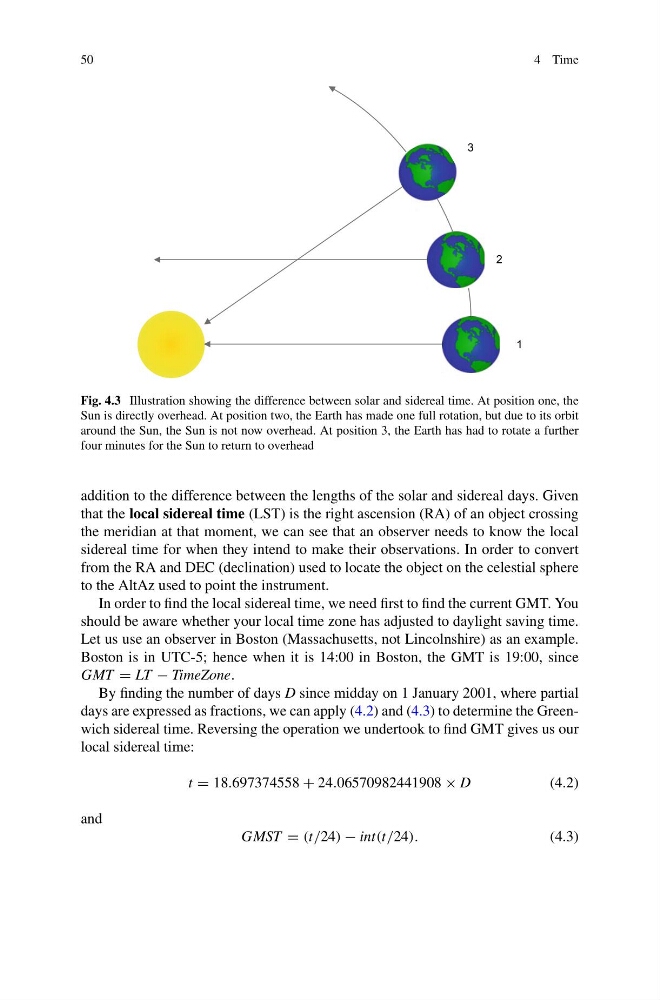
Fig. 4.3 Illustration showing the difference between solar and sidereal time. At position one, the
Sun is directly overhead. At position two, the Earth has made one full rotation, but due to its orbit
around the Sun, the Sun is not now overhead. At position 3, the Earth has had to rotate a further
four minutes for the Sun to return to overhead
addition to the difference between the lengths of the solar and sidereal days. Given
that the local sidereal time (LST) is the right ascension (RA) of an object crossing
the meridian at that moment, we can see that an observer needs to know the local
sidereal time for when they intend to make their observations. In order to convert
from the RA and DEC (declination) used to locate the object on the celestial sphere
to the AltAz used to point the instrument.
In order to find the local sidereal time, we need first to find the current GMT. You
should be aware whether your local time zone has adjusted to daylight saving time.
Let us use an observer in Boston (Massachusetts, not Lincolnshire) as an example.
Boston is in UTC-5; hence when it is 14:00 in Boston, the GMT is 19:00, since
GMT = LT − TimeZone.
By finding the number of days D since midday on 1 January 2001, where partial
days are expressed as fractions, we can apply (4.2) and (4.3) to determine the Greenwich sidereal time. Reversing the operation we undertook to find GMT gives us our
local sidereal time:
t = 18.697374558 + 24.06570982441908 × D
(4.2)
and
GMST = (t/24) − int(t/24).
(4.3)
4 Time
Fig. 4.3 Illustration showing the difference between solar and sidereal time. At position one, the
Sun is directly overhead. At position two, the Earth has made one full rotation, but due to its orbit
around the Sun, the Sun is not now overhead. At position 3, the Earth has had to rotate a further
four minutes for the Sun to return to overhead
addition to the difference between the lengths of the solar and sidereal days. Given
that the local sidereal time (LST) is the right ascension (RA) of an object crossing
the meridian at that moment, we can see that an observer needs to know the local
sidereal time for when they intend to make their observations. In order to convert
from the RA and DEC (declination) used to locate the object on the celestial sphere
to the AltAz used to point the instrument.
In order to find the local sidereal time, we need first to find the current GMT. You
should be aware whether your local time zone has adjusted to daylight saving time.
Let us use an observer in Boston (Massachusetts, not Lincolnshire) as an example.
Boston is in UTC-5; hence when it is 14:00 in Boston, the GMT is 19:00, since
GMT = LT − TimeZone.
By finding the number of days D since midday on 1 January 2001, where partial
days are expressed as fractions, we can apply (4.2) and (4.3) to determine the Greenwich sidereal time. Reversing the operation we undertook to find GMT gives us our
local sidereal time:
t = 18.697374558 + 24.06570982441908 × D
(4.2)
and
GMST = (t/24) − int(t/24).
(4.3)