

48
4 Time
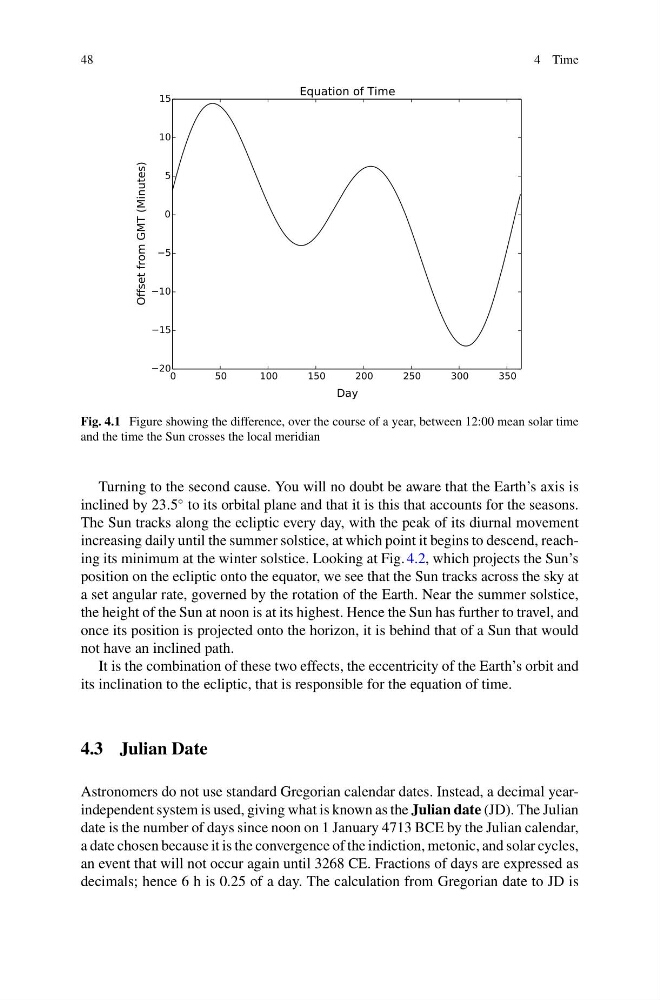
Fig. 4.1 Figure showing the difference, over the course of a year, between 12:00 mean solar time
and the time the Sun crosses the local meridian
Turning to the second cause. You will no doubt be aware that the Earth’s axis is
inclined by 23.5
◦ to its orbital plane and that it is this that accounts for the seasons.
The Sun tracks along the ecliptic every day, with the peak of its diurnal movement
increasing daily until the summer solstice, at which point it begins to descend, reaching its minimum at the winter solstice. Looking at Fig. 4.2, which projects the Sun’s
position on the ecliptic onto the equator, we see that the Sun tracks across the sky at
a set angular rate, governed by the rotation of the Earth. Near the summer solstice,
the height of the Sun at noon is at its highest. Hence the Sun has further to travel, and
once its position is projected onto the horizon, it is behind that of a Sun that would
not have an inclined path.
It is the combination of these two effects, the eccentricity of the Earth’s orbit and
its inclination to the ecliptic, that is responsible for the equation of time.
4.3 Julian Date
Astronomers do not use standard Gregorian calendar dates. Instead, a decimal yearindependent system is used, giving what is known as the Julian date (JD). The Julian
date is the number of days since noon on 1 January 4713 BCE by the Julian calendar,
a date chosen because it is the convergence of the indiction, metonic, and solar cycles,
an event that will not occur again until 3268 CE. Fractions of days are expressed as
decimals; hence 6 h is 0.25 of a day. The calculation from Gregorian date to JD is
4 Time
Fig. 4.1 Figure showing the difference, over the course of a year, between 12:00 mean solar time
and the time the Sun crosses the local meridian
Turning to the second cause. You will no doubt be aware that the Earth’s axis is
inclined by 23.5
◦ to its orbital plane and that it is this that accounts for the seasons.
The Sun tracks along the ecliptic every day, with the peak of its diurnal movement
increasing daily until the summer solstice, at which point it begins to descend, reaching its minimum at the winter solstice. Looking at Fig. 4.2, which projects the Sun’s
position on the ecliptic onto the equator, we see that the Sun tracks across the sky at
a set angular rate, governed by the rotation of the Earth. Near the summer solstice,
the height of the Sun at noon is at its highest. Hence the Sun has further to travel, and
once its position is projected onto the horizon, it is behind that of a Sun that would
not have an inclined path.
It is the combination of these two effects, the eccentricity of the Earth’s orbit and
its inclination to the ecliptic, that is responsible for the equation of time.
4.3 Julian Date
Astronomers do not use standard Gregorian calendar dates. Instead, a decimal yearindependent system is used, giving what is known as the Julian date (JD). The Julian
date is the number of days since noon on 1 January 4713 BCE by the Julian calendar,
a date chosen because it is the convergence of the indiction, metonic, and solar cycles,
an event that will not occur again until 3268 CE. Fractions of days are expressed as
decimals; hence 6 h is 0.25 of a day. The calculation from Gregorian date to JD is