

20
2 The Nature of Light
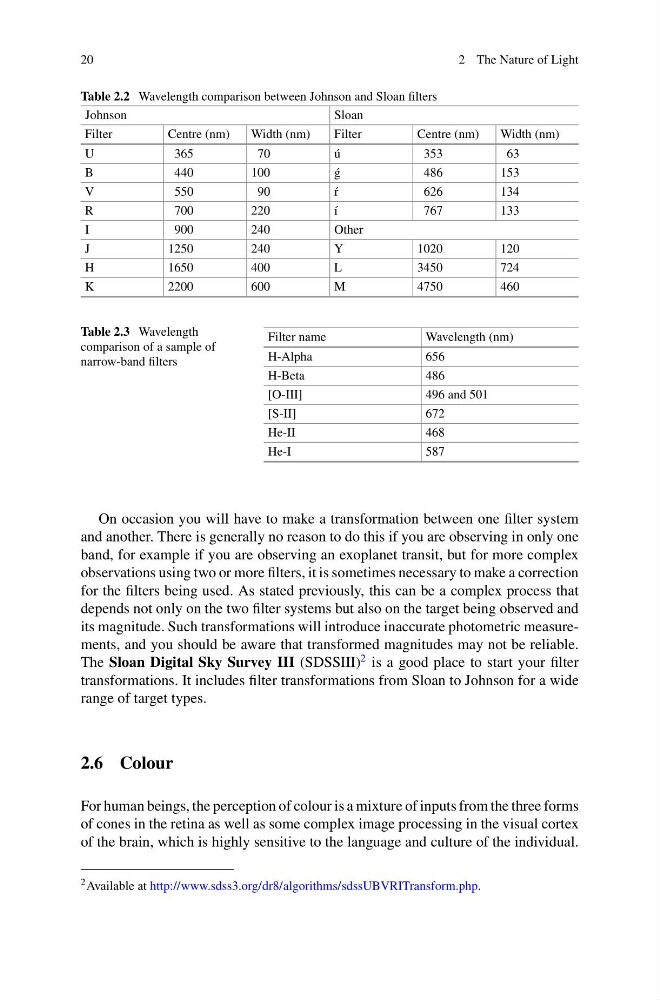
Table 2.2 Wavelength comparison between Johnson and Sloan filters
Johnson
Sloan
Filter
Centre (nm)
Width (nm)
Filter
Centre (nm)
Width (nm)
U
365
70
ú
353
63
B
440
100
´
g
486
153
V
550
90
´ r
626
134
R
700
220
í
767
133
I
900
240
Other
J
1250
240
Y
1020
120
H
1650
400
L
3450
724
K
2200
600
M
4750
460
Table 2.3 Wavelength
comparison of a sample of
narrow-band filters
Filter name
Wavelength (nm)
H-Alpha
656
H-Beta
486
[O-III]
496 and 501
[S-II]
672
He-II
468
He-I
587
On occasion you will have to make a transformation between one filter system
and another. There is generally no reason to do this if you are observing in only one
band, for example if you are observing an exoplanet transit, but for more complex
observations using two or more filters, it is sometimes necessary to make a correction
for the filters being used. As stated previously, this can be a complex process that
depends not only on the two filter systems but also on the target being observed and
its magnitude. Such transformations will introduce inaccurate photometric measurements, and you should be aware that transformed magnitudes may not be reliable.
The Sloan Digital Sky Survey III (SDSSIII)
2 is a good place to start your filter
transformations. It includes filter transformations from Sloan to Johnson for a wide
range of target types.
2.6 Colour
For human beings, the perception of colour is a mixture of inputs from the three forms
of cones in the retina as well as some complex image processing in the visual cortex
of the brain, which is highly sensitive to the language and culture of the individual.
2 Available at http://www.sdss3.org/dr8/algorithms/sdssUBVRITransform.php.
2 The Nature of Light
Table 2.2 Wavelength comparison between Johnson and Sloan filters
Johnson
Sloan
Filter
Centre (nm)
Width (nm)
Filter
Centre (nm)
Width (nm)
U
365
70
ú
353
63
B
440
100
´
g
486
153
V
550
90
´ r
626
134
R
700
220
í
767
133
I
900
240
Other
J
1250
240
Y
1020
120
H
1650
400
L
3450
724
K
2200
600
M
4750
460
Table 2.3 Wavelength
comparison of a sample of
narrow-band filters
Filter name
Wavelength (nm)
H-Alpha
656
H-Beta
486
[O-III]
496 and 501
[S-II]
672
He-II
468
He-I
587
On occasion you will have to make a transformation between one filter system
and another. There is generally no reason to do this if you are observing in only one
band, for example if you are observing an exoplanet transit, but for more complex
observations using two or more filters, it is sometimes necessary to make a correction
for the filters being used. As stated previously, this can be a complex process that
depends not only on the two filter systems but also on the target being observed and
its magnitude. Such transformations will introduce inaccurate photometric measurements, and you should be aware that transformed magnitudes may not be reliable.
The Sloan Digital Sky Survey III (SDSSIII)
2 is a good place to start your filter
transformations. It includes filter transformations from Sloan to Johnson for a wide
range of target types.
2.6 Colour
For human beings, the perception of colour is a mixture of inputs from the three forms
of cones in the retina as well as some complex image processing in the visual cortex
of the brain, which is highly sensitive to the language and culture of the individual.
2 Available at http://www.sdss3.org/dr8/algorithms/sdssUBVRITransform.php.