

2.5 Filters and Filter Transformations
19
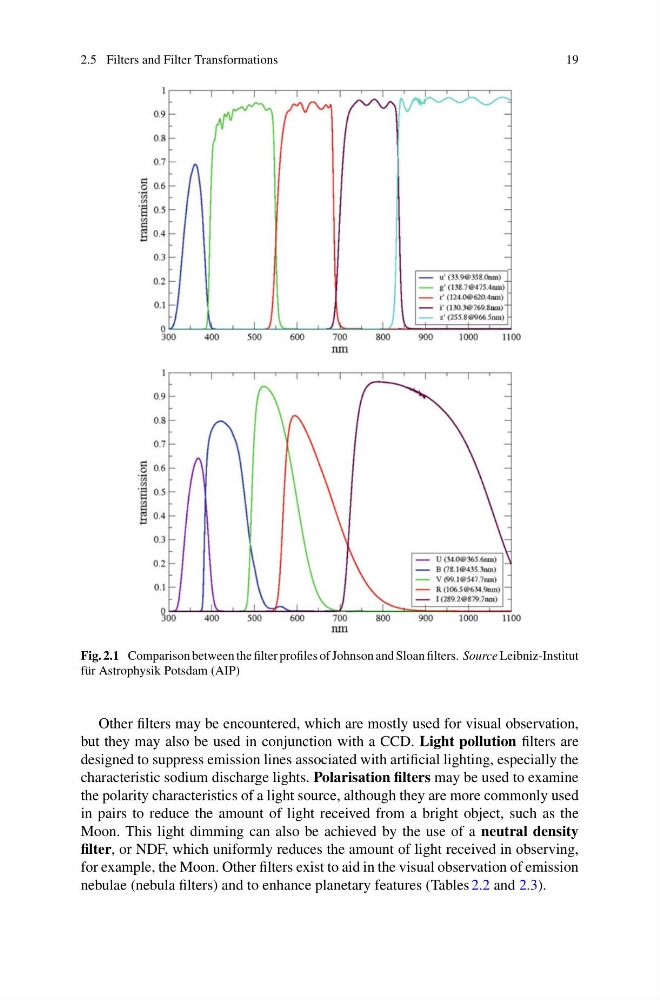
Fig. 2.1 Comparison between the filter profiles of Johnson and Sloan filters. Source Leibniz-Institut
für Astrophysik Potsdam (AIP)
Other filters may be encountered, which are mostly used for visual observation,
but they may also be used in conjunction with a CCD. Light pollution filters are
designed to suppress emission lines associated with artificial lighting, especially the
characteristic sodium discharge lights. Polarisation filters may be used to examine
the polarity characteristics of a light source, although they are more commonly used
in pairs to reduce the amount of light received from a bright object, such as the
Moon. This light dimming can also be achieved by the use of a neutral density
filter, or NDF, which uniformly reduces the amount of light received in observing,
for example, the Moon. Other filters exist to aid in the visual observation of emission
nebulae (nebula filters) and to enhance planetary features (Tables 2.2 and 2.3).
19
Fig. 2.1 Comparison between the filter profiles of Johnson and Sloan filters. Source Leibniz-Institut
für Astrophysik Potsdam (AIP)
Other filters may be encountered, which are mostly used for visual observation,
but they may also be used in conjunction with a CCD. Light pollution filters are
designed to suppress emission lines associated with artificial lighting, especially the
characteristic sodium discharge lights. Polarisation filters may be used to examine
the polarity characteristics of a light source, although they are more commonly used
in pairs to reduce the amount of light received from a bright object, such as the
Moon. This light dimming can also be achieved by the use of a neutral density
filter, or NDF, which uniformly reduces the amount of light received in observing,
for example, the Moon. Other filters exist to aid in the visual observation of emission
nebulae (nebula filters) and to enhance planetary features (Tables 2.2 and 2.3).