

3.16 Measurement of Surface Strains—Strain Rosettes
75
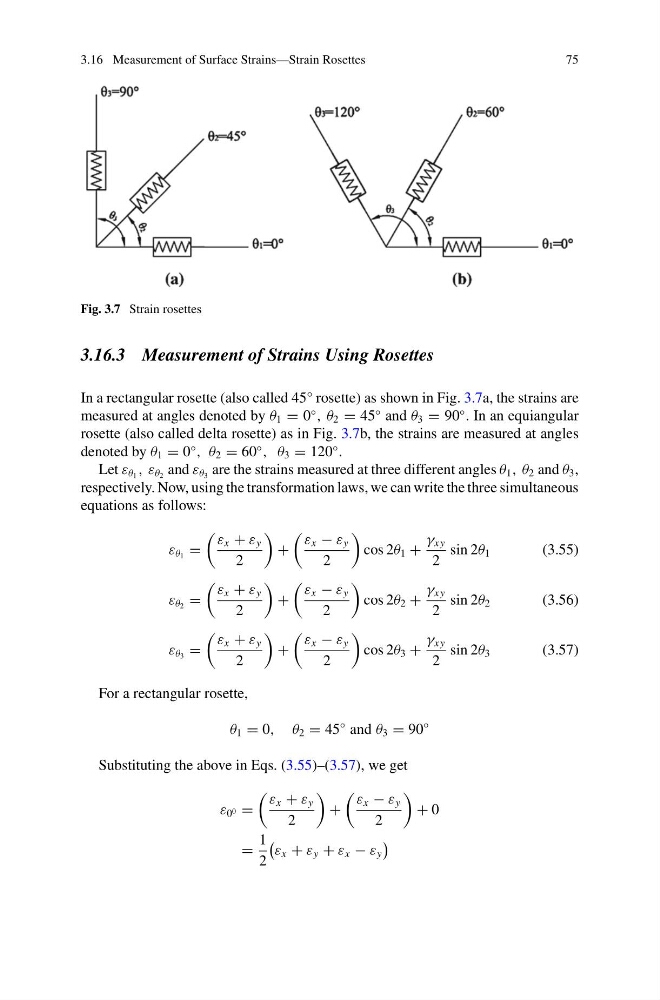
Fig. 3.7 Strain rosettes
3.16.3 Measurement of Strains Using Rosettes
In a rectangular rosette (also called 45° rosette) as shown in Fig. 3.7a, the strains are
measured at angles denoted by θ 1 = 0
◦
, θ 2 = 45
◦ and θ 3 = 90
◦ . In an equiangular
rosette (also called delta rosette) as in Fig. 3.7b, the strains are measured at angles
denoted by θ 1 = 0
◦
, θ 2 = 60
◦
, θ 3 = 120
◦ .
Let ε θ 1 , ε θ 2 and ε θ 3 are the strains measured at three different angles θ 1 , θ 2 and θ 3 ,
respectively. Now, using the transformation laws, we can write the three simultaneous
equations as follows:
ε θ 1 =
ε x + ε y
2
+
ε x − ε y
2
cos 2θ 1 +
γ xy
2
sin 2θ 1
(3.55)
ε θ 2 =
ε x + ε y
2
+
ε x − ε y
2
cos 2θ 2 +
γ xy
2
sin 2θ 2
(3.56)
ε θ 3 =
ε x + ε y
2
+
ε x − ε y
2
cos 2θ 3 +
γ xy
2
sin 2θ 3
(3.57)
For a rectangular rosette,
θ 1 = 0, θ 2 = 45
◦ and θ 3 = 90
◦
Substituting the above in Eqs. (3.55)–(3.57), we get
ε 0 0 =
ε x + ε y
2
+
ε x − ε y
2
+ 0
=
1
2
ε x + ε y + ε x − ε y
75
Fig. 3.7 Strain rosettes
3.16.3 Measurement of Strains Using Rosettes
In a rectangular rosette (also called 45° rosette) as shown in Fig. 3.7a, the strains are
measured at angles denoted by θ 1 = 0
◦
, θ 2 = 45
◦ and θ 3 = 90
◦ . In an equiangular
rosette (also called delta rosette) as in Fig. 3.7b, the strains are measured at angles
denoted by θ 1 = 0
◦
, θ 2 = 60
◦
, θ 3 = 120
◦ .
Let ε θ 1 , ε θ 2 and ε θ 3 are the strains measured at three different angles θ 1 , θ 2 and θ 3 ,
respectively. Now, using the transformation laws, we can write the three simultaneous
equations as follows:
ε θ 1 =
ε x + ε y
2
+
ε x − ε y
2
cos 2θ 1 +
γ xy
2
sin 2θ 1
(3.55)
ε θ 2 =
ε x + ε y
2
+
ε x − ε y
2
cos 2θ 2 +
γ xy
2
sin 2θ 2
(3.56)
ε θ 3 =
ε x + ε y
2
+
ε x − ε y
2
cos 2θ 3 +
γ xy
2
sin 2θ 3
(3.57)
For a rectangular rosette,
θ 1 = 0, θ 2 = 45
◦ and θ 3 = 90
◦
Substituting the above in Eqs. (3.55)–(3.57), we get
ε 0 0 =
ε x + ε y
2
+
ε x − ε y
2
+ 0
=
1
2
ε x + ε y + ε x − ε y