

76
3 Analysis of Strain
∴ ε 0 0 = ε x
ε 45 =
ε x + ε y
2
+
ε x − ε y
2
(0) +
γ xy
2
=
1
2
ε x + ε y + γ xy
or 2ε 45 = ε x + ε y + γ xy
∴ γ xy = 2ε 45 −
ε x + ε y
Also,
ε 90 =
ε x + ε y
2
+
ε x − ε y
2
(cos 180
◦
) +
γ xy
2
(sin 180
◦
)
=
ε x + ε y
2
−
ε x − ε y
2
=
1
2
ε x + ε y − ε x + ε y
∴ ε 90 = ε y
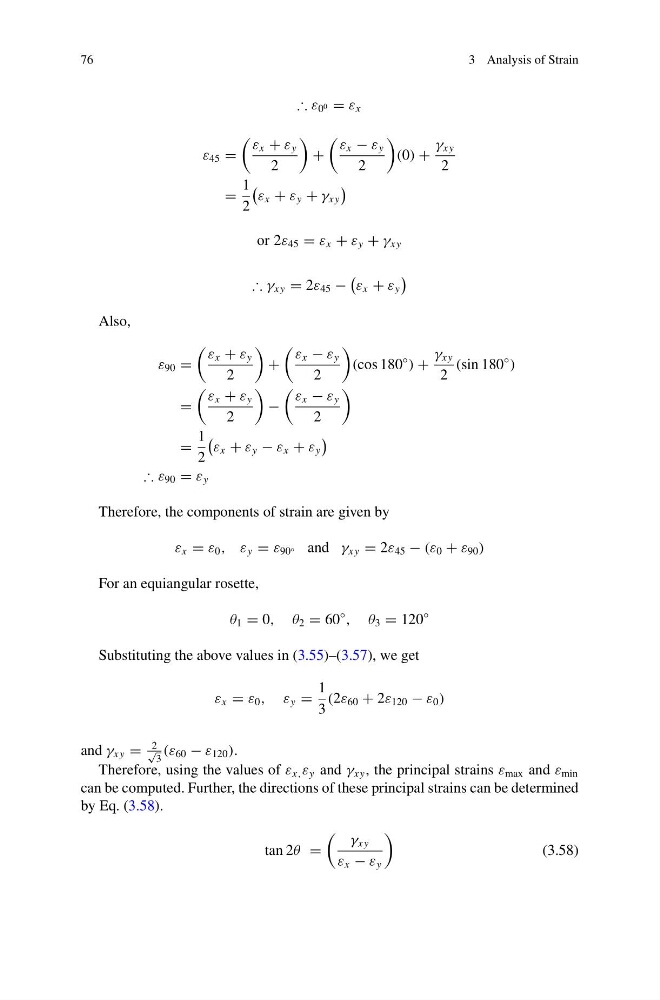
Therefore, the components of strain are given by
ε x = ε 0 , ε y = ε 90 ◦ and γ xy = 2ε 45 − (ε 0 + ε 90 )
For an equiangular rosette,
θ 1 = 0, θ 2 = 60
◦
, θ 3 = 120
◦
Substituting the above values in (3.55)–(3.57), we get
ε x = ε 0 , ε y =
1
3
(2ε 60 + 2ε 120 − ε 0 )
and γ xy =
2
√
3
(ε 60 − ε 120 ).
Therefore, using the values of ε x, ε y and γ xy , the principal strains ε max and ε min
can be computed. Further, the directions of these principal strains can be determined
by Eq. (3.58).
tan 2θ =
γ xy
ε x − ε y
(3.58)
3 Analysis of Strain
∴ ε 0 0 = ε x
ε 45 =
ε x + ε y
2
+
ε x − ε y
2
(0) +
γ xy
2
=
1
2
ε x + ε y + γ xy
or 2ε 45 = ε x + ε y + γ xy
∴ γ xy = 2ε 45 −
ε x + ε y
Also,
ε 90 =
ε x + ε y
2
+
ε x − ε y
2
(cos 180
◦
) +
γ xy
2
(sin 180
◦
)
=
ε x + ε y
2
−
ε x − ε y
2
=
1
2
ε x + ε y − ε x + ε y
∴ ε 90 = ε y
Therefore, the components of strain are given by
ε x = ε 0 , ε y = ε 90 ◦ and γ xy = 2ε 45 − (ε 0 + ε 90 )
For an equiangular rosette,
θ 1 = 0, θ 2 = 60
◦
, θ 3 = 120
◦
Substituting the above values in (3.55)–(3.57), we get
ε x = ε 0 , ε y =
1
3
(2ε 60 + 2ε 120 − ε 0 )
and γ xy =
2
√
3
(ε 60 − ε 120 ).
Therefore, using the values of ε x, ε y and γ xy , the principal strains ε max and ε min
can be computed. Further, the directions of these principal strains can be determined
by Eq. (3.58).
tan 2θ =
γ xy
ε x − ε y
(3.58)