

3.12 Principal Strains and Strain Invariants
67
3.12 Principal Strains and Strain Invariants
During the discussion of the state of stress at a point, it was stated that at any point
in a continuum there exists three mutually orthogonal planes, known as principal
planes, on which there are no shear stresses.
Similar to that, planes exist on which there are no shear strains and only normal
strains occur. These planes are termed as principal planes and the corresponding
strains known as principal strains. The principal strains can be obtained by first
determining the three mutually perpendicular directions along which the normal
strains have stationary values. Hence, for this purpose, the normal strains given by
Eq. (3.22) can be used.
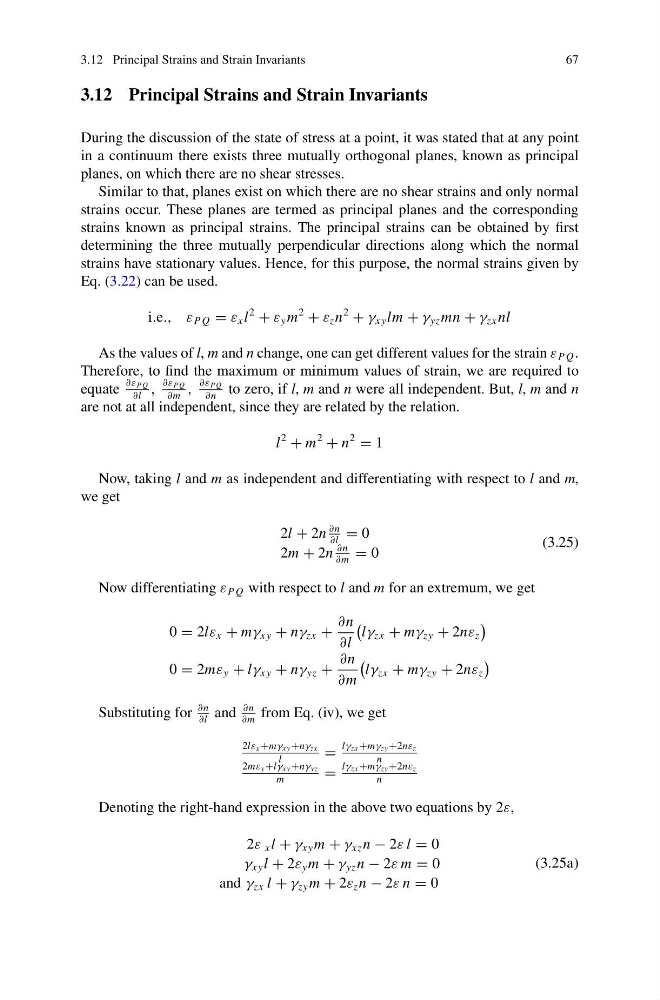
i.e., ε P Q = ε x l
2
+ ε y m
2
+ ε z n
2
+ γ xy lm + γ yz mn + γ zx nl
As the values of l, m and n change, one can get different values for the strain ε P Q .
Therefore, to find the maximum or minimum values of strain, we are required to
equate
∂ε P Q
∂l
,
∂ε P Q
∂m
,
∂ε P Q
∂n
to zero, if l, m and n were all independent. But, l, m and n
are not at all independent, since they are related by the relation.
l
2
+ m
2
+ n
2
= 1
Now, taking l and m as independent and differentiating with respect to l and m,
we get
2l + 2n
∂n
∂l
= 0
2m + 2n
∂n
∂m
= 0
(3.25)
Now differentiating ε P Q with respect to l and m for an extremum, we get
0 = 2lε x + mγ xy + nγ zx +
∂n
∂l
lγ zx + mγ zy + 2nε z
0 = 2mε y + lγ xy + nγ yz +
∂n
∂m
lγ zx + mγ zy + 2nε z
Substituting for
∂n
∂l
and
∂n
∂m
from Eq. (iv), we get
2lε x +mγ xy +nγ zx
l
=
lγ zx +mγ zy +2nε z
n
2mε y +lγ xy +nγ yz
m
=
lγ zx +mγ zy +2nε z
n
Denoting the right-hand expression in the above two equations by 2ε,
2ε x l + γ xy m + γ xz n − 2ε l = 0
γ xy l + 2ε y m + γ yz n − 2ε m = 0
and γ zx l + γ zy m + 2ε z n − 2ε n = 0
(3.25a)
67
3.12 Principal Strains and Strain Invariants
During the discussion of the state of stress at a point, it was stated that at any point
in a continuum there exists three mutually orthogonal planes, known as principal
planes, on which there are no shear stresses.
Similar to that, planes exist on which there are no shear strains and only normal
strains occur. These planes are termed as principal planes and the corresponding
strains known as principal strains. The principal strains can be obtained by first
determining the three mutually perpendicular directions along which the normal
strains have stationary values. Hence, for this purpose, the normal strains given by
Eq. (3.22) can be used.
i.e., ε P Q = ε x l
2
+ ε y m
2
+ ε z n
2
+ γ xy lm + γ yz mn + γ zx nl
As the values of l, m and n change, one can get different values for the strain ε P Q .
Therefore, to find the maximum or minimum values of strain, we are required to
equate
∂ε P Q
∂l
,
∂ε P Q
∂m
,
∂ε P Q
∂n
to zero, if l, m and n were all independent. But, l, m and n
are not at all independent, since they are related by the relation.
l
2
+ m
2
+ n
2
= 1
Now, taking l and m as independent and differentiating with respect to l and m,
we get
2l + 2n
∂n
∂l
= 0
2m + 2n
∂n
∂m
= 0
(3.25)
Now differentiating ε P Q with respect to l and m for an extremum, we get
0 = 2lε x + mγ xy + nγ zx +
∂n
∂l
lγ zx + mγ zy + 2nε z
0 = 2mε y + lγ xy + nγ yz +
∂n
∂m
lγ zx + mγ zy + 2nε z
Substituting for
∂n
∂l
and
∂n
∂m
from Eq. (iv), we get
2lε x +mγ xy +nγ zx
l
=
lγ zx +mγ zy +2nε z
n
2mε y +lγ xy +nγ yz
m
=
lγ zx +mγ zy +2nε z
n
Denoting the right-hand expression in the above two equations by 2ε,
2ε x l + γ xy m + γ xz n − 2ε l = 0
γ xy l + 2ε y m + γ yz n − 2ε m = 0
and γ zx l + γ zy m + 2ε z n − 2ε n = 0
(3.25a)