

66
3 Analysis of Strain
ε x =
∂u
∂ x ,
ε y =
∂v
∂ y ,
ε z =
∂w
∂z
γ x y =
∂u
∂ y +
∂v
∂ x , γ y z =
∂v
∂z +
∂w
∂ y , γ z x =
∂w
∂ x +
∂u
∂z
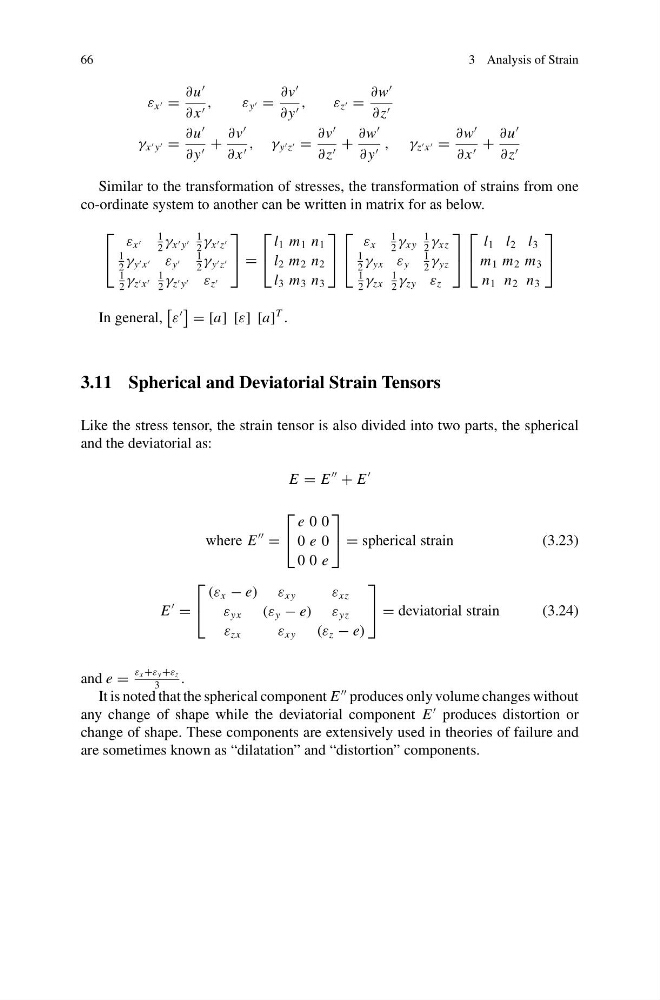
Similar to the transformation of stresses, the transformation of strains from one
co-ordinate system to another can be written in matrix for as below.
⎡
⎣
ε x
1
2
γ x y
1
2
γ x z
1
2
γ y x ε y
1
2
γ y z
1
2
γ z x
1
2
γ z y ε z
⎤
⎦ =
⎡
⎣
l 1 m 1 n 1
l 2 m 2 n 2
l 3 m 3 n 3
⎤
⎦
⎡
⎣
ε x
1
2
γ xy
1
2
γ xz
1
2
γ yx ε y
1
2
γ yz
1
2
γ zx
1
2
γ zy ε z
⎤
⎦
⎡
⎣
l 1 l 2 l 3
m 1 m 2 m 3
n 1 n 2 n 3
⎤
⎦
In general,
ε
= [a] [ε] [a]
T .
3.11 Spherical and Deviatorial Strain Tensors
Like the stress tensor, the strain tensor is also divided into two parts, the spherical
and the deviatorial as:
E = E
+ E
where E
=
⎡
⎣
e 0 0
0 e 0
0 0 e
⎤
⎦ = spherical strain
(3.23)
E
=
⎡
⎣
(ε x − e) ε xy
ε xz
ε yx (ε y − e) ε yz
ε zx
ε xy (ε z − e)
⎤
⎦ = deviatorial strain
(3.24)
and e =
ε x +ε y +ε z
3
.
It is noted that the spherical component E
produces only volume changes without
any change of shape while the deviatorial component E
produces distortion or
change of shape. These components are extensively used in theories of failure and
are sometimes known as “dilatation” and “distortion” components.
3 Analysis of Strain
ε x =
∂u
∂ x ,
ε y =
∂v
∂ y ,
ε z =
∂w
∂z
γ x y =
∂u
∂ y +
∂v
∂ x , γ y z =
∂v
∂z +
∂w
∂ y , γ z x =
∂w
∂ x +
∂u
∂z
Similar to the transformation of stresses, the transformation of strains from one
co-ordinate system to another can be written in matrix for as below.
⎡
⎣
ε x
1
2
γ x y
1
2
γ x z
1
2
γ y x ε y
1
2
γ y z
1
2
γ z x
1
2
γ z y ε z
⎤
⎦ =
⎡
⎣
l 1 m 1 n 1
l 2 m 2 n 2
l 3 m 3 n 3
⎤
⎦
⎡
⎣
ε x
1
2
γ xy
1
2
γ xz
1
2
γ yx ε y
1
2
γ yz
1
2
γ zx
1
2
γ zy ε z
⎤
⎦
⎡
⎣
l 1 l 2 l 3
m 1 m 2 m 3
n 1 n 2 n 3
⎤
⎦
In general,
ε
= [a] [ε] [a]
T .
3.11 Spherical and Deviatorial Strain Tensors
Like the stress tensor, the strain tensor is also divided into two parts, the spherical
and the deviatorial as:
E = E
+ E
where E
=
⎡
⎣
e 0 0
0 e 0
0 0 e
⎤
⎦ = spherical strain
(3.23)
E
=
⎡
⎣
(ε x − e) ε xy
ε xz
ε yx (ε y − e) ε yz
ε zx
ε xy (ε z − e)
⎤
⎦ = deviatorial strain
(3.24)
and e =
ε x +ε y +ε z
3
.
It is noted that the spherical component E
produces only volume changes without
any change of shape while the deviatorial component E
produces distortion or
change of shape. These components are extensively used in theories of failure and
are sometimes known as “dilatation” and “distortion” components.