

68
3 Analysis of Strain
Using Eq. (3.25a), we can obtain the values of l, m and n which determine the
direction along which the relative extension is an extremum. Now, multiplying the
first Equation by l, the second by m and the third by n, and adding them,
We get
2
ε x l
2
+ ε y m
2
+ ε z n
2
+ γ xy lm + γ yz mn + γ zx nl
= 2ε
l
2
+ m
2
+ n
2
(3.25b)
Here, ε P Q = ε x l
2
+ ε y m
2
+ ε z n
2
+ γ xy lm + γ yz mn + γ zx nl
l
2
+ m
2
+ n
2
= 1
Hence, Eq. (3.25b) can be written as
ε P Q = ε
which means that in Eq. (3.25a), the values of l, m and n determine the direction
along which the relative extension is an extremum and also, the value of ε is equal
to this extremum. Hence, Eq. (3.25a) can be written as
(ε x − ε) l +
1
2
γ xy m +
1
2
γ xz n = 0
1
2
γ yx l +
ε y − ε
m +
1
2
γ yz n = 0
1
2
γ zx l +
1
2
γ zy m + (ε z − ε) n = 0
(3.25c)
Denoting
1
2
γ xy = ε xy ,
1
2
γ yz = ε yz ,
1
2
γ zx = ε zx , then
Equation (3.25c) can be written as
(ε x − ε) + ε xy m + ε xz n = 0
ε yx l +
ε y − ε
m + ε yz n = 0
ε zx l + ε zy m + (ε z − ε) n = 0
(3.25d)
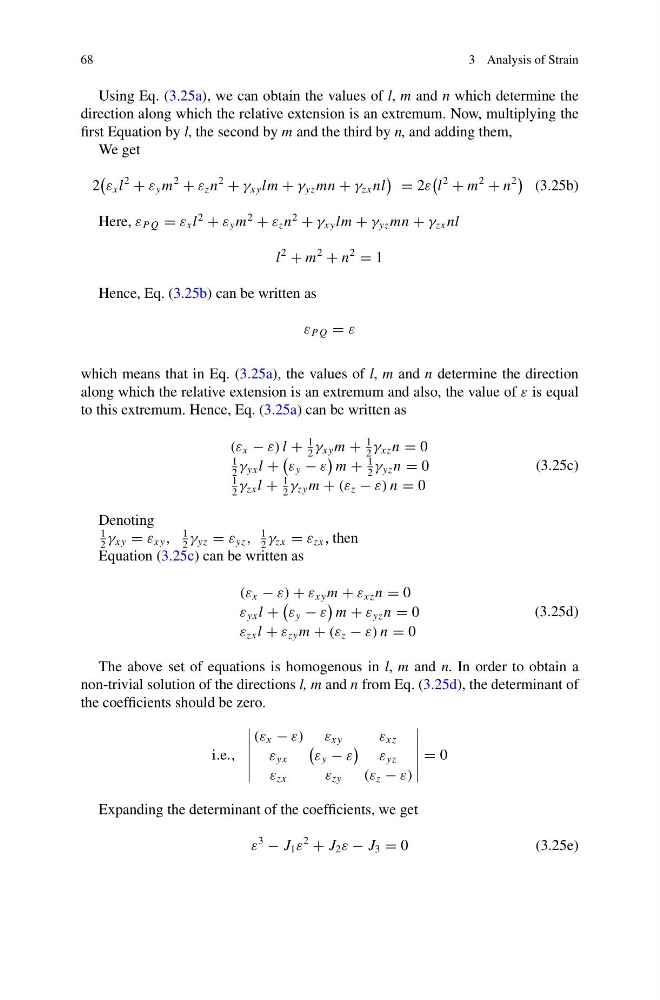
The above set of equations is homogenous in l, m and n. In order to obtain a
non-trivial solution of the directions l, m and n from Eq. (3.25d), the determinant of
the coefficients should be zero.
i.e.,
(ε x − ε) ε xy
ε xz
ε yx
ε y − ε
ε yz
ε zx
ε zy (ε z − ε)
= 0
Expanding the determinant of the coefficients, we get
ε
3
− J 1 ε
2
+ J 2 ε − J 3 = 0
(3.25e)
3 Analysis of Strain
Using Eq. (3.25a), we can obtain the values of l, m and n which determine the
direction along which the relative extension is an extremum. Now, multiplying the
first Equation by l, the second by m and the third by n, and adding them,
We get
2
ε x l
2
+ ε y m
2
+ ε z n
2
+ γ xy lm + γ yz mn + γ zx nl
= 2ε
l
2
+ m
2
+ n
2
(3.25b)
Here, ε P Q = ε x l
2
+ ε y m
2
+ ε z n
2
+ γ xy lm + γ yz mn + γ zx nl
l
2
+ m
2
+ n
2
= 1
Hence, Eq. (3.25b) can be written as
ε P Q = ε
which means that in Eq. (3.25a), the values of l, m and n determine the direction
along which the relative extension is an extremum and also, the value of ε is equal
to this extremum. Hence, Eq. (3.25a) can be written as
(ε x − ε) l +
1
2
γ xy m +
1
2
γ xz n = 0
1
2
γ yx l +
ε y − ε
m +
1
2
γ yz n = 0
1
2
γ zx l +
1
2
γ zy m + (ε z − ε) n = 0
(3.25c)
Denoting
1
2
γ xy = ε xy ,
1
2
γ yz = ε yz ,
1
2
γ zx = ε zx , then
Equation (3.25c) can be written as
(ε x − ε) + ε xy m + ε xz n = 0
ε yx l +
ε y − ε
m + ε yz n = 0
ε zx l + ε zy m + (ε z − ε) n = 0
(3.25d)
The above set of equations is homogenous in l, m and n. In order to obtain a
non-trivial solution of the directions l, m and n from Eq. (3.25d), the determinant of
the coefficients should be zero.
i.e.,
(ε x − ε) ε xy
ε xz
ε yx
ε y − ε
ε yz
ε zx
ε zy (ε z − ε)
= 0
Expanding the determinant of the coefficients, we get
ε
3
− J 1 ε
2
+ J 2 ε − J 3 = 0
(3.25e)