

230
7 Torsion of Prismatic Bars
∂τ xz
∂z
= 0,
∂τ yz
∂z
= 0,
∂τ xz
∂ x
+
∂τ yz
∂ y
= 0.
The first two are already satisfied since τ xz and τ yz , as given by Equations (d) and
(e) are independent of z.
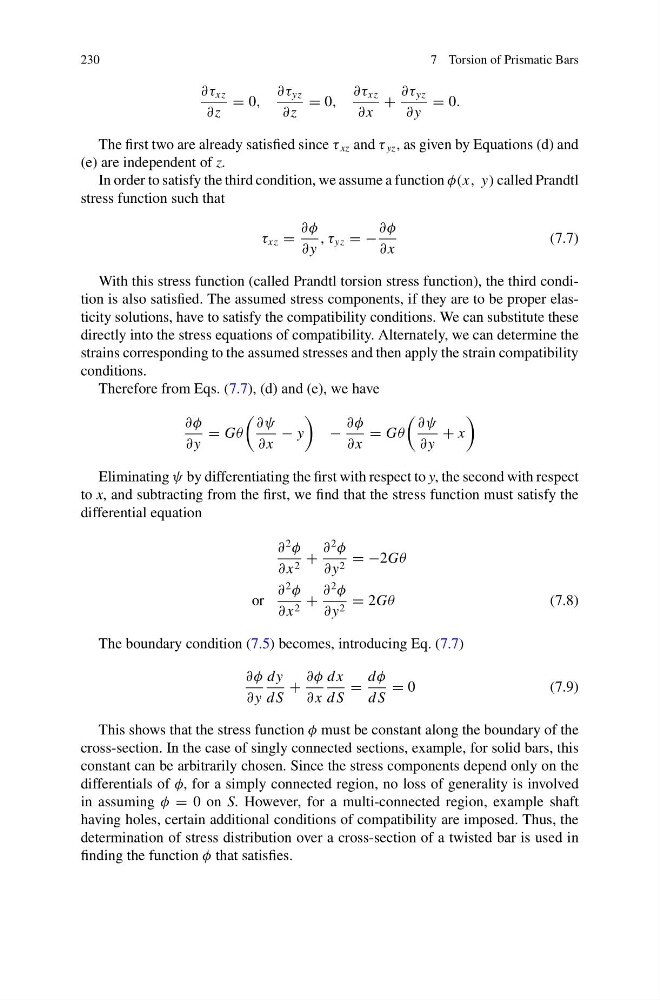
In order to satisfy the third condition, we assume a function φ(x, y) called Prandtl
stress function such that
τ xz =
∂φ
∂ y
, τ yz = −
∂φ
∂ x
(7.7)
With this stress function (called Prandtl torsion stress function), the third condition is also satisfied. The assumed stress components, if they are to be proper elasticity solutions, have to satisfy the compatibility conditions. We can substitute these
directly into the stress equations of compatibility. Alternately, we can determine the
strains corresponding to the assumed stresses and then apply the strain compatibility
conditions.
Therefore from Eqs. (7.7), (d) and (e), we have
∂φ
∂ y
= Gθ
∂ψ
∂ x
− y
−
∂φ
∂ x
= Gθ
∂ψ
∂ y
+ x
Eliminating ψ by differentiating the first with respect to y, the second with respect
to x, and subtracting from the first, we find that the stress function must satisfy the
differential equation
∂
2
φ
∂ x 2 +
∂
2
φ
∂ y 2 = −2Gθ
or
∂
2
φ
∂ x 2 +
∂
2
φ
∂ y 2 = 2Gθ
(7.8)
The boundary condition (7.5) becomes, introducing Eq. (7.7)
∂φ
∂ y
dy
d S
+
∂φ
∂ x
dx
d S
=
dφ
d S
= 0
(7.9)
This shows that the stress function φ must be constant along the boundary of the
cross-section. In the case of singly connected sections, example, for solid bars, this
constant can be arbitrarily chosen. Since the stress components depend only on the
differentials of φ, for a simply connected region, no loss of generality is involved
in assuming φ = 0 on S. However, for a multi-connected region, example shaft
having holes, certain additional conditions of compatibility are imposed. Thus, the
determination of stress distribution over a cross-section of a twisted bar is used in
finding the function φ that satisfies.
7 Torsion of Prismatic Bars
∂τ xz
∂z
= 0,
∂τ yz
∂z
= 0,
∂τ xz
∂ x
+
∂τ yz
∂ y
= 0.
The first two are already satisfied since τ xz and τ yz , as given by Equations (d) and
(e) are independent of z.
In order to satisfy the third condition, we assume a function φ(x, y) called Prandtl
stress function such that
τ xz =
∂φ
∂ y
, τ yz = −
∂φ
∂ x
(7.7)
With this stress function (called Prandtl torsion stress function), the third condition is also satisfied. The assumed stress components, if they are to be proper elasticity solutions, have to satisfy the compatibility conditions. We can substitute these
directly into the stress equations of compatibility. Alternately, we can determine the
strains corresponding to the assumed stresses and then apply the strain compatibility
conditions.
Therefore from Eqs. (7.7), (d) and (e), we have
∂φ
∂ y
= Gθ
∂ψ
∂ x
− y
−
∂φ
∂ x
= Gθ
∂ψ
∂ y
+ x
Eliminating ψ by differentiating the first with respect to y, the second with respect
to x, and subtracting from the first, we find that the stress function must satisfy the
differential equation
∂
2
φ
∂ x 2 +
∂
2
φ
∂ y 2 = −2Gθ
or
∂
2
φ
∂ x 2 +
∂
2
φ
∂ y 2 = 2Gθ
(7.8)
The boundary condition (7.5) becomes, introducing Eq. (7.7)
∂φ
∂ y
dy
d S
+
∂φ
∂ x
dx
d S
=
dφ
d S
= 0
(7.9)
This shows that the stress function φ must be constant along the boundary of the
cross-section. In the case of singly connected sections, example, for solid bars, this
constant can be arbitrarily chosen. Since the stress components depend only on the
differentials of φ, for a simply connected region, no loss of generality is involved
in assuming φ = 0 on S. However, for a multi-connected region, example shaft
having holes, certain additional conditions of compatibility are imposed. Thus, the
determination of stress distribution over a cross-section of a twisted bar is used in
finding the function φ that satisfies.