

7.3 Boundary Conditions
229
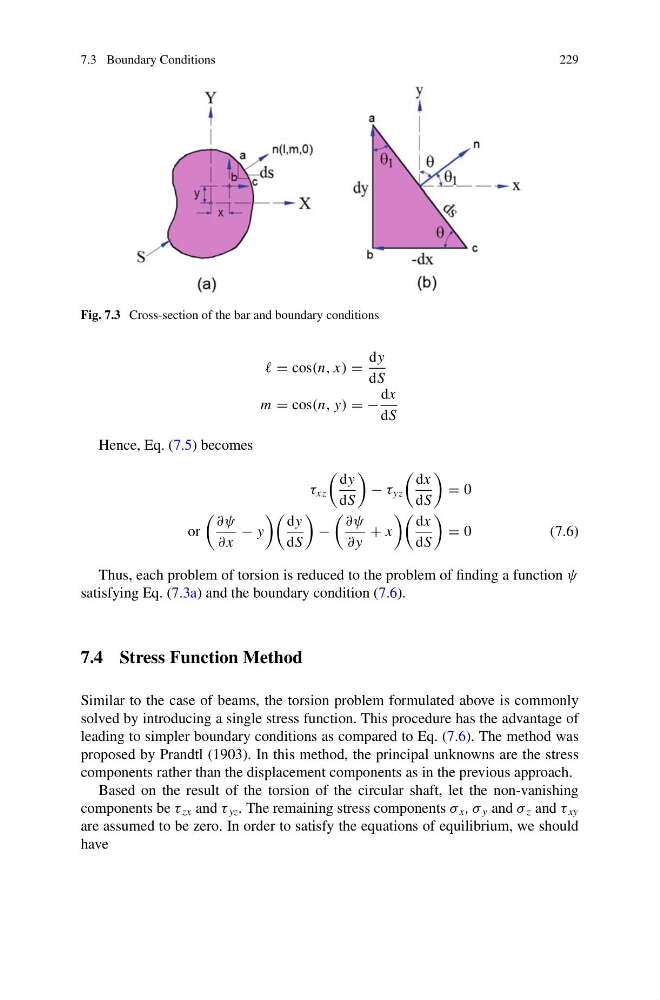
Fig. 7.3 Cross-section of the bar and boundary conditions
= cos(n, x) =
dy
dS
m = cos(n, y) = −
dx
dS
Hence, Eq. (7.5) becomes
τ xz
dy
dS
− τ yz
dx
dS
= 0
or
∂ψ
∂ x
− y
dy
dS
−
∂ψ
∂ y
+ x
dx
dS
= 0
(7.6)
Thus, each problem of torsion is reduced to the problem of finding a function ψ
satisfying Eq. (7.3a) and the boundary condition (7.6).
7.4 Stress Function Method
Similar to the case of beams, the torsion problem formulated above is commonly
solved by introducing a single stress function. This procedure has the advantage of
leading to simpler boundary conditions as compared to Eq. (7.6). The method was
proposed by Prandtl (1903). In this method, the principal unknowns are the stress
components rather than the displacement components as in the previous approach.
Based on the result of the torsion of the circular shaft, let the non-vanishing
components be τ zx and τ yz . The remaining stress components σ x , σ y and σ z and τ xy
are assumed to be zero. In order to satisfy the equations of equilibrium, we should
have
229
Fig. 7.3 Cross-section of the bar and boundary conditions
= cos(n, x) =
dy
dS
m = cos(n, y) = −
dx
dS
Hence, Eq. (7.5) becomes
τ xz
dy
dS
− τ yz
dx
dS
= 0
or
∂ψ
∂ x
− y
dy
dS
−
∂ψ
∂ y
+ x
dx
dS
= 0
(7.6)
Thus, each problem of torsion is reduced to the problem of finding a function ψ
satisfying Eq. (7.3a) and the boundary condition (7.6).
7.4 Stress Function Method
Similar to the case of beams, the torsion problem formulated above is commonly
solved by introducing a single stress function. This procedure has the advantage of
leading to simpler boundary conditions as compared to Eq. (7.6). The method was
proposed by Prandtl (1903). In this method, the principal unknowns are the stress
components rather than the displacement components as in the previous approach.
Based on the result of the torsion of the circular shaft, let the non-vanishing
components be τ zx and τ yz . The remaining stress components σ x , σ y and σ z and τ xy
are assumed to be zero. In order to satisfy the equations of equilibrium, we should
have