

7.4 Stress Function Method
231
Equation (7.8) and is zero at the boundary.
Conditions at the Ends of the Twisted Bar
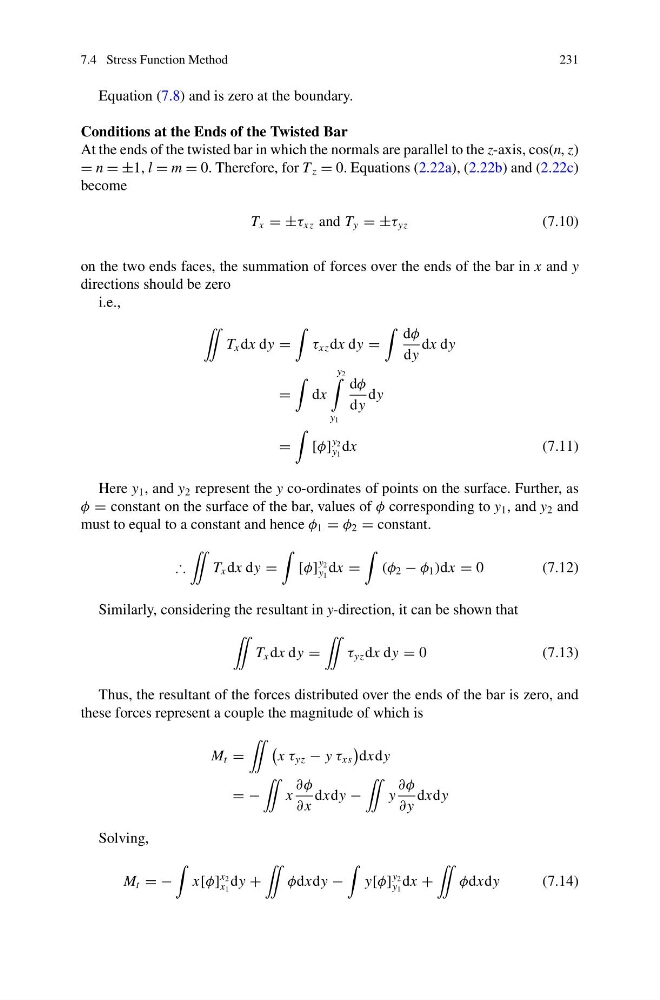
At the ends of the twisted bar in which the normals are parallel to the z-axis, cos(n, z)
= n = ±1, l = m = 0. Therefore, for T z = 0. Equations (2.22a), (2.22b) and (2.22c)
become
T x = ±τ xz and T y = ±τ yz
(7.10)
on the two ends faces, the summation of forces over the ends of the bar in x and y
directions should be zero
i.e.,
¨
T x dx dy =
τ xz dx dy =
dφ
dy
dx dy
=
dx
y 2
y 1
dφ
dy
dy
=
[φ]
y 2
y 1
dx
(7.11)
Here y 1 , and y 2 represent the y co-ordinates of points on the surface. Further, as
φ = constant on the surface of the bar, values of φ corresponding to y 1 , and y 2 and
must to equal to a constant and hence φ 1 = φ 2 = constant.
∴
¨
T x dx dy =
[φ]
y 2
y 1
dx =
(φ 2 − φ 1 )dx = 0
(7.12)
Similarly, considering the resultant in y-direction, it can be shown that
¨
T x dx dy =
¨
τ yz dx dy = 0
(7.13)
Thus, the resultant of the forces distributed over the ends of the bar is zero, and
these forces represent a couple the magnitude of which is
M t =
¨
x τ yz − y τ xs
dxdy
= −
¨
x
∂φ
∂ x
dxdy −
¨
y
∂φ
∂ y
dxdy
Solving,
M t = −
x[φ]
x 2
x 1
dy +
¨
φdxdy −
y[φ]
y 2
y 1
dx +
¨
φdxdy
(7.14)
231
Equation (7.8) and is zero at the boundary.
Conditions at the Ends of the Twisted Bar
At the ends of the twisted bar in which the normals are parallel to the z-axis, cos(n, z)
= n = ±1, l = m = 0. Therefore, for T z = 0. Equations (2.22a), (2.22b) and (2.22c)
become
T x = ±τ xz and T y = ±τ yz
(7.10)
on the two ends faces, the summation of forces over the ends of the bar in x and y
directions should be zero
i.e.,
¨
T x dx dy =
τ xz dx dy =
dφ
dy
dx dy
=
dx
y 2
y 1
dφ
dy
dy
=
[φ]
y 2
y 1
dx
(7.11)
Here y 1 , and y 2 represent the y co-ordinates of points on the surface. Further, as
φ = constant on the surface of the bar, values of φ corresponding to y 1 , and y 2 and
must to equal to a constant and hence φ 1 = φ 2 = constant.
∴
¨
T x dx dy =
[φ]
y 2
y 1
dx =
(φ 2 − φ 1 )dx = 0
(7.12)
Similarly, considering the resultant in y-direction, it can be shown that
¨
T x dx dy =
¨
τ yz dx dy = 0
(7.13)
Thus, the resultant of the forces distributed over the ends of the bar is zero, and
these forces represent a couple the magnitude of which is
M t =
¨
x τ yz − y τ xs
dxdy
= −
¨
x
∂φ
∂ x
dxdy −
¨
y
∂φ
∂ y
dxdy
Solving,
M t = −
x[φ]
x 2
x 1
dy +
¨
φdxdy −
y[φ]
y 2
y 1
dx +
¨
φdxdy
(7.14)