

6.8 Thick-Walled Cylinder Subjected to Internal and External Pressures
175
Substituting these in Eqs. (6.22) and (6.23), we get
σ r =
a
2 p i − b
2 p 0
b 2 − a 2
−
( p i − p 0 )a
2 b
2
(b 2 − a 2 )r 2
(6.24)
σ θ =
a
2 p i − b
2 p 0
b 2 − a 2
+
( p i − p 0 )a
2 b
2
(b 2 − a 2 )r 2
(6.25)
u =
1 − ν
E
(a
2 p i − b
2 p 0 )r
(b 2 − a 2 )
+
1 + ν
E
( p i − p 0 )a
2 b
2
(b 2 − a 2 )r
(6.26)
These expressions were first derived by G. Lambe.
It is interesting to observe that the sum (σ r + σ θ ) is constant through the thickness of the wall of the cylinder, regardless of radial position. Hence according to
Hooke’s law, the stresses σ r and σ θ produce a uniform extension or contraction in
z-direction. The cross-sections perpendicular to the axis of the cylinder remain plane.
If two adjacent cross-sections are considered, then the deformation undergone by the
element does not interfere with the deformation of the neighbouring element. Hence,
the elements are considered to be in the plane stress state.
Special Cases.
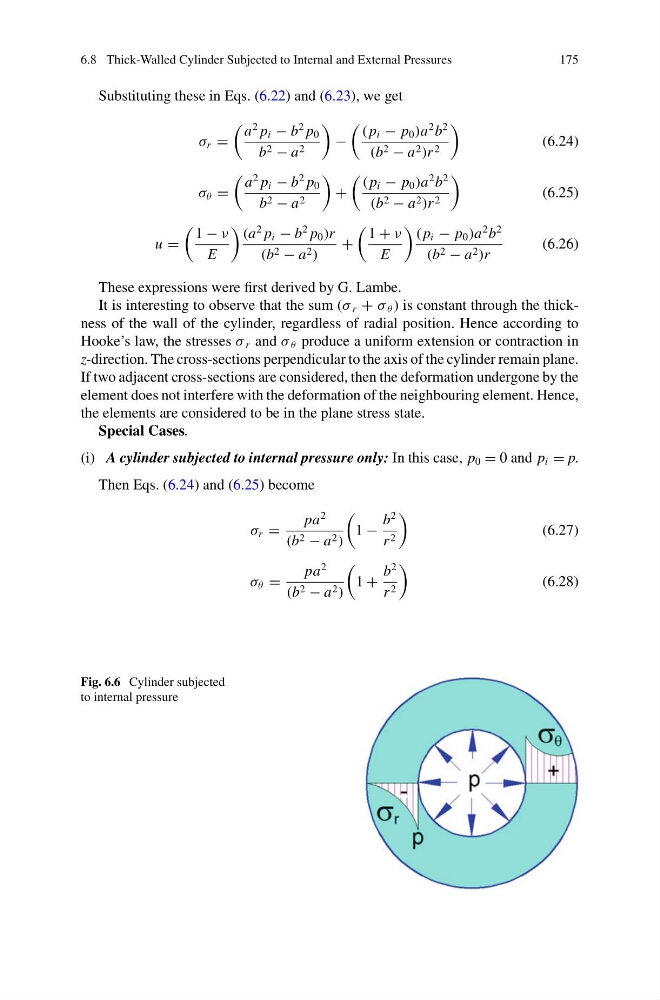
(i) A cylinder subjected to internal pressure only: In this case, p 0 = 0 and p i = p.
Then Eqs. (6.24) and (6.25) become
σ r =
pa
2
(b 2 − a 2 )
1 −
b
2
r 2
(6.27)
σ θ =
pa
2
(b 2 − a 2 )
1 +
b
2
r 2
(6.28)
Fig. 6.6 Cylinder subjected
to internal pressure
175
Substituting these in Eqs. (6.22) and (6.23), we get
σ r =
a
2 p i − b
2 p 0
b 2 − a 2
−
( p i − p 0 )a
2 b
2
(b 2 − a 2 )r 2
(6.24)
σ θ =
a
2 p i − b
2 p 0
b 2 − a 2
+
( p i − p 0 )a
2 b
2
(b 2 − a 2 )r 2
(6.25)
u =
1 − ν
E
(a
2 p i − b
2 p 0 )r
(b 2 − a 2 )
+
1 + ν
E
( p i − p 0 )a
2 b
2
(b 2 − a 2 )r
(6.26)
These expressions were first derived by G. Lambe.
It is interesting to observe that the sum (σ r + σ θ ) is constant through the thickness of the wall of the cylinder, regardless of radial position. Hence according to
Hooke’s law, the stresses σ r and σ θ produce a uniform extension or contraction in
z-direction. The cross-sections perpendicular to the axis of the cylinder remain plane.
If two adjacent cross-sections are considered, then the deformation undergone by the
element does not interfere with the deformation of the neighbouring element. Hence,
the elements are considered to be in the plane stress state.
Special Cases.
(i) A cylinder subjected to internal pressure only: In this case, p 0 = 0 and p i = p.
Then Eqs. (6.24) and (6.25) become
σ r =
pa
2
(b 2 − a 2 )
1 −
b
2
r 2
(6.27)
σ θ =
pa
2
(b 2 − a 2 )
1 +
b
2
r 2
(6.28)
Fig. 6.6 Cylinder subjected
to internal pressure