

176
6 Two-Dimensional Problems in Elasticity …
Figure 6.6 shows the variation of radial and circumferential stresses across the
thickness of the cylinder under internal pressure.
The circumferential stress is greatest at the inner surface of the cylinder and is
given by
(σ θ ) max =
p(a
2
+ b
2
)
b 2 − a 2
(6.29)
(ii) A cylinder subjected to external pressure only: In this case, p i = 0 and p 0 =
p.
Equation (6.25) becomes
σ r = −
pb
2
b 2 − a 2
1 −
a
2
r 2
(6.30)
σ θ = −
pb
2
b 2 − a 2
1 +
a
2
r 2
(6.31)
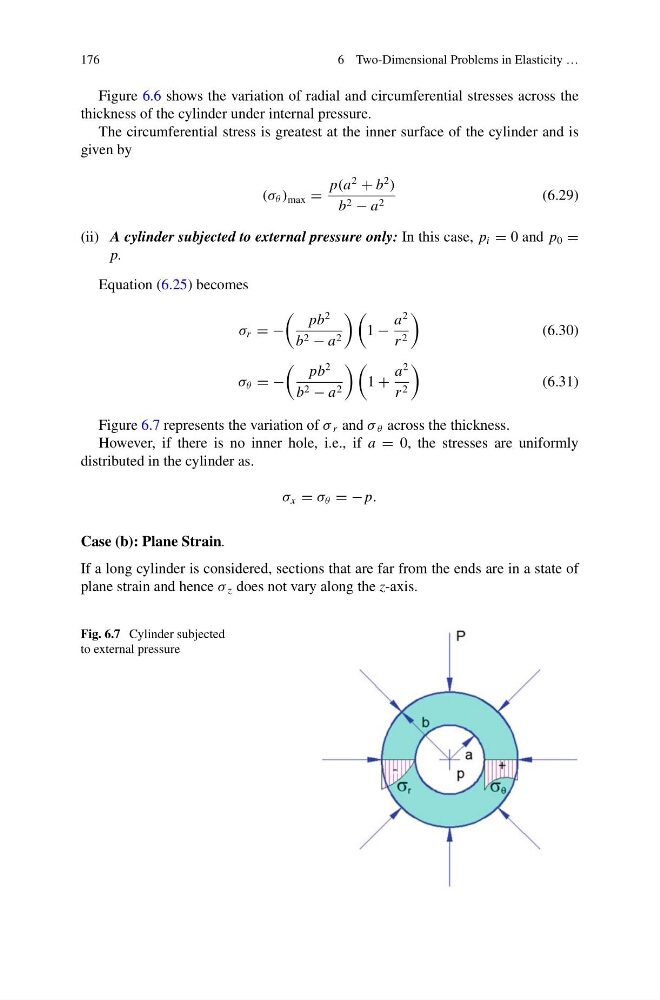
Figure 6.7 represents the variation of σ r and σ θ across the thickness.
However, if there is no inner hole, i.e., if a = 0, the stresses are uniformly
distributed in the cylinder as.
σ x = σ θ = −p.
Case (b): Plane Strain.
If a long cylinder is considered, sections that are far from the ends are in a state of
plane strain and hence σ z does not vary along the z-axis.
Fig. 6.7 Cylinder subjected
to external pressure
6 Two-Dimensional Problems in Elasticity …
Figure 6.6 shows the variation of radial and circumferential stresses across the
thickness of the cylinder under internal pressure.
The circumferential stress is greatest at the inner surface of the cylinder and is
given by
(σ θ ) max =
p(a
2
+ b
2
)
b 2 − a 2
(6.29)
(ii) A cylinder subjected to external pressure only: In this case, p i = 0 and p 0 =
p.
Equation (6.25) becomes
σ r = −
pb
2
b 2 − a 2
1 −
a
2
r 2
(6.30)
σ θ = −
pb
2
b 2 − a 2
1 +
a
2
r 2
(6.31)
Figure 6.7 represents the variation of σ r and σ θ across the thickness.
However, if there is no inner hole, i.e., if a = 0, the stresses are uniformly
distributed in the cylinder as.
σ x = σ θ = −p.
Case (b): Plane Strain.
If a long cylinder is considered, sections that are far from the ends are in a state of
plane strain and hence σ z does not vary along the z-axis.
Fig. 6.7 Cylinder subjected
to external pressure